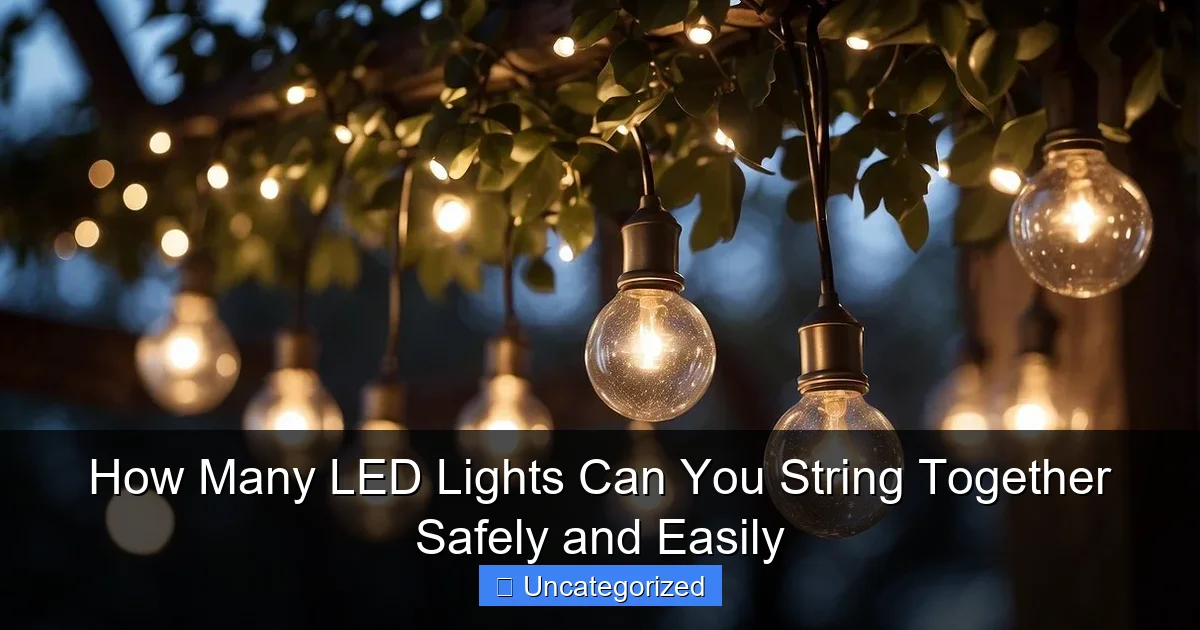
Featured image for how many led lights can you string together
Image source: sleekspacedesigns.com
You can typically string up to 20–30 LED light sets together safely, depending on wattage, manufacturer guidelines, and circuit capacity. Always check the product’s UL rating and power specifications to avoid overloading circuits and ensure a safe, dazzling display. Exceeding limits risks overheating, fire hazards, or tripped breakers—safety first!
Key Takeaways
- Check wattage limits: Always verify the manufacturer’s maximum wattage before connecting LED strings.
- Use parallel connections: Reduce overload risk by connecting strands in parallel, not series.
- Stay under 80% capacity: Never exceed 80% of the circuit’s rated load for safety.
- Prioritize LED efficiency: LEDs draw less power, allowing more strands than incandescent lights.
- Test before installing: Power test connections to ensure stability and avoid mid-install failures.
- Label each strand: Tag lights with wattage to simplify future expansions or adjustments.
📑 Table of Contents
- How Many LED Lights Can You String Together Safely and Easily
- Understanding LED Power Consumption and Voltage
- Key Factors That Limit String Length
- Calculating Safe Limits for Your Setup
- Special Considerations for Different LED Types
- Data Table: Safe LED Stringing Limits by Type
- Best Practices for Safe and Easy LED Stringing
How Many LED Lights Can You String Together Safely and Easily
Stringing LED lights together can transform your home, patio, or holiday decor into a dazzling display. Whether you’re wrapping trees for Christmas, outlining your roofline for a festive touch, or creating an ambient glow in your backyard, LED lights are a versatile, energy-efficient choice. But as you plan your lighting setup, a critical question arises: How many LED lights can you safely string together without overloading circuits or risking damage? While the answer isn’t one-size-fits-all, understanding the technical limits, safety guidelines, and best practices can help you create a stunning display without the risk of tripped breakers or fire hazards.
LED lights have revolutionized home lighting due to their low power consumption, longevity, and vibrant colors. Unlike traditional incandescent bulbs, which can only be strung in limited numbers before overheating or blowing a fuse, LEDs offer greater flexibility. However, even the most advanced LED technology has its limits. This guide will walk you through the key factors that determine how many LED lights you can safely connect, including power draw, wire gauge, voltage drop, and safety standards. We’ll also provide practical examples, pro tips, and a data table to simplify your planning process. Whether you’re a DIY enthusiast or a professional installer, this article will equip you with the knowledge to string LED lights safely and efficiently.
Understanding LED Power Consumption and Voltage
The foundation of safely stringing LED lights lies in understanding their power consumption and voltage requirements. Unlike older lighting technologies, LEDs are designed to operate at lower voltages and use significantly less energy, making them ideal for extended runs. However, even low-wattage lights can add up when connected in large numbers, so it’s essential to calculate your total load accurately.
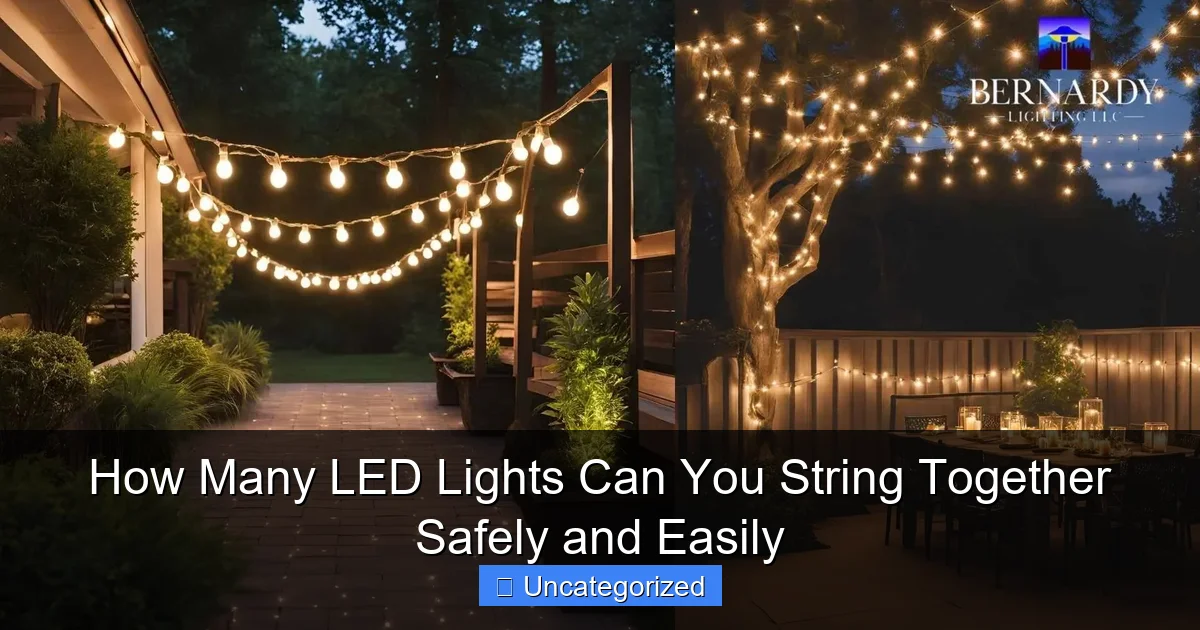
Visual guide about how many led lights can you string together
Image source: lirp.cdn-website.com
LED Wattage and Amperage Basics
Most LED light strings consume between 2 to 10 watts per 100 bulbs, depending on the type, color, and brightness. For example:
- Mini LED string lights (50 bulbs): ~2.4 watts
- LED icicle lights (70 bulbs): ~4.2 watts
- LED rope lights (per 16 feet): ~12 watts
- RGB color-changing LEDs: ~5–8 watts per strand
To find the total power draw (wattage), multiply the wattage per strand by the number of strands you plan to connect. Then, convert wattage to amperage using the formula: Amps = Watts ÷ Volts. For standard U.S. outlets (120V), a 60-watt LED setup draws 0.5 amps. Most household circuits are rated for 15 or 20 amps, meaning you can theoretically run up to 1,800 watts (15A × 120V) or 2,400 watts (20A × 120V) on a single circuit. However, safety guidelines recommend using only 80% of the circuit’s capacity—1,440 watts for a 15A circuit and 1,920 watts for a 20A circuit.
Voltage Considerations: 120V vs. Low-Voltage Systems
Most plug-in LED lights operate on 120V AC (standard household voltage), but some specialty systems use 12V or 24V DC with a transformer. Low-voltage LED systems (e.g., landscape or strip lights) have different rules:
- 120V systems: Higher current draw over long runs, but easier to plug into standard outlets.
- 12V/24V systems: Lower current, less risk of voltage drop, but require a compatible transformer and may need thicker wires for long distances.
Pro Tip: Always check the manufacturer’s specifications for voltage and wattage. For example, a 100-bulb LED string might be labeled “2.4W at 120V,” meaning it draws 0.02 amps per strand. If you connect 20 such strands (48 watts total), you’re using only 0.4 amps—well within safe limits.
Key Factors That Limit String Length
While wattage and voltage are critical, other factors can restrict how many LED lights you can string together. Ignoring these can lead to dimming, flickering, or even fire hazards.
Visual guide about how many led lights can you string together
Image source: multimeterworld.com
1. Wire Gauge and Resistance
The thickness (gauge) of the wire in your light strings affects how much current it can carry without overheating. Thinner wires (higher gauge numbers) have higher resistance, which can cause voltage drop—a phenomenon where the lights at the end of the string appear dimmer than those at the beginning.
- 20 AWG: Common for mini LED strings; safe for up to 500 watts (e.g., 10–20 strands).
- 18 AWG: Used in heavier-duty lights; can handle up to 750 watts.
- 16 AWG or thicker: Ideal for long runs or high-wattage setups (e.g., commercial displays).
Example: If you connect 50 mini LED strings (each 2.4W) to a 20 AWG cord, you’re drawing 120 watts. This is safe, but if you extend the run to 100 strands (240W), the voltage drop may cause the last 20 strands to flicker. Upgrade to 18 AWG or split the load across multiple circuits.
2. Voltage Drop Over Distance
Voltage drop occurs when electricity loses energy as it travels through the wire. For LED lights, a drop of more than 10% (12V on a 120V system) can cause noticeable dimming. The formula to calculate voltage drop is:
VD = (2 × L × R × I) ÷ 1000
Where:
– VD = Voltage drop
– L = Length of wire (feet)
– R = Resistance (ohms per 1,000 feet; e.g., 20 AWG = 10.4 ohms)
– I = Current (amps)
Pro Tip: For long runs (over 100 feet), use thicker wires or divide the load into shorter segments connected via extension cords with inline fuses.
3. Manufacturer’s “Max Connectable” Rating
Reputable LED brands specify the maximum number of strands that can be safely connected end-to-end. For example:
- GE Energy Smart LED: Up to 25 strands (100 bulbs each)
- Philips LED: Up to 50 strands (50 bulbs each)
- Christmas Light Source LED: Up to 100 strands (35 bulbs each)
Warning: Exceeding the manufacturer’s limit can void warranties and create fire risks. If no rating is listed, assume a conservative limit of 5–10 strands for mini lights.
Calculating Safe Limits for Your Setup
To determine how many LED lights you can safely string, follow this step-by-step process. We’ll use a real-world example to illustrate.
Step 1: Determine Total Wattage
Suppose you have 20 LED icicle light strands (70 bulbs each, 4.2W per strand). Total wattage = 20 × 4.2W = 84 watts.
Step 2: Check Circuit Capacity
Your home has a 15A circuit (1,800W max). The 80% rule limits you to 1,440W. Since 84W is well below this, you’re safe—but you must account for other devices on the same circuit (e.g., a TV, space heater). If the circuit already has 1,200W of load, adding 84W would exceed the 80% limit.
Step 3: Factor in Wire Gauge and Voltage Drop
Your 20 strands are connected via a 50-foot 20 AWG extension cord. Using the voltage drop formula:
- L = 50 feet
- R = 10.4 ohms (20 AWG)
- I = 84W ÷ 120V = 0.7A
- VD = (2 × 50 × 10.4 × 0.7) ÷ 1000 = 0.73V (0.6% drop)
A 0.6% drop is negligible. You could safely add 10 more strands (total 30) before reaching a 1% drop—still safe for LEDs.
Step 4: Verify Manufacturer Limits
Check the packaging: If the manufacturer allows up to 30 icicle strands, you’re within the safe range. If not, split the load into two groups (e.g., 15 strands per outlet).
Advanced Tip: Use a Power Strip with Surge Protection
Instead of daisy-chaining strands, plug multiple light strings into a UL-listed power strip with surge protection. This reduces strain on the first strand’s plug and minimizes fire risk. Ensure the strip is rated for the total wattage (e.g., 1,500W).
Special Considerations for Different LED Types
Not all LED lights are created equal. The type of LED you’re using—mini lights, rope lights, strip lights, or commercial-grade—will affect how many you can safely connect.
1. Mini LED String Lights
These are the most common for holiday decor. Most mini LED strings use 20 AWG wire and are rated for 5–25 strands. For example:
- 50-bulb mini lights: Up to 25 strands (1,250 bulbs)
- 100-bulb mini lights: Up to 10 strands (1,000 bulbs)
Pro Tip: For large trees or rooflines, use “stackable” plugs (where the end of one strand connects directly to the next) to minimize extension cords.
2. LED Rope Lights
Rope lights are flexible tubes with embedded LEDs, often used for outlining windows or railings. They draw more power per foot (e.g., 1.5W/ft) but are designed for longer runs. A 16-foot rope light (~24W) can typically be connected to 5–10 additional segments, depending on the brand.
Example: A 100-foot rope light setup (6.25 segments) drawing ~150W is safe on a 15A circuit. However, if each segment uses 20 AWG wire, voltage drop may be an issue after 60 feet. Use a thicker gauge or split into two circuits.
3. LED Strip Lights
These are popular for under-cabinet lighting or accent decor. Low-voltage (12V/24V) strips require a transformer. The max run length depends on the strip’s current draw and wire thickness:
- 60 LEDs/meter (12V): Max 5 meters (16.4 feet) before voltage drop
- 144 LEDs/meter (24V): Max 2–3 meters (6.5–10 feet)
Pro Tip: For longer runs, use a “power injection” method—connecting the transformer to both ends of the strip to balance voltage.
4. Commercial-Grade and Smart LEDs
High-end LED systems (e.g., for stage lighting or architectural features) often use DMX or Wi-Fi controls. These are designed for large-scale installations and may support hundreds of feet or thousands of bulbs. Always follow the manufacturer’s guidelines and use professional-grade wiring (e.g., 14 AWG or lower).
Data Table: Safe LED Stringing Limits by Type
| LED Type | Typical Wattage | Max Strands (Manufacturer) | Max Total Length (Feet) | Wire Gauge | Voltage Drop Threshold |
|---|---|---|---|---|---|
| Mini String (50 bulbs) | 2.4W | 25 | 125 | 20 AWG | 10% (12V) |
| Mini String (100 bulbs) | 4.8W | 10 | 100 | 20 AWG | 10% (12V) |
| Icicle Lights (70 bulbs) | 4.2W | 30 | 210 | 18 AWG | 8% (9.6V) |
| Rope Lights (16 ft) | 24W | 6 | 96 | 18 AWG | 10% (12V) |
| LED Strip (12V, 60 LEDs/m) | 4.8W/m | 5 meters | 16.4 | 22 AWG (in strip) | 5% (0.6V) |
| LED Strip (24V, 144 LEDs/m) | 14.4W/m | 3 meters | 10 | 20 AWG (in strip) | 5% (1.2V) |
Note: Always verify manufacturer specifications before exceeding these limits. Use a circuit calculator or consult an electrician for custom setups.
Best Practices for Safe and Easy LED Stringing
Now that you know the technical limits, here are pro tips to ensure your LED display is both safe and visually stunning.
1. Use GFCI Outlets
Ground Fault Circuit Interrupter (GFCI) outlets are essential for outdoor or damp-area installations. They automatically cut power if a short circuit or ground fault occurs, reducing fire and shock risks. Test the outlet monthly by pressing the “Test” and “Reset” buttons.
2. Avoid Overloading Circuits
Even if your lights are within the 80% rule, other appliances (e.g., space heaters, microwaves) can overload the circuit. Use a circuit checker tool or plug lights into different circuits. For example, run tree lights on one circuit and roof lights on another.
3. Inspect Lights Before Use
Check for frayed wires, loose bulbs, or damaged plugs. Replace any faulty strands. Use outdoor-rated lights for exterior installations, and ensure all connections are waterproof (e.g., with silicone sealant).
4. Minimize Voltage Drop
For long runs, use thicker extension cords (16 AWG or lower) and avoid daisy-chaining more than 3–4 cords. Alternatively, use a voltage booster for low-voltage systems.
5. Plan for Future Expansion
If you plan to add more lights next year, leave room on the circuit. For example, if you’re using 500W of a 1,440W limit, reserve space for an additional 500W. Use labeled power strips to organize your setup.
6. Automate with Timers
Programmable timers or smart plugs let you turn lights on/off automatically, reducing wear and energy use. For example, set lights to turn on at sunset and off at 10 PM.
Stringing LED lights safely is both a science and an art. By understanding power consumption, voltage drop, and manufacturer limits, you can create a dazzling display without risking circuit overloads or fire hazards. Whether you’re decorating a small apartment balcony or a sprawling commercial space, the key is to plan, calculate, and verify every step. Remember: when in doubt, consult an electrician or stick to conservative limits. With the right approach, your LED lights will shine brightly—and safely—for years to come.
Frequently Asked Questions
How many LED lights can you string together without overloading the circuit?
The number of LED lights you can safely string together depends on their wattage and your circuit’s capacity (typically 15–20 amps). As a rule of thumb, keep the total wattage under 80% of the circuit’s maximum load to prevent tripping breakers.
What’s the maximum number of LED string lights you can connect end-to-end?
Most manufacturers specify a limit (e.g., 3–5 strings) on packaging, based on voltage drop and power draw. Always check the product manual or label to determine how many LED lights you can string together safely for that specific model.
Can I connect different types of LED lights together?
Mixing brands or wattages can cause uneven brightness or overload risks. To stay safe, only connect identical LED strings or use a dedicated power source for each type to avoid exceeding total power limits.
How do I know if I’ve exceeded the limit when stringing LED lights?
Signs include flickering, dimming, or tripped breakers. Use a plug-in wattage meter to measure total draw and ensure it stays within safe limits for your wiring and circuit.
Does the length of extension cords affect how many LED lights I can string?
Yes, longer cords increase voltage drop, reducing brightness and efficiency. For optimal performance, keep cords short and use thicker gauge wires when connecting many LED lights together.
Are there special LED lights designed for longer string connections?
Yes, some commercial-grade or “continuous run” LED lights support 20+ strings by using lower wattage or parallel wiring. Check for features like “end-to-end connector” or “high-load tolerance” to find models for extended setups.