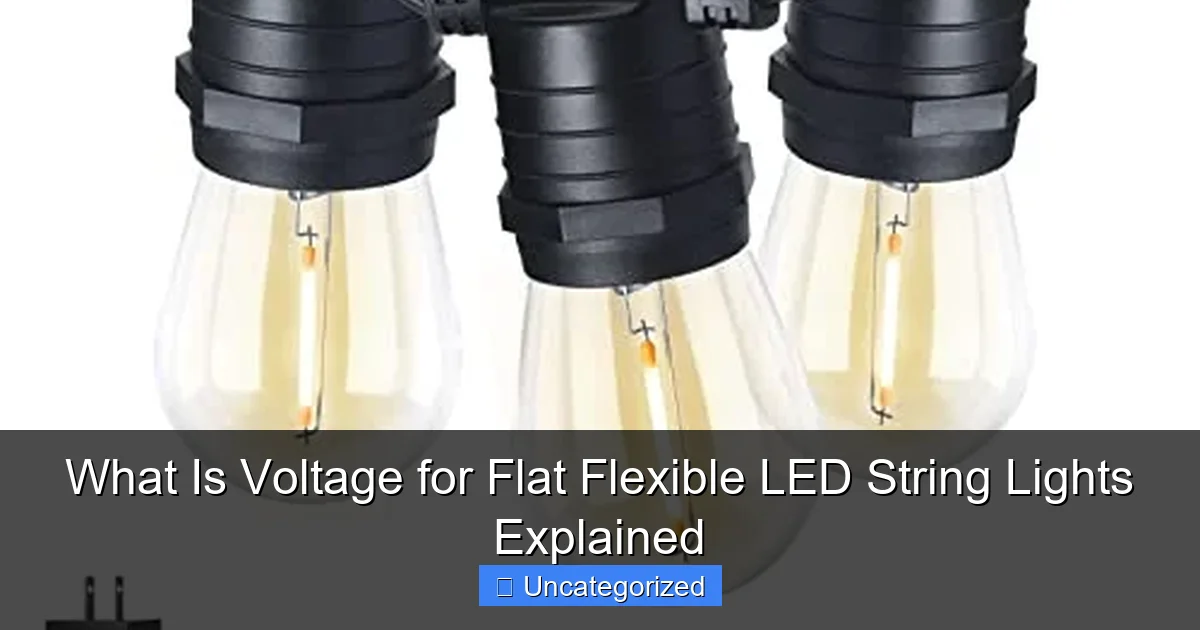
Featured image for what is voltage for flat flexible led string lights
Image source: m.media-amazon.com
Voltage for flat flexible LED string lights determines their brightness, efficiency, and compatibility with power sources. Most operate on low-voltage DC (5V–24V), making them safe, energy-efficient, and ideal for indoor or outdoor decorative lighting. Choosing the correct voltage ensures optimal performance and prevents damage to the LEDs or power supply.
Key Takeaways
- Voltage determines brightness: Higher voltage increases LED output but risks damage if mismatched.
- Match voltage to power source: Always align LED strip voltage with your adapter or battery.
- Low voltage is safer: 12V or 24V strips reduce fire risk in home installations.
- Check for voltage drop: Long runs need higher voltage to maintain consistent brightness.
- Use a voltage regulator: Stabilize input to prevent flickering and extend LED lifespan.
- DC vs. AC matters: Most flexible LEDs require DC; verify before connecting to AC sources.
📑 Table of Contents
- Understanding Voltage in Flat Flexible LED String Lights
- What Is Voltage and Why It Matters for LED Lights
- Common Voltage Options for Flat Flexible LED String Lights
- How to Choose the Right Voltage for Your Project
- Voltage Drop and How to Prevent It
- Voltage Safety, Compatibility, and Troubleshooting
- Data Table: Voltage Comparison for LED String Lights
- Conclusion
Understanding Voltage in Flat Flexible LED String Lights
Flat flexible LED string lights have become a go-to choice for both indoor and outdoor lighting solutions, thanks to their versatility, sleek design, and energy efficiency. Whether you’re decorating your patio, accenting a piece of furniture, or creating a cozy ambiance in your living room, these lights offer a modern, low-profile lighting option that blends seamlessly into any environment. However, one of the most critical factors to consider when purchasing or using flat flexible LED string lights is voltage. Understanding the voltage requirements ensures not only optimal performance but also safety and longevity of your lighting system.
Voltage plays a pivotal role in how LED lights operate, affecting brightness, power consumption, heat generation, and compatibility with power sources. Unlike traditional incandescent bulbs, LEDs are highly sensitive to voltage fluctuations. Too high, and you risk damaging the LEDs or shortening their lifespan; too low, and the lights may flicker, dim, or fail to turn on. In this comprehensive guide, we’ll explore everything you need to know about voltage in flat flexible LED string lights—from the science behind it to practical tips for selecting the right voltage for your project. Whether you’re a DIY enthusiast, a home decorator, or an event planner, this guide will help you make informed decisions and get the most out of your lighting setup.
What Is Voltage and Why It Matters for LED Lights
The Science Behind Voltage
At its core, voltage (measured in volts, V) is the electrical potential difference between two points in a circuit. It’s the “push” that drives electric current through a conductor. In the context of LED string lights, voltage determines how much electrical energy is supplied to the LEDs to produce light. Unlike incandescent bulbs, which can tolerate a wide range of voltages, LEDs are semiconductor devices that require precise voltage levels to function efficiently.
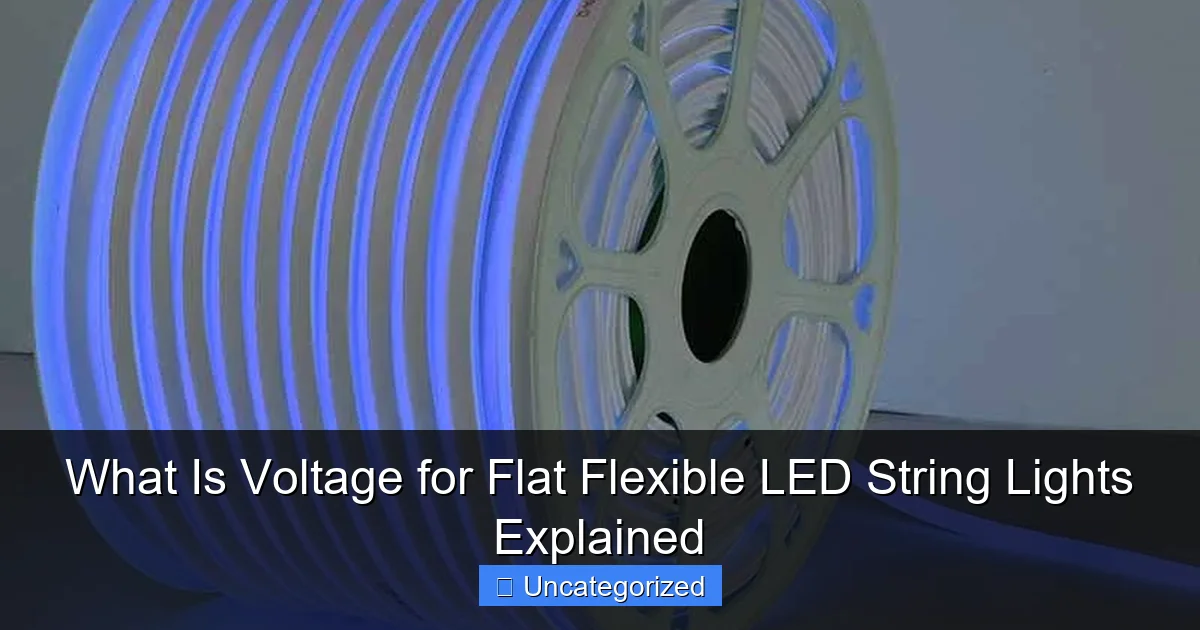
Visual guide about what is voltage for flat flexible led string lights
Image source: tekholled.com
LEDs operate on direct current (DC) and are designed to work within a narrow voltage window. For example, a typical white or blue LED has a forward voltage (Vf) of around 3.0–3.4 volts, while red or yellow LEDs may require 1.8–2.2 volts. When multiple LEDs are connected in a string (series), their forward voltages add up. This is why understanding the total voltage requirement of your LED strip is crucial.
Voltage vs. Current: Key Differences
While voltage is the “pressure” that moves electricity, current (measured in amperes, A) is the amount of electricity flowing through the circuit. LEDs are current-driven devices, meaning they respond to changes in current rather than voltage. However, since current is directly influenced by voltage and resistance (via Ohm’s Law: V = I × R), controlling voltage is the primary method to regulate LED brightness and prevent burnout.
- Too high voltage: Excess voltage causes excessive current to flow through the LED, generating heat and potentially destroying the semiconductor.
- Too low voltage: Insufficient voltage prevents the LED from reaching its forward threshold, resulting in dim or non-functional lights.
- Stable voltage: Ensures consistent brightness, color temperature, and extended lifespan.
Why Voltage Stability Is Critical
Flat flexible LED string lights often include built-in resistors or use constant-current drivers to regulate current. However, if the input voltage fluctuates—due to an unstable power supply, long cable runs, or poor-quality transformers—these components can’t compensate effectively. This leads to flickering, color shifting, or premature failure. For example, a 12V LED strip powered by a 15V supply without a voltage regulator may overheat within hours. Therefore, matching the correct voltage to your LED string is not just a recommendation—it’s a necessity for safe and reliable operation.
Common Voltage Options for Flat Flexible LED String Lights
Low Voltage: 3V, 5V, and 12V Systems
Most flat flexible LED string lights are designed to operate at low voltage, typically between 3V and 12V. These systems are safer for indoor use, require less insulation, and can be powered by batteries or small DC adapters. Here’s a breakdown of the most common options:
- 3V systems: Often used in small decorative items like LED candles, keychains, or miniature holiday lights. These are usually battery-powered (e.g., two AA batteries) and are ideal for temporary installations.
- 5V systems: Popular for USB-powered LED strips, such as those used for TV backlighting, computer case lighting, or portable decor. These are compatible with power banks, USB wall chargers, and laptop ports. Example: A 5V USB-powered 1-meter LED strip draws ~2A and produces 120 LEDs/m.
- 12V systems: The most common voltage for residential and commercial LED strips. Offers a balance between safety and performance. Suitable for longer runs (up to 5 meters) without significant voltage drop. Example: A 12V, 60-LED/m strip consumes ~24W per meter and is ideal for under-cabinet lighting or cove lighting.
Higher Voltage: 24V and 48V Systems
For larger installations or commercial projects, 24V and 48V LED systems are gaining popularity. These higher-voltage options offer several advantages:
- Reduced voltage drop: Higher voltage allows longer cable runs with less power loss, making them ideal for long linear installations (e.g., ceiling coves, retail displays).
- Lower current draw: For the same power output (watts), higher voltage means lower current (since P = V × I). This reduces heat generation and allows thinner wires.
- Energy efficiency: Less resistive loss in wiring improves overall system efficiency.
Example: A 24V, 120-LED/m strip consuming 14.4W per meter can run up to 10 meters with minimal brightness variation, whereas a 12V equivalent would require mid-point power injection for runs over 5 meters.
AC vs. DC Voltage: What’s the Difference?
While LEDs operate on DC, many power sources (like wall outlets) provide alternating current (AC). Therefore, flat flexible LED string lights often include an AC-to-DC converter (power supply or transformer) in the system.
- DC voltage: Direct current flows in one direction. LED strips are inherently DC devices. A 12V DC power supply provides steady voltage ideal for LED performance.
- AC voltage: Alternating current changes direction 50–60 times per second (Hz). Some LED strips use AC-DC drivers integrated into the strip or in the plug. These are labeled as “AC-powered” but internally convert to DC.
Tip: Always check if your LED string requires an external driver. Most 12V/24V strips need a separate DC power supply, while plug-in “AC” strips have built-in transformers.
How to Choose the Right Voltage for Your Project
Assessing Your Installation Environment
The right voltage depends on where and how you plan to use your flat flexible LED string lights. Consider these factors:
- Indoor vs. Outdoor: Outdoor installations require weatherproof (IP65 or higher) LED strips. 12V and 24V are preferred due to safety (low voltage reduces shock risk) and compatibility with solar or battery systems.
- Length of the run: For runs under 3 meters, 12V is sufficient. For 5+ meters, consider 24V to avoid voltage drop. Example: A 12V 100-LED strip over 8 meters may dim at the far end; a 24V version maintains brightness.
- Power source availability: USB-powered (5V) strips are great for temporary setups (e.g., events, camping). For permanent installations, 12V/24V with wall adapters or hardwiring is more reliable.
Matching Voltage to Power Supply and Drivers
Never assume that any power supply will work with your LED strip. Always match:
- Voltage (V): Must match exactly. A 12V strip needs a 12V power supply.
- Current (A) or Power (W): The power supply must provide at least the total current/power your strip requires. Use the formula:
Total Power (W) = Voltage (V) × Current (A).
For example, a 5-meter 12V strip drawing 2A/m needs 12V × 10A = 120W power supply (add 20% buffer: 144W minimum). - Connector type: Ensure the power supply has the correct plug (e.g., 2.1mm barrel jack) or bare wires for hardwiring.
Tip: Use a multimeter to verify the power supply output voltage before connecting to LEDs.
Special Considerations for RGB and Addressable LEDs
RGB (color-changing) and addressable (individually controllable) LED strips have additional voltage requirements:
- RGB strips: Typically 12V or 24V. Each color channel (red, green, blue) has its own circuit. A 12V RGB strip may draw 60mA per LED (180mA total per LED).
- Addressable strips (e.g., WS2812B, SK6812): Usually 5V. These require a microcontroller (e.g., Arduino, Raspberry Pi) and are sensitive to voltage fluctuations. Even a 0.5V drop can cause color inaccuracies or signal errors.
Example: A 5V addressable strip with 60 LEDs/m draws ~3.6A per meter. Use a high-quality 5V/10A+ power supply and inject power every 2–3 meters to avoid voltage drop.
Voltage Drop and How to Prevent It
What Is Voltage Drop?
Voltage drop occurs when electrical resistance in wires or the LED strip itself causes a reduction in voltage over distance. This results in dimmer lights at the end of the strip. The longer the run, the more significant the drop. For example, a 12V LED strip may measure only 10V at the far end of a 5-meter run, causing the last LEDs to flicker or appear orange (lower voltage shifts color temperature).
Voltage drop is calculated using: VD = (2 × L × I × R) / 1000, where:
- L = length in meters
- I = current in amps
- R = resistance per meter (ohms/m) of the conductor
Strategies to Minimize Voltage Drop
- Use higher voltage strips: 24V systems halve the current for the same power, reducing drop by 75% compared to 12V.
- Shorten the run: Break long strips into shorter segments (e.g., 3x 3-meter instead of 1x 9-meter).
- Power injection: Supply power at multiple points along the strip. For a 12V strip over 5+ meters, connect power to both ends or every 2–3 meters.
- Use thicker wires: Replace thin 22 AWG wires with 18 AWG or 16 AWG for power injection cables.
- Upgrade to low-resistance strips: Look for strips with 2oz copper traces (vs. standard 1oz) for better conductivity.
Example: For a 6-meter 12V RGB strip (3A/m), inject power at 0m, 3m, and 6m using 18 AWG wires to maintain full brightness.
Measuring and Diagnosing Voltage Drop
Use a multimeter to check voltage at the start, middle, and end of your strip:
- Disconnect the power supply.
- Set the multimeter to DC voltage (20V range).
- Touch probes to the + and – pads at each point.
- If voltage drops by more than 0.5V (for 12V) or 1V (for 24V), implement power injection.
Voltage Safety, Compatibility, and Troubleshooting
Safety Considerations for Low Voltage Systems
While low voltage (≤24V) is generally safe, follow these guidelines:
- Use Class 2 power supplies: These are UL-listed for safety and limit output current to 5A.
- Proper insulation: Even low voltage can cause burns if wires are exposed. Use heat shrink tubing or electrical tape.
- Waterproofing: For outdoor use, ensure IP65+ rating and seal connections with silicone.
- Overheating: High current (e.g., 10A+) can overheat wires. Use 16 AWG or thicker for power injection.
Compatibility with Smart Controllers and Dimmers
Smart LED systems (e.g., Philips Hue, LIFX) often use 12V/24V strips but require compatible controllers:
- Voltage matching: A 12V controller won’t work with 24V strips.
- Dimming type: PWM (pulse-width modulation) dimmers work with most 12V/24V strips. Trailing-edge dimmers may not be compatible.
- Signal integrity: Addressable strips (5V) need stable voltage; avoid using cheap power supplies.
Common Voltage-Related Issues and Fixes
- Flickering lights: Caused by loose connections, voltage drop, or incompatible dimmer. Check connections, measure voltage, and replace the dimmer if needed.
- Partial strip not lighting: Often due to voltage drop or broken circuit. Test continuity and inject power at the break.
- Overheating: Caused by overvoltage or poor ventilation. Use a voltage regulator and ensure adequate airflow.
- Color shifting (RGB): Low voltage makes colors appear warmer (e.g., white turns yellow). Increase voltage or reduce run length.
Data Table: Voltage Comparison for LED String Lights
| Voltage (V) | Best For | Max Run Length | Typical Current (A/m) | Power Supply Type | Safety Rating |
|---|---|---|---|---|---|
| 3V | Mini decor, battery-powered | 0.5–1m | 0.1–0.3 | Battery (AA/AAA) | Safe for children |
| 5V | USB, portable, addressable | 3–5m | 0.6–3.6 | USB adapter/power bank | Low risk |
| 12V | Indoor, under-cabinet, RGB | 3–5m (inject at 5m+) | 0.5–3.0 | DC wall adapter | Low voltage (safe) |
| 24V | Long runs, commercial, outdoor | 5–10m | 0.3–1.5 | DC wall adapter | Low voltage (safe) |
| 48V | Large-scale, industrial | 10–20m | 0.1–0.8 | Industrial PSU | Low voltage (safe with insulation) |
Conclusion
Understanding the voltage requirements for flat flexible LED string lights is essential for achieving optimal performance, safety, and longevity. Whether you’re using 3V battery-powered mini lights or a 24V commercial-grade installation, matching the correct voltage to your project ensures bright, consistent lighting without flickering, overheating, or premature failure. Remember, voltage is not a one-size-fits-all parameter—it depends on your installation length, environment, power source, and LED type (single-color, RGB, or addressable).
By choosing the right voltage, using proper power supplies, and addressing voltage drop with techniques like power injection, you can create stunning lighting displays that stand the test of time. Always prioritize safety with low-voltage systems, use high-quality components, and verify voltage levels with a multimeter when in doubt. With this knowledge, you’re equipped to tackle any LED lighting project—from a cozy bedroom accent to a dazzling outdoor event setup. Illuminate your world with confidence, knowing that the right voltage is the foundation of every great lighting design.
Frequently Asked Questions
What voltage do flat flexible LED string lights typically use?
Most flat flexible LED string lights operate on low voltage, commonly 5V, 12V, or 24V DC. This ensures safety and energy efficiency, making them ideal for indoor and decorative use. Always check the product label to confirm.
Can I use a higher voltage power supply for my flat flexible LED string lights?
No, using a higher voltage than specified (e.g., powering 12V LEDs with 24V) can damage the lights or create a fire hazard. Match the voltage exactly to the manufacturer’s requirements for safe operation.
Are flat flexible LED string lights safe for battery-powered projects?
Yes, many flat flexible LED string lights are designed for low-voltage DC power (e.g., 5V USB or 3xAA batteries). Their low power draw makes them perfect for portable, battery-operated setups without overheating risks.
Do flat flexible LED string lights require a transformer or driver?
Most plug-in versions include a built-in transformer to convert AC mains voltage (110V/220V) to safe low-voltage DC. Battery-powered or USB models skip this step, drawing power directly from the source.
What is the voltage for flat flexible LED string lights used in outdoor applications?
Outdoor-rated flat flexible LED string lights typically use 12V or 24V DC, paired with waterproof connectors and weather-resistant coatings. These lower voltages reduce shock risks in wet conditions.
How does voltage affect the brightness of flat flexible LED string lights?
Higher voltage (within the rated range) increases brightness slightly, but LEDs are designed to operate optimally at their specified voltage. Overvoltage causes rapid burnout, while undervoltage leads to dim or flickering output.