Featured image for are led christmas string light in series or parallel
Image source: energy.gov
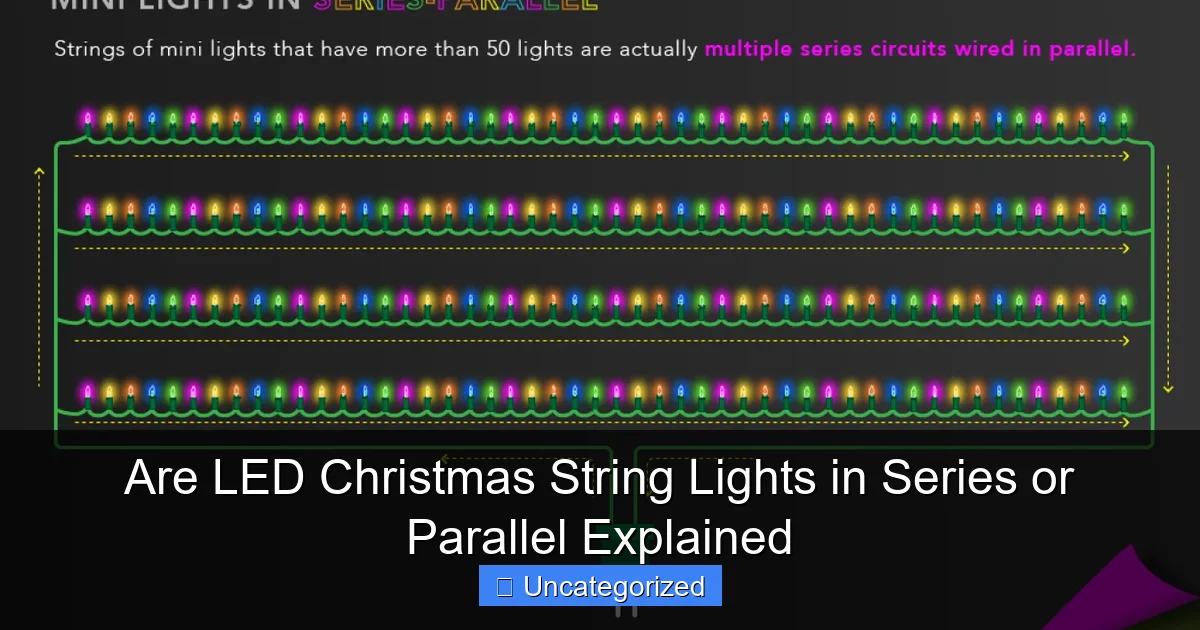
Most LED Christmas string lights are wired in parallel, allowing each bulb to operate independently so a single failure won’t darken the entire strand. This design enhances reliability and brightness consistency, making parallel circuits the preferred choice for modern, energy-efficient holiday lighting displays.
Key Takeaways
- Most LED string lights use parallel circuits for consistent brightness and independent bulb function.
- Series circuits are rare in LEDs due to voltage drop and single-bulb failure risks.
- Check manufacturer specs to confirm your lights’ wiring configuration before troubleshooting.
- Parallel LEDs stay lit if one fails, unlike series-connected traditional bulbs.
- Voltage stability matters—parallel LEDs maintain performance across long strands.
- Use a multimeter to test circuit type if unsure of your lights’ design.
- Hybrid designs exist—some combine series and parallel for efficiency and safety.
📑 Table of Contents
- The Magic Behind LED Christmas String Lights: Series or Parallel?
- Understanding Electrical Circuits: Series vs. Parallel Basics
- How LED Christmas String Lights Are Typically Wired
- Advantages and Disadvantages of Series vs. Parallel LED Lights
- How to Identify if Your LED String Lights Are in Series or Parallel
- Practical Tips for Using and Maintaining Series vs. Parallel LED Lights
- Conclusion: Making the Right Choice for Your Holiday Lights
The Magic Behind LED Christmas String Lights: Series or Parallel?
As the holiday season approaches, homes around the world begin to sparkle with the warm glow of LED Christmas string lights. These twinkling decorations have become a staple of festive cheer, offering energy efficiency, durability, and vibrant colors compared to their incandescent predecessors. But have you ever stopped to wonder: how do these lights work together so perfectly? The answer lies in a fundamental principle of electrical engineering—how the individual bulbs are connected: in series or parallel.
Understanding whether your LED Christmas string lights are wired in series or parallel isn’t just a curiosity—it’s crucial for troubleshooting, safety, and even extending the lifespan of your holiday decor. Whether you’re replacing a burnt-out bulb, diagnosing a flickering strand, or planning an elaborate light display, knowing the wiring configuration can save time, money, and frustration. In this comprehensive guide, we’ll dive deep into the science behind LED string lights, explore the pros and cons of series vs. parallel circuits, and provide practical advice for homeowners, decorators, and DIY enthusiasts. By the end, you’ll be equipped with the knowledge to make informed decisions about your holiday lighting—no electrical degree required.
Understanding Electrical Circuits: Series vs. Parallel Basics
What Is a Series Circuit?
A series circuit is an electrical configuration where components—like LED bulbs—are connected end-to-end in a single path. This means the current flows through each bulb one after another. If one bulb fails (e.g., burns out or is removed), the entire circuit is broken, and all the lights go out. Think of it like a chain: if one link breaks, the whole chain fails.
Visual guide about are led christmas string light in series or parallel
Image source: energy.gov
For example, imagine a string of 50 LEDs wired in series. The electricity enters the first bulb, passes through the second, then the third, and so on, until it reaches the end and returns to the power source. Because the current must pass through every bulb, the resistance adds up, and the voltage is divided equally among them. In a 120-volt household circuit, each of the 50 LEDs might receive just 2.4 volts—enough to illuminate, but only if the entire chain is intact.
What Is a Parallel Circuit?
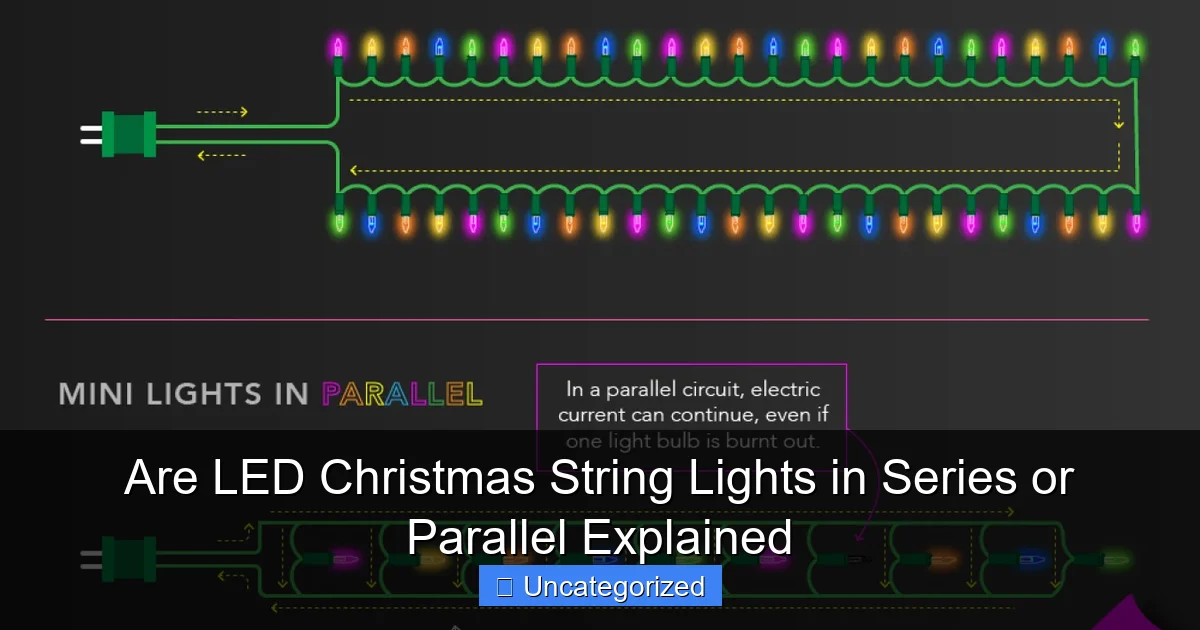
In a parallel circuit, each LED is connected across the same two wires, creating multiple independent paths for the current. This means that if one bulb burns out or is removed, the others continue to function normally. The voltage across each bulb remains the same (e.g., 120 volts in a standard household circuit), but the current is shared among the branches.
Picture a tree with many branches: even if one branch falls off, the rest of the tree remains intact. This is the beauty of parallel circuits—they’re more reliable and user-friendly, especially for large-scale lighting displays. For instance, a parallel-wired string of 50 LEDs will keep shining even if 5 bulbs fail, making it ideal for outdoor setups where access is difficult.
Key Differences at a Glance
- Current Flow: In series, current is the same through all bulbs; in parallel, current splits among branches.
- Voltage Distribution: In series, voltage is shared; in parallel, voltage is the same across all bulbs.
- Failure Impact: One failed bulb breaks the entire series circuit; a failed bulb has no effect in a parallel circuit.
- Complexity: Series circuits are simpler to design; parallel circuits require more wiring but offer greater reliability.
Now that you understand the basics, let’s explore how these principles apply specifically to LED Christmas string lights.
How LED Christmas String Lights Are Typically Wired
Modern LED Lights: Mostly Parallel with Series Subsections
While traditional incandescent Christmas lights were often wired entirely in series (remember the frustration when one bulb burned out and the whole string went dark?), modern LED Christmas string lights use a hybrid approach. Most are designed with parallel wiring for the overall strand, but with series subsections within each “section” or “cluster.”
Visual guide about are led christmas string light in series or parallel
Image source: i.stack.imgur.com
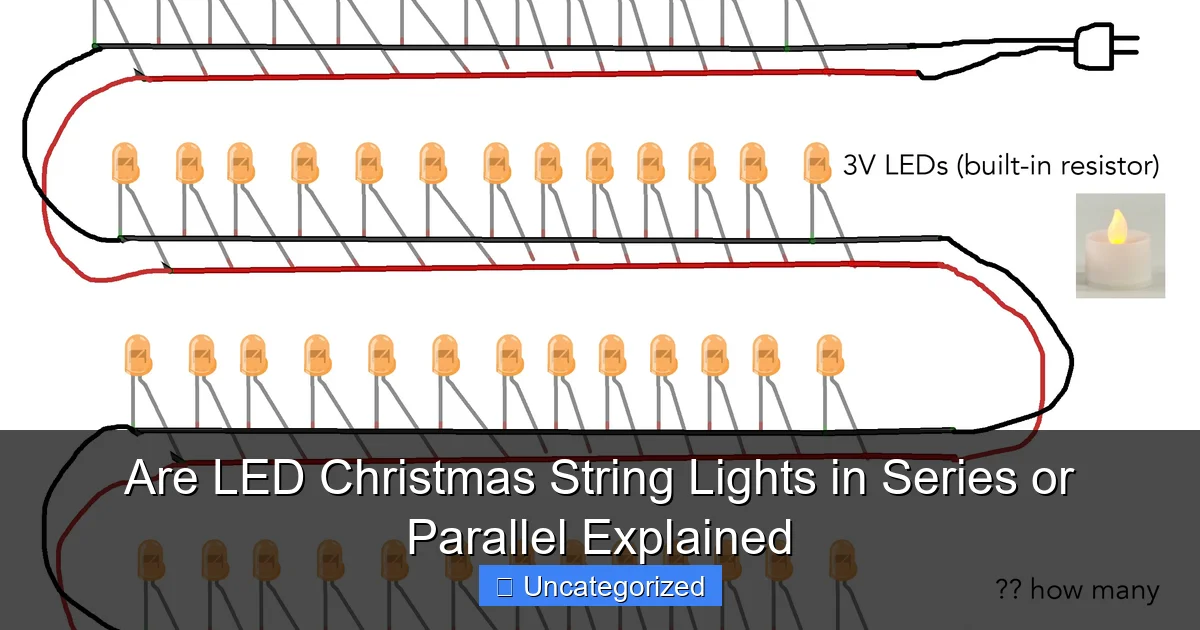
Here’s how it works: A typical LED string might have 100 bulbs, grouped into 10 clusters of 10 LEDs each. Each cluster of 10 LEDs is wired in series because LEDs require a specific forward voltage (usually 2–3.5 volts per diode). By connecting 10 LEDs in series, the cluster can operate at around 30 volts (3V x 10), which is safe and efficient for the driver circuit. However, these 10 clusters are then wired in parallel to the main power supply (e.g., 120V AC or 24V DC).
This hybrid design offers the best of both worlds: the voltage efficiency of series clusters and the reliability of parallel connections. If one LED in a cluster fails, only that cluster goes out—not the entire string. And if one cluster fails, the other nine continue to shine.
Example: A 100-Light LED String
- Cluster Configuration: 10 clusters of 10 LEDs in series
- Voltage per Cluster: ~30V (3V per LED)
- Total Voltage Input: 120V AC (converted to DC via internal driver)
- Parallel Wiring: All 10 clusters connected in parallel to the driver
- Failure Impact: One dead LED = one cluster out; one dead cluster = 90 lights still working
Exceptions: Pure Series and Pure Parallel Designs
While hybrid designs dominate the market, some specialty LED lights still use pure configurations:
- Pure Series: Rare, but found in older or budget LED strings. If one LED fails, the whole string goes dark. These are less common due to poor user experience.
- Pure Parallel: More common in commercial-grade or high-end LED strings. Each LED has its own current-limiting resistor and is independently connected. Extremely reliable but more expensive to manufacture.
Pro Tip: Check the packaging or manufacturer’s specifications. Look for terms like “shunted” or “non-shunted” sockets. Shunted sockets allow current to bypass a failed bulb—common in parallel or hybrid designs.
Advantages and Disadvantages of Series vs. Parallel LED Lights
Advantages of Series-Wired LED Lights
Despite their drawbacks, series-wired LED strings (or series subsections) offer several benefits:
- Lower Voltage Requirements: By connecting LEDs in series, you can achieve the required forward voltage with fewer power supply components. This reduces cost and complexity.
- Uniform Brightness: In a series circuit, all LEDs receive the same current, ensuring consistent brightness across the cluster.
- Simpler Driver Design: A single current-regulating circuit can power the entire series chain, making it easier to design and manufacture.
- Energy Efficiency: Less power is lost to resistive heating compared to parallel circuits with individual resistors.
For example, a 20-LED series cluster operating at 60V requires a driver that can handle higher voltage but lower current. This is more efficient than 20 parallel LEDs, each needing a separate resistor.
Disadvantages of Series-Wired LED Lights
- Single Point of Failure: One dead LED can disable the entire cluster. This is mitigated in hybrid designs but remains a risk in pure series strings.
- Voltage Sensitivity: The total voltage must match the sum of individual LED voltages. Too much voltage can damage LEDs; too little prevents them from lighting.
- Difficult Troubleshooting: Finding a single failed LED in a long series chain requires testing each bulb individually.
Advantages of Parallel-Wired LED Lights
Parallel-wired LED strings (or parallel clusters) are the gold standard for reliability:
- Independent Operation: Each LED or cluster operates independently. Failures are isolated.
- Easier Maintenance: If a section goes out, you can replace just that section without affecting the rest.
- Scalability: Adding more parallel branches is straightforward, making them ideal for large displays.
- Brightness Consistency: Modern parallel designs use constant-current drivers to maintain uniform brightness, even with variable loads.
Disadvantages of Parallel-Wired LED Lights
- Higher Current Demand: The total current is the sum of all branch currents, requiring a higher-capacity driver and thicker wires.
- Increased Complexity: Each branch may need a current-limiting resistor or individual driver circuitry, raising manufacturing costs.
- Potential for Overloading: Adding too many parallel branches can exceed the driver’s capacity, causing overheating or failure.
- Voltage Drop Issues: In very long parallel strings, resistance in the wires can cause voltage drop, dimming lights at the far end.
Real-World Example: A homeowner uses a 200-light parallel LED string. After 3 years, 10 LEDs fail due to weather exposure. Only the affected clusters dim or go out; the rest of the string remains fully functional. The homeowner simply replaces the faulty clusters—no need to buy a new string.
How to Identify if Your LED String Lights Are in Series or Parallel
Visual Inspection and Physical Testing
You don’t need an electrical engineering degree to determine your LED string’s wiring. Here’s how to identify it:
Method 1: The Bulb Removal Test
- Turn on the string lights.
- Carefully remove one LED bulb (don’t touch the metal contacts).
- Observe the rest of the string:
- If the entire string goes out: Likely a pure series or series cluster with no shunting.
- If only a small section (e.g., 5–10 lights) goes out: It’s a hybrid design (series clusters in parallel).
- If the entire string stays lit: It’s a parallel-wired string (or has shunted sockets).
Caution: Never perform this test on incandescent lights—they can overheat when bulbs are removed.
Method 2: Check for Shunted Sockets
Shunted sockets have internal metal bridges that redirect current around a missing or failed bulb. To check:
- Remove a bulb and examine the socket.
- Look for a small metal tab or bridge between the contacts.
- Shunted sockets = parallel or hybrid wiring. Non-shunted = series.
Method 3: Read the Label or Manual
- Look for terms like “parallel,” “shunted,” “independent,” or “cluster.”
- Check the voltage rating. A string rated for 120V with 50 LEDs is likely hybrid (e.g., 5 clusters of 10 in series).
- Manufacturer websites often provide wiring diagrams for technical models.
Method 4: Use a Multimeter (Advanced)
For tech-savvy users, a multimeter can measure voltage and continuity:
- Set the multimeter to continuity mode.
- Test between adjacent bulbs. In series, continuity exists only along the chain. In parallel, each bulb connects directly to the main wires.
- Measure voltage across individual bulbs. Series bulbs share voltage; parallel bulbs have full voltage.
Pro Tip: Take photos of the wiring before disassembling. This helps reassemble correctly.
Practical Tips for Using and Maintaining Series vs. Parallel LED Lights
Choosing the Right Lights for Your Needs
Your choice between series, parallel, or hybrid LED strings depends on your use case:
| Use Case | Recommended Wiring | Why |
|---|---|---|
| Indoor Tree Decor (10–20 lights) | Hybrid or Parallel | Reliability and easy replacement |
| Outdoor Rooflines (100+ lights) | Parallel or Hybrid | One failed cluster won’t ruin the display |
| Window Displays (short strings) | Hybrid | Cost-effective with good reliability |
| Commercial Installations (500+ lights) | Pure Parallel | Maximum uptime and scalability |
| Budget Decor (small displays) | Hybrid | Balances cost and functionality |
Maintenance and Troubleshooting Tips
- For Series/Hybrid Strings:
- Keep spare bulbs of the correct type (voltage and size).
- Use a LED light tester to find failed bulbs quickly.
- Replace bulbs promptly—leaving a dead LED can stress the driver.
- For Parallel Strings:
- Inspect connections annually for corrosion (especially outdoors).
- Use waterproof connectors for outdoor installations.
- Check the driver/transformer for overheating signs.
- General Best Practices:
- Always unplug lights before handling.
- Store lights loosely coiled to prevent wire damage.
- Use timers or smart plugs to reduce on-time and extend lifespan.
- Replace entire strings after 5–7 years (even if working) due to LED degradation.
Upgrading Your Display
Want to create a dazzling, professional-looking display? Consider:
- Mixing Series and Parallel: Use parallel strings for large areas and series clusters for intricate details (e.g., wreaths).
- Smart LED Strings: Many modern parallel strings offer app control, color changing, and synchronization—ideal for dynamic displays.
- Voltage Drop Solutions: For long parallel runs, use thicker extension cords or install additional power sources.
Example: A homeowner decorates a 30-foot roofline with 3 parallel LED strings (100 lights each). One string fails after 4 years. They replace just that string—no need to rewire the entire roof.
Conclusion: Making the Right Choice for Your Holiday Lights
Understanding whether your LED Christmas string lights are in series or parallel—or a hybrid of both—empowers you to make smarter decisions about your holiday decor. Gone are the days of throwing out entire strings because one bulb failed. Modern LED lights, with their intelligent hybrid designs, offer unprecedented reliability, energy efficiency, and user-friendliness.
Whether you’re a DIY decorator, a professional installer, or simply a homeowner who loves a festive home, knowing the wiring behind your lights helps you troubleshoot issues, extend their lifespan, and create dazzling displays that last for years. The hybrid approach—series clusters in parallel—has become the industry standard for good reason: it combines the electrical efficiency of series wiring with the reliability of parallel connections.
As you prepare for this holiday season, take a moment to inspect your LED strings. Test a bulb, check the sockets, and read the labels. You might just discover that your favorite lights are smarter than you thought. And remember: the next time someone asks, “Are LED Christmas string lights in series or parallel?”—you’ll have the answer, backed by science, experience, and a little holiday magic.
So string up those lights, enjoy the glow, and let your home shine bright—safely, efficiently, and brilliantly—all season long.
Frequently Asked Questions
Are LED Christmas string lights wired in series or parallel?
Most LED Christmas string lights use a parallel circuit design. This ensures that if one bulb fails, the others stay lit, unlike traditional series-wired lights.
What happens if one LED bulb goes out in a parallel string?
In parallel-wired LED Christmas lights, a single burnt-out bulb won’t affect the rest. The circuit remains closed, allowing other LEDs to keep functioning normally.
Why are LED Christmas lights better in parallel than in series?
Parallel wiring improves reliability and longevity. Since voltage is distributed evenly, LEDs operate at full brightness, and failures don’t cascade—a common issue in series circuits.
Can I connect multiple LED string lights end-to-end safely?
Yes, because most LED strings are parallel-wired, connecting multiple sets won’t overload the circuit. Always check the manufacturer’s max connection limit to avoid overheating.
Do series or parallel LED lights affect energy consumption?
Parallel-wired LED Christmas lights use slightly more energy than series-wired ones, but the difference is minimal. The benefit of reliability and consistent brightness outweighs the marginal increase.
How can I tell if my LED string lights are in series or parallel?
Test by removing one bulb: if the rest stay lit, it’s a parallel circuit. Series-wired LEDs will all go out. Most modern sets are parallel for user convenience.

