Featured image for how to measure for outdoor string lights
Image source: live.staticflickr.com
Accurate measurements are the foundation for perfectly hung outdoor string lights—start by measuring the exact length of your installation area using a flexible tape measure, accounting for posts, trees, or eaves. Always add 10–15% extra length to accommodate sags, hooks, and future adjustments, ensuring a flawless, professional look every time.
Key Takeaways
- Measure twice: Always double-check dimensions before buying or installing lights.
- Map your layout: Sketch the area to plan light placement and spacing accurately.
- Account for sag: Add 10–15% extra length to compensate for natural cable droop.
- Use flexible tools: A fabric measuring tape bends easily around curves and obstacles.
- Check power access: Ensure outlets are within reach or plan for extension cords.
- Test before finalizing: Hang temporary lights to verify coverage and adjust measurements.
📑 Table of Contents
- Why Measuring for Outdoor String Lights Is the Secret to a Magical Backyard
- Understanding Your Outdoor Space: Start with the Right Mindset
- Measuring Techniques: Tools, Tips, and Common Pitfalls
- Calculating Length, Spacing, and Power Needs
- Special Cases: Trees, Pergolas, and Unique Spaces
- Final Checks and Installation Tips
- Data Table: Common Outdoor String Light Measurements
- The Bottom Line: Measure, Test, and Enjoy
Why Measuring for Outdoor String Lights Is the Secret to a Magical Backyard
Picture this: It’s a warm summer evening. You’ve just grilled dinner, the kids are laughing on the patio, and the sun is setting behind the trees. You flip a switch—and nothing happens. You forgot to measure for outdoor string lights. Now you’re stuck with a tangled mess of cords that don’t reach, or worse, lights that hang too low, casting awkward shadows instead of that soft, golden glow you imagined. Been there? I have. And it’s not just frustrating—it’s a total mood killer.
But here’s the good news: getting it right isn’t rocket science. Measuring for outdoor string lights is actually one of the easiest ways to guarantee a stunning, functional, and safe outdoor space. Whether you’re stringing lights across a pergola, wrapping them around trees, or lining your deck railing, a few simple measurements can make all the difference. No guesswork. No last-minute trips to the hardware store. Just a perfectly lit oasis that feels like it was designed by a pro—because it was, by you.
Understanding Your Outdoor Space: Start with the Right Mindset
Step 1: Define Your Lighting Goals
Before you grab a tape measure, ask yourself: What do I want these lights to do? Are you going for ambiance? Safety? Task lighting? Each goal changes how you measure and install.
Visual guide about how to measure for outdoor string lights
Image source: c.pxhere.com
- Ambiance: Soft, warm, and evenly spaced. Think café-style strings across a dining area.
- Safety: Lights along pathways or stairs. Focus on coverage and visibility.
- Task lighting: Bright, focused light over a grill, bar, or outdoor kitchen. May require higher wattage or brighter bulbs.
For example, my neighbor Sarah wanted lights just for ambiance. She measured her pergola (10 feet wide) and added a few extra feet for gentle sagging between posts. The result? A dreamy, romantic glow that made her backyard feel like a Tuscan vineyard. On the other hand, my brother-in-law needed lights for safety along his deck steps. He measured each step (7 inches high, 11 inches deep) and spaced lights every 3 feet to avoid tripping.
Step 2: Sketch Your Layout
Grab a piece of paper or use a free app like SketchUp Free or RoomSketcher. Draw a rough sketch of your space. Mark:
- Key structures (pergolas, trees, railings)
- Power source location (outlet, GFCI box, solar panel)
- Areas you want to illuminate (seating, dining, walkways)
This isn’t about being an artist. It’s about visualizing. I once skipped this step and ended up with lights that blocked my view of the garden. A quick sketch would’ve saved me hours of restringing.
Step 3: Consider the View
Think about where people will be looking. Are the lights visible from the kitchen window? Will they shine in your neighbor’s eyes? Measuring isn’t just about distance—it’s about sightlines. I recommend measuring from multiple angles. Stand where guests will sit, walk, and cook. Does the light feel balanced? Does it highlight what you love (like a beautiful tree or water feature) or distract from it?
Measuring Techniques: Tools, Tips, and Common Pitfalls
The Right Tools for Accurate Measurements
You don’t need fancy gear. Here’s what I keep in my toolkit:
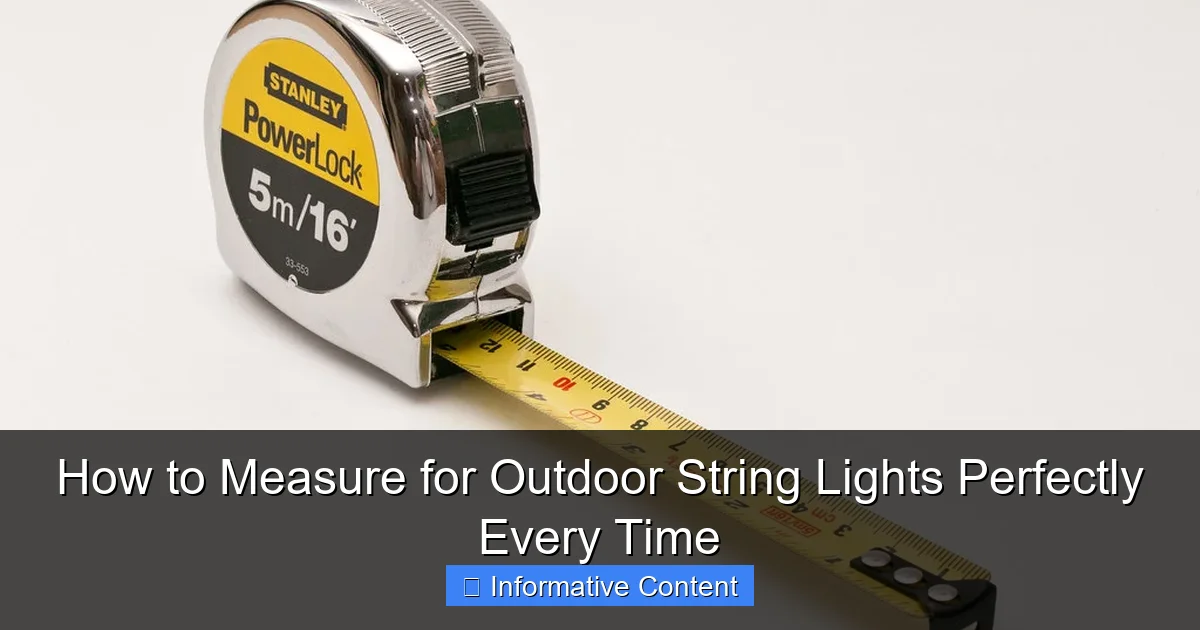
- Measuring tape (25-foot minimum): Flexible and durable. I like the Stanley 25-foot PowerLock—it doesn’t kink.
- String or rope (non-stretch): For measuring curved paths or tree branches.
- Measuring wheel (optional): Great for long distances (e.g., a 50-foot driveway).
- Smartphone with AR app: Apps like Measure (iOS) or AR Ruler (Android) use augmented reality to estimate distances. Handy for rough drafts.
Pro tip: Always measure twice. I once measured a pergola as 12 feet, only to realize I’d started from the wrong post. A second check saved me from buying the wrong length.
How to Measure Linear Runs (Pergolas, Railings, Fences)
For straight lines, it’s simple:
- Measure the total distance from one anchor point to the other.
- Add 10–15% extra for sagging or wrapping around posts. (More on sagging below.)
- Round up to the nearest available string light length. Most come in 25, 50, or 100-foot strands.
Example: My deck railing is 38 feet long. I added 15% (5.7 feet) for sagging, totaling 43.7 feet. I bought a 50-foot strand—perfect.
Measuring Curves and Trees (The “String Trick”)
Trees and curved paths are trickier. Here’s my go-to method:
- Tie a non-stretch string or rope to your starting point (e.g., a tree trunk).
- Follow the path you want to light, wrapping around branches or curving along a garden bed.
- Cut the string at the endpoint.
- Measure the string with your tape. That’s your true length.
I used this for a winding garden path. The straight-line distance was 20 feet, but the string measured 27 feet. Without the string, I’d have been short by 7 feet—enough to leave the last section dark.
Common Pitfalls (And How to Avoid Them)
- Ignoring sagging: String lights naturally sag between anchor points. If you measure the straight distance and hang taut, they’ll look stiff and unnatural. Always add 10–15% extra for gentle dips.
- Forgetting the power source: Measure from your outlet to the first light. I once bought a 25-foot strand, only to realize my outlet was 30 feet away. I had to splice in an extension cord—ugly and unsafe.
- Overlooking obstacles: Trees, gutters, and furniture can block light paths. Measure around them, not through them.
Calculating Length, Spacing, and Power Needs
How Much Length Do You Really Need?
Here’s a simple formula:
- Base length: Total distance from anchor point A to B (or along a path).
- Add 10–15%: For sagging or wrapping.
- Add 5–10%: For “buffer” (in case you miscalculated or need to rehang).
- Total = Base + Sagging + Buffer
Example: A 40-foot pergola.
- Base: 40 ft
- Sagging (12%): 4.8 ft
- Buffer (8%): 3.2 ft
- Total: 48 ft → Buy a 50-foot strand
Note: For very long runs (100+ feet), consider multiple shorter strands. Longer strands are harder to install and may lose brightness at the end.
Spacing Between Bulbs: More Than Just Aesthetics
Bulb spacing affects both look and function:
- 4–6 inches: Dense, bright, great for task lighting (e.g., over a grill).
- 8–12 inches: Classic “café” style. Balanced ambiance.
- 18+ inches: Minimalist, subtle glow. Best for large open spaces.
I prefer 10-inch spacing for dining areas. It feels warm without being overwhelming. For my 50-foot strand (10-inch spacing), I get 60 bulbs—plenty for a 10×10 ft patio.
Power Requirements: Don’t Overload Your Circuit
Most outdoor string lights use 5–10 watts per bulb. But daisy-chaining too many strands can trip breakers or cause dimming. Here’s how to check:
- Step 1: Check the wattage on your lights’ packaging (e.g., “5W per bulb, 25 bulbs per strand” = 125W per strand).
- Step 2: Add up total wattage. Most outdoor outlets support 1,800W max (15A circuit).
- Step 3: Leave 20% headroom. Never exceed 1,440W (80% of 1,800W).
Example: I use 125W strands. 1,440W ÷ 125W = 11.5 → I can safely connect 11 strands. But I only use 8—safety first!
Special Cases: Trees, Pergolas, and Unique Spaces
Wrapping Trees: The “Helix” Method
For a magical, fairy-tale effect, wrap lights around tree trunks. But how much length?
- Measure the tree’s circumference at chest height (use string or tape).
- Multiply by the number of wraps (e.g., 3 wraps = 3x circumference).
- Add 10% for spacing between wraps and height (e.g., from 5 ft to 15 ft).
Example: A 3-ft circumference tree with 3 wraps: 3 ft × 3 = 9 ft + 10% (0.9 ft) = 10 ft total.
Tip: Use zip ties or light clips to secure lights without damaging bark.
Pergolas and Gazebos: The “Grid” or “Canopy” Style
Pergolas offer two options:
- Grid style: Lights crisscrossing between beams. Measure each “lane” (e.g., 8 ft long, 4 lanes = 32 ft total).
- Canopy style: Lights draped over the top, sagging down. Measure the perimeter (e.g., 10×12 ft = 44 ft) + 15% sagging = 50.6 ft → Buy a 50-foot strand (or two 25-footers).
I used the canopy style on my 12×12 ft pergola. The lights drape 2 ft down each side, creating a glowing tent effect. Perfect for summer dinners.
Unusual Spaces (Staircases, Water Features, etc.)
For stairs:
- Measure the total rise and run (height + depth of all steps).
- Multiply by 2 (for both sides).
- Add 10% for wrapping handrails.
For a 6-step staircase (7” rise, 11” run): (6×7”) + (6×11”) = 108” = 9 ft. ×2 = 18 ft + 10% = 20 ft total.
For water features: Use submersible LED lights. Measure the perimeter of the pond or fountain. Always use GFCI-protected outlets.
Final Checks and Installation Tips
Test Before You Hang
Before installing, test your lights:
- Unroll the entire strand.
- Plug it into a power source (use an extension cord if needed).
- Check for dead bulbs, flickering, or dimming.
I once skipped this step and hung a strand with 3 dead bulbs. It took me an hour to troubleshoot. Now I test every time.
Use the Right Hanging Hardware
Don’t just nail lights to wood. Use:
- Light clips: Plastic or metal clips that attach to gutters, shingles, or beams.
- Zip ties: For trees or railings. Cut ends flush to avoid snags.
- Eye hooks: For pergolas. Drill pilot holes to avoid splitting wood.
My go-to: Adhesive-backed light clips for vinyl siding. No drilling, no damage.
Weatherproofing: Protect Your Investment
Outdoor lights face sun, rain, and wind. To extend their life:
- Use outdoor-rated lights (look for “UL Wet Rated” or “IP65”).
- Seal plug connections with electrical tape or waterproof caps.
- Store lights in a dry place during winter (or use all-season lights).
I leave my lights up year-round, but I unplug them in winter storms. A simple habit that keeps them glowing for 5+ years.
Data Table: Common Outdoor String Light Measurements
| Space Type | Base Length (ft) | Sagging/Buffers (ft) | Recommended Strand Length (ft) | Bulb Spacing (in) |
|---|---|---|---|---|
| 10×10 ft patio (perimeter) | 40 | 4.8 (12%) + 3.2 (8%) = 8 | 48 → 50 | 10 |
| 30-ft deck railing | 30 | 4.5 (15%) + 3 (10%) = 7.5 | 37.5 → 50 (use 2×25 ft) | 8 |
| Tree (4-ft circumference, 3 wraps) | 12 | 1.2 (10%) | 13.2 → 15 | 6 |
| Staircase (8 steps, 7″ rise, 11″ run) | 14.7 | 1.5 (10%) | 16.2 → 20 | 12 |
The Bottom Line: Measure, Test, and Enjoy
Measuring for outdoor string lights isn’t just about numbers—it’s about creating a space that feels right. Whether you’re hosting a dinner party, reading under the stars, or just enjoying a quiet night, the right lights turn your backyard into a sanctuary. And with these tips, you’ll get it perfect every time.
Remember: Start with your goals. Sketch your layout. Measure twice, buy once. Add sagging and buffer. Test before you hang. And most importantly—don’t stress. Even if you miscalculate, it’s fixable. I’ve had to restring lights more times than I can count. But each time, the result was worth it.
So grab your tape measure, sketch that dreamy setup, and get ready to light up your nights. Your perfect outdoor oasis is just a few measurements away. Happy stringing!
Frequently Asked Questions
How do I measure for outdoor string lights to fit my space perfectly?
Start by measuring the total length of the area where you plan to hang the lights, such as a patio, pergola, or fence. Add 10–15% extra to your measurement to account for sagging or decorative draping, ensuring you have enough coverage without overstretching the strands.
What tools do I need to measure for outdoor string lights accurately?
Use a flexible tape measure or a laser distance measurer for straight runs, and a string or rope for curved or irregular areas. Mark anchor points (like poles or hooks) during measurement to plan bulb spacing and ensure even lighting.
How do I account for bulb spacing when measuring for outdoor string lights?
Check the spacing between bulbs (e.g., 12 inches) on your chosen string lights and divide your total measured length by that number to determine how many bulbs you’ll need. This helps avoid gaps or overcrowding in your final setup.
Can I connect multiple strands of outdoor string lights together?
Yes, but check the manufacturer’s maximum wattage or strand limit before connecting. Measure each section separately and ensure the combined length fits your space without exceeding electrical or safety guidelines.
How do I measure for outdoor string lights on a sloped or uneven surface?
Use a level or inclinometer app to calculate the slope, then measure along the surface (not horizontally) with a tape measure. Add extra length to accommodate the incline and prevent tension on connectors.
What’s the best way to plan for power source placement when measuring?
Measure from your outlet or power source to the starting point of your lights, and choose a strand length that reaches with a few feet to spare. Avoid daisy-chaining extension cords, as this can create tripping hazards and voltage drops.