Featured image for can i plug 7 strings of led christmas lights
Image source: tankbig.com
Yes, you can safely plug 7 strings of LED Christmas lights together—if they’re designed for end-to-end connection and your total wattage stays within the circuit’s 15-amp limit (1,800 watts). Always check the manufacturer’s rating for “max connectable” strings and avoid overloading outlets to prevent fire hazards. LEDs draw less power than incandescent, making 7-string setups feasible, but safety first: inspect cords, use outdoor-rated lights, and never exceed 75–80% of your circuit’s capacity.
Key Takeaways
- Check the manufacturer’s limit: Never exceed the recommended number of connected LED light strings.
- Use a power strip: Distribute load safely with a surge protector rated for outdoor use.
- Inspect for damage: Faulty cords or bulbs can cause overheating and fire hazards.
- Calculate total wattage: Ensure your circuit can handle the combined power draw.
- Opt for LED-only: LEDs use less power, reducing overload risks vs. incandescent lights.
- Test connections: Verify each string works before connecting more to avoid cascading failures.
📑 Table of Contents
- The Magic of Christmas Lights: How Much Is Too Much?
- Understanding LED Christmas Light Specifications
- Calculating Total Power Draw: The Math Behind 7 Strings
- Electrical Safety: Breakers, Outlets, and GFCI Protection
- Common Mistakes and How to Avoid Them
- Data Table: Comparing LED Light Configurations
- Conclusion: Safe, Bright, and Festive
The Magic of Christmas Lights: How Much Is Too Much?
Every holiday season, homes across the world transform into glowing wonderlands, adorned with strings of LED Christmas lights that twinkle with festive cheer. From classic warm whites to vibrant multicolor displays, these lights bring joy and a sense of celebration to neighborhoods. But as the excitement builds, so does the urge to go all-out—lining rooftops, wrapping trees, and draping every available surface. This leads many homeowners to a critical question: Can I plug 7 strings of LED Christmas lights safely? While the idea of a dazzling, light-filled home is undeniably tempting, it’s essential to balance festive spirit with electrical safety.
Understanding the electrical limits of your home’s circuits, the specifications of your lights, and how to connect multiple strings without overloading the system is crucial. With LED technology, the landscape has changed—LEDs are far more energy-efficient than traditional incandescent bulbs, but that doesn’t mean the rules of safe electrical usage have been erased. In fact, the ability to connect more strings without blowing a fuse or tripping a breaker is one of the reasons LED lights are so popular. But how many is too many? And what happens when you plug in 7 strings? This comprehensive guide will walk you through the technical details, safety considerations, and practical tips to ensure your holiday display is as safe as it is spectacular.
Understanding LED Christmas Light Specifications
Before you start stringing up your lights, it’s vital to understand the specifications of your LED Christmas lights. Not all LED strings are created equal, and knowing the key metrics—wattage, amperage, and maximum connectable strings—will help you make informed decisions.
Visual guide about can i plug 7 strings of led christmas lights
Image source: i1.wp.com
Wattage and Amperage: The Basics
Every electrical device draws power measured in watts (W), and this power is delivered through amperage (A). For Christmas lights, the wattage is typically listed on the packaging or the UL (Underwriters Laboratories) tag attached to the plug. For example, a standard 100-bulb LED string might draw around 4.8 to 6 watts, while an incandescent string of the same size could draw up to 40 watts. This dramatic difference is why LED lights are more efficient and allow for longer chains.
Amperage is calculated using the formula: Amps = Watts / Volts. In North America, standard household circuits operate at 120 volts. So, a 6-watt LED string draws 0.05 amps (6W / 120V = 0.05A). This low draw is what makes LED strings so much safer to connect in series.
Maximum Connectable Strings: What the Label Tells You
Most LED light sets come with a UL safety label that specifies the maximum number of strings you can connect end-to-end. This number is determined by the manufacturer based on the total wattage and amperage of the connected set. For example:
- A 100-bulb LED string: “Connect up to 21 sets”
- A 50-bulb LED string: “Connect up to 42 sets”
- A mini-LED net light: “Connect up to 10 sets”
These limits are not arbitrary—they’re based on the maximum safe current draw for the internal wiring and plug design. Exceeding this number can cause overheating, melted insulation, or even fire hazards. Always check this label before connecting multiple strings.
Types of LED Strings and Their Connectivity
LED Christmas lights come in various styles, each with different connectivity rules:
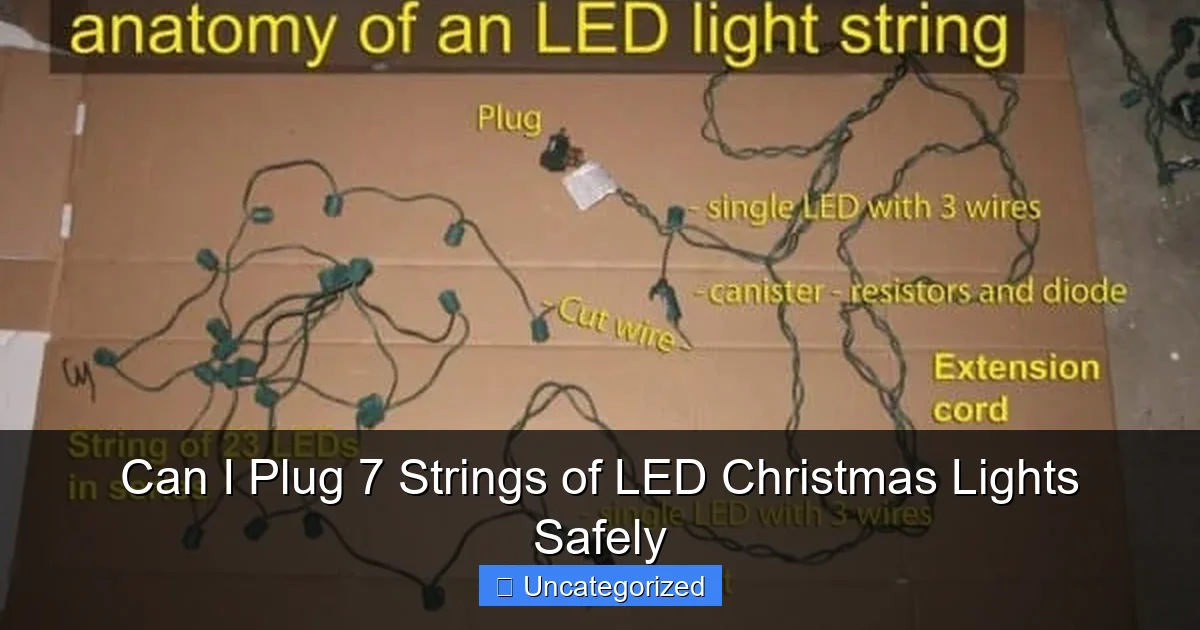
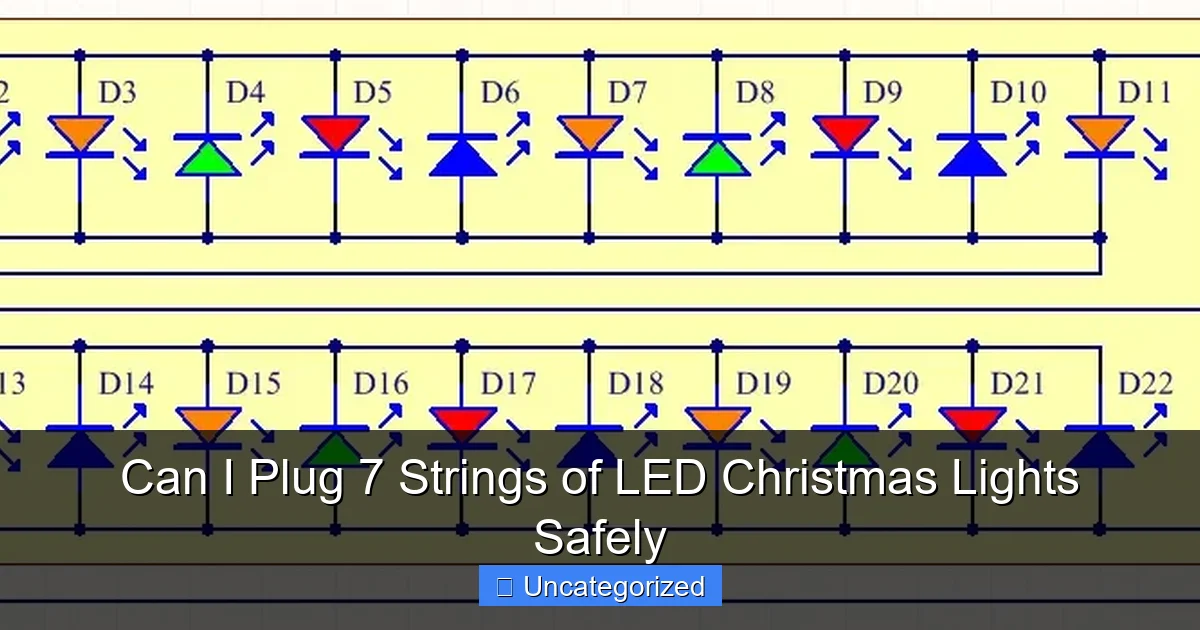
- Series-wired strings: All bulbs are connected in a single circuit. If one bulb fails, the whole string may go out (though newer “shunted” LEDs prevent this).
- Parallel-wired strings: Multiple circuits run in parallel. These are less common but allow for more stable operation and longer chains.
- End-to-end connectors: Most LED sets have male and female plugs that snap together. Some have “stackable” male plugs that allow daisy-chaining.
- Plug-in adapters: Some sets use a central adapter with multiple outlets, allowing you to plug in several strings without daisy-chaining.
Understanding your light type helps you plan your layout and avoid overloading the system. For example, if your 7 strings are all end-to-end connected, ensure they’re within the manufacturer’s limit. If they’re connected via a power strip, the calculation changes (more on that later).
Calculating Total Power Draw: The Math Behind 7 Strings
Now, let’s dive into the core question: Can you safely plug in 7 strings of LED Christmas lights? The answer depends on the total power draw and your home’s electrical capacity. Let’s break it down with real-world examples.
Visual guide about can i plug 7 strings of led christmas lights
Image source: i5.walmartimages.com
Step 1: Determine the Wattage of One String
Check the UL tag or packaging. For this example, let’s assume you have a standard 100-bulb LED string drawing 6 watts. Some brands may vary, so always verify:
- Brand A: 5.8 watts
- Brand B: 6.2 watts
- Brand C (mini lights): 4.5 watts
Using the 6-watt baseline, 7 strings would draw: 7 × 6 = 42 watts.
Step 2: Convert to Amperage
Using the formula Amps = Watts / Volts:
42 watts / 120 volts = 0.35 amps.
This is a very low current draw—less than half an amp. For comparison, a single 60-watt incandescent light bulb draws 0.5 amps. Your 7 LED strings are drawing less than that.
Step 3: Compare to Circuit Capacity
Standard household circuits in North America are rated for 15 or 20 amps. A 15-amp circuit can handle up to 1,800 watts (15A × 120V), while a 20-amp circuit can handle 2,400 watts. Even if you’re using a 15-amp circuit, your 42-watt draw is just 2.3% of the total capacity.
However, circuits are rarely dedicated to Christmas lights alone. Consider what else is plugged in:
- Living room: TV (100W), sound system (50W), lamps (60W) → Total: 210W
- Kitchen: Coffee maker (800W), toaster (1,200W) → These are high-draw appliances
- Outdoor outlets: Often on the same circuit as indoor outlets
As a general rule, never exceed 80% of a circuit’s capacity to avoid tripping the breaker. For a 15-amp circuit, that’s 1,440 watts (1,800 × 0.8). Your 42-watt LED draw is well within this limit.
Real-World Example: 7 Strings on a Typical Outlet
Let’s say you’re using 7 strings of 100-bulb LED lights (6W each) on an outdoor GFCI outlet connected to a 15-amp circuit. Here’s the breakdown:
- Total wattage: 42W
- Total amperage: 0.35A
- Circuit capacity: 1,800W (15A)
- 80% safe limit: 1,440W
- Other loads on circuit: Outdoor lights (50W), garage door opener (150W) → Total: 200W
- Remaining capacity: 1,440W – 200W = 1,240W
Conclusion: You can safely plug in 7 strings (42W) with over 1,200 watts to spare. Even if you add 10 more strings (total 17 strings, 102W), you’re still under 10% of the circuit’s capacity.
Electrical Safety: Breakers, Outlets, and GFCI Protection
While the math shows 7 LED strings are safe, electrical safety involves more than just wattage. Proper use of outlets, breakers, and GFCI (Ground Fault Circuit Interrupter) protection is essential to prevent hazards.
Breaker Capacity and Load Management
As mentioned, a 15-amp breaker trips if the load exceeds 1,800 watts. However, breakers are designed to handle temporary surges (like a motor starting). The key is sustained load. To avoid tripping:
- Distribute lights across multiple circuits: Don’t plug all 7 strings into one outlet. Use outlets on different circuits (e.g., one in the living room, one in the garage).
- Use a circuit tester: A simple plug-in tester can tell you which outlets are on the same circuit. Avoid clustering high-draw devices.
- Label breakers: Know which breaker controls which area. This helps you manage load during setup.
Tip: If you’re running a large display (e.g., 20+ strings), consider hiring an electrician to install a dedicated 20-amp circuit for holiday lights.
GFCI Outlets: Critical for Outdoor Use
Outdoor outlets must be GFCI-protected to prevent electrocution in wet conditions. GFCI outlets monitor the current flow and trip if they detect a ground fault (e.g., water in a connection). Key points:
- Always use outdoor-rated LED strings: Indoor lights aren’t waterproof and can fail outdoors.
- Inspect connections
- Test GFCI monthly
When connecting 7 strings outdoors, ensure each connection is dry and protected. If you’re daisy-chaining, use a GFCI-protected power strip or extension cord.
Extension Cords and Power Strips: Safe Use
Using extension cords or power strips to connect multiple strings is common, but safety rules apply:
- Use outdoor-rated cords: Indoor cords lack weatherproofing.
- Check amp/watt ratings: A 16-gauge outdoor extension cord can handle up to 10 amps (1,200W). For 7 strings (42W), even a 20-gauge cord is safe.
- Avoid “daisy-chaining” power strips: Connecting multiple strips together can overload the first strip. Instead, plug strips into separate outlets.
- Use a timer: A mechanical or smart timer turns lights off automatically, reducing fire risk.
Example: Plug 3 strings into one outdoor power strip and 4 into another, each on separate GFCI outlets. This distributes the load and adds redundancy.
Common Mistakes and How to Avoid Them
Even with LED’s efficiency, mistakes can lead to hazards. Here are the top pitfalls and how to avoid them.
Mistake 1: Ignoring Manufacturer Limits
Connecting 7 strings is safe only if each string’s “max connectable” label allows it. For example, if the label says “Connect up to 5 sets,” plugging in 7 could overload the internal wiring. Always check the label. If it says “5 sets,” use a power strip to add the extra strings instead of daisy-chaining.
Mistake 2: Using Damaged or Indoor Lights Outdoors
Cracked bulbs, frayed wires, or indoor-rated strings can fail outdoors. Inspect every string before hanging:
- Look for broken sockets or loose bulbs.
- Check for melted or cracked insulation.
- Ensure the plug has no corrosion.
Replace any damaged strings. For outdoor use, look for the “UL Outdoor” rating on the packaging.
Mistake 3: Overloading a Single Outlet
Even with low-wattage LEDs, plugging 7 strings into one outlet can be risky if the outlet is old or loose. Signs of a bad outlet:
- Warm to the touch
- Sparks when plugging/unplugging
- Loose plug fit
Use a plug-in outlet tester to check for wiring issues. If the outlet is faulty, replace it or use a different one.
Mistake 4: Poor Cable Management
Tangled cords, exposed wires, or lights near water sources (gutters, pools) increase fire and shock risks. Best practices:
- Use clips or hooks to secure cords—don’t staple them.
- Keep connections elevated (e.g., under eaves) to avoid puddles.
- Use zip ties to bundle cords and prevent tripping hazards.
Pro Tip: For trees, wrap lights from the trunk outward, not the branches inward. This prevents tangling and reduces strain on the wiring.
Data Table: Comparing LED Light Configurations
Below is a table to help you calculate the total load for different LED light setups. Use this as a quick reference when planning your display.
| LED String Type | Wattage per String | Amps per String | Max Connectable (UL Label) | 7-Strings Total Watts | 7-Strings Total Amps | Circuit Load (15A) |
|---|---|---|---|---|---|---|
| 100-Bulb Warm White | 6.0W | 0.05A | 21 sets | 42W | 0.35A | 2.3% |
| 50-Bulb Multicolor | 4.5W | 0.0375A | 42 sets | 31.5W | 0.26A | 1.7% |
| Net Lights (5×6 ft) | 8.0W | 0.067A | 10 sets | 56W | 0.47A | 3.1% |
| Mini Icicle Lights | 3.6W | 0.03A | 30 sets | 25.2W | 0.21A | 1.4% |
| LED Rope Lights (16 ft) | 10.0W | 0.083A | 15 sets | 70W | 0.58A | 3.9% |
Note: Circuit load assumes no other devices are plugged in. Always check for additional loads before finalizing your setup.
Conclusion: Safe, Bright, and Festive
So, can you plug 7 strings of LED Christmas lights safely? The answer is a resounding yes—as long as you follow the guidelines. LED technology has revolutionized holiday lighting, offering energy efficiency, longer lifespans, and the ability to connect multiple strings without overwhelming your home’s electrical system. With 7 strings typically drawing less than 0.5 amps (42–70 watts), you’re using a tiny fraction of your circuit’s capacity.
However, safety isn’t just about numbers. It’s about respecting manufacturer limits, using proper outdoor-rated equipment, distributing loads across circuits, and ensuring all connections are dry and secure. By avoiding common mistakes—like daisy-chaining beyond the UL label or using damaged cords—you can create a dazzling display that’s as safe as it is beautiful.
Remember, the goal is to celebrate the season without risking a fire, tripped breaker, or GFCI outage. Use this guide to plan your layout, calculate your loads, and enjoy a holiday that’s bright in every sense of the word. Whether you’re lighting up your porch, wrapping your trees, or creating a rooftop wonderland, 7 strings of LED lights are more than just possible—they’re a safe and joyful choice for the holidays. So go ahead, plug them in, and let the festivities begin!
Frequently Asked Questions
Can I plug 7 strings of LED Christmas lights into one outlet safely?
Yes, you can plug 7 strings of LED Christmas lights into one outlet if the total wattage stays within the circuit’s limit (typically 15–20 amps for most homes). LED lights use significantly less power than incandescent ones, so 7 strings are often safe—just verify the wattage of each set and add them up.
How do I know if my LED Christmas lights are safe to connect in a chain?
Check the manufacturer’s label on each string for a “max connectable” number (e.g., “connect up to 25 sets”). LED Christmas lights are designed to be linked, but never exceed the specified limit to avoid overheating or tripping breakers.
Is there a risk of overloading a circuit with 7 strings of LED lights?
Generally, no—7 strings of LED lights consume far less power than traditional incandescent sets. However, always calculate the total amperage (wattage ÷ voltage) and ensure it stays under 80% of your circuit’s capacity (e.g., 12 amps on a 15-amp circuit).
What’s the safest way to plug in multiple LED Christmas lights?
Use a UL-listed power strip with overload protection and distribute lights across multiple outlets if possible. For 7 strings of LED Christmas lights, daisy-chaining is safe as long as you follow the manufacturer’s guidelines and avoid mixing old and new sets.
Can I plug LED and incandescent Christmas lights together?
No, avoid mixing LED and incandescent strings. LEDs draw less power, so combining them can overload the incandescent sets or trip the circuit. Stick to one type for consistent voltage and safety.
Do LED Christmas lights generate less heat when connected in series?
Yes, LED Christmas lights produce minimal heat compared to incandescent bulbs, even when linked in long chains. This makes them safer for extended use, but always ensure proper ventilation and avoid covering them with flammable materials.