Featured image for hang outdoor string lights from fence posts
Image source: cdn.shopify.com
Hanging outdoor string lights from fence posts is effortless with the right hardware and spacing—use durable hooks or eye screws anchored securely into each post for a stable, professional look. Maintain even tension and consistent height by measuring intervals and using a guide wire if needed, ensuring a clean, polished display that enhances your outdoor space.
Key Takeaways
- Plan spacing: Measure and mark equal distances between fence posts for balanced lighting.
- Use proper hardware: Install eye hooks or cup hooks for secure, lasting attachment.
- Check wire tension: Keep lights taut to prevent sagging and weather damage.
- Weatherproof connections: Seal plugs with silicone to protect against moisture and rain.
- Anchor end points: Reinforce first and last hooks to bear the weight of the strand.
- Test before finalizing: Turn on lights to check alignment and brightness before securing.
📑 Table of Contents
- Why Hanging String Lights on Fence Posts Is the Ultimate Outdoor Upgrade
- Choosing the Right String Lights for Your Fence
- Planning Your Layout: Design Tips for a Balanced Look
- Tools and Materials You’ll Need (Plus a Few Clever Hacks)
- Step-by-Step Installation: A Foolproof Process
- Maintenance and Troubleshooting: Keeping Your Lights Glowing
- Data Table: Comparing Fence Light Installation Methods
- Final Thoughts: Your Perfect Outdoor Oasis Awaits
Why Hanging String Lights on Fence Posts Is the Ultimate Outdoor Upgrade
Imagine this: a warm summer evening, the sun dipping below the horizon, and your backyard bathed in a soft, golden glow from delicate string lights swaying gently in the breeze. It’s not just a scene from a movie—it’s a transformation you can easily create by hanging outdoor string lights from fence posts. Whether you’re hosting a backyard BBQ, enjoying a quiet night with a book, or simply want to make your outdoor space feel cozier, string lights can elevate your fence line from ordinary to magical.
But here’s the catch: it’s not as simple as just draping lights over your fence. Done poorly, they can look messy, sag too much, or even fall during the first gust of wind. I learned this the hard way after my first attempt left me with tangled wires and a lopsided display. After years of trial, error, and a few late-night fixes (with a headlamp and a ladder, no less), I’ve figured out the secrets to a flawless, long-lasting setup. This guide will walk you through every step—from choosing the right lights to securing them properly—so you can hang your outdoor string lights from fence posts perfectly, no stress involved.
Choosing the Right String Lights for Your Fence
Types of String Lights: LED vs. Incandescent
Before you even touch a screwdriver, the first decision is which string lights to buy. The two main options are LED and incandescent, and each has its pros and cons.
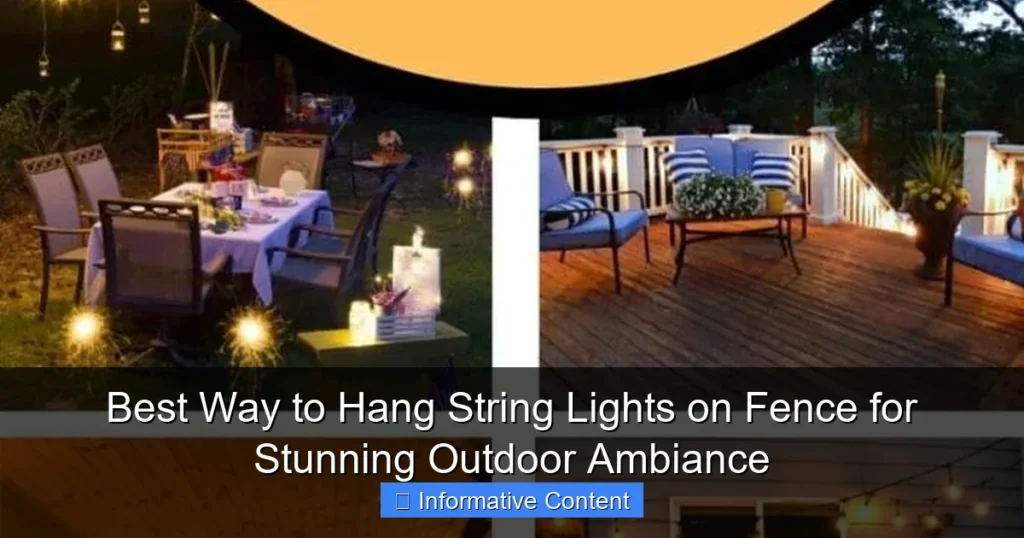
Visual guide about hang outdoor string lights from fence posts
Image source: i.pinimg.com
- LED string lights: These are the modern favorite. They’re energy-efficient, last up to 50,000 hours (that’s years!), and stay cool to the touch. Perfect for leaving on all night. They also come in warm white, cool white, multicolor, and even smart bulbs that you can control with an app. The only downside? They can be pricier upfront, but you’ll save on electricity and replacements in the long run.
- Incandescent string lights: These give off that classic, warm glow you might associate with holiday lights. They’re cheaper upfront but burn out faster, get hot, and use more energy. Not ideal if you plan to leave them on for hours.
My tip: Go with LED for year-round use. I switched to LED after burning out three incandescent strands in one season. The difference in longevity and safety is night and day.
Weatherproof and Outdoor-Rated Lights
Not all string lights are made for the outdoors. Look for labels that say “weatherproof” or “outdoor-rated”—this means the bulbs and wiring are sealed to handle rain, humidity, and UV rays. I once used indoor lights on my fence, and within a month, half the bulbs were dead from moisture. Lesson learned.
- Check the IP rating: An IP44 rating or higher is good for outdoor use. IP65 is even better for areas with heavy rain.
- Plug type: Use outdoor-rated plugs or GFCI-protected outlets to prevent electrical hazards.
Length, Spacing, and Bulb Style
Measure your fence line first—don’t guess! Most string lights come in 25, 50, or 100-foot lengths. If your fence is 60 feet, for example, a 50-foot strand might leave gaps, but you can use two 25-foot strands connected (with a compatible connector). Here’s what else to consider:
- Bulb spacing: Closer bulbs (every 6 inches) create a dense, festive look; wider spacing (every 12-18 inches) feels more subtle and modern.
- Bulb style: Globe bulbs give a classic look, Edison-style bulbs add a vintage vibe, and fairy lights offer a delicate, twinkling effect.
- Connectability: Some lights let you daisy-chain multiple strands. Great for long fences, but don’t exceed the manufacturer’s recommended limit (usually 3-5 strands).
Real example: I have a 40-foot fence. I used two 25-foot LED strands (with a 5-foot overlap at the corner), spaced bulbs 12 inches apart. It’s bright enough to see by but not blinding.
Planning Your Layout: Design Tips for a Balanced Look
Measuring and Marking Your Fence
Grab a tape measure and walk your fence. Mark key points where you’ll attach lights—corners, posts, and any mid-fence support. I use painter’s tape to mark spots temporarily. This helps me visualize the layout before committing to screws or hooks.
Visual guide about hang outdoor string lights from fence posts
Image source: marathonhandbook.com
- Spacing for hooks: For a straight line, place attachment points every 2-3 feet. If your fence has uneven posts, adjust spacing to maintain even tension.
- Height: Hang lights 7-8 feet off the ground for a balanced look. Too low, and they’ll get in the way; too high, and they’ll feel disconnected.
Creating Visual Interest: Curves, Swags, and Patterns
Don’t just run lights straight across! A little creativity makes your setup stand out. Try:
- Swags: Let the lights dip slightly between posts (about 6-12 inches). This adds movement and softness. I use zip ties to create small loops at each post, giving the lights a gentle curve.
- Zigzag or crisscross: For a playful look, run lights diagonally across your fence. Works great on square or rectangular patios.
- Layered heights: Hang two strands at different heights (e.g., one at 7 feet, one at 8 feet) for depth. I did this on my back fence, and it looks like a professional installation.
Pro tip: Use a laser level or string line to keep your layout straight. Nothing ruins a good design like a crooked strand!
Avoiding Common Layout Mistakes
- Sagging lights: Too much slack? Lights will droop and look messy. Pull them taut, but not so tight they strain the wiring.
- Uneven spacing: If posts are irregular, adjust hook spacing to keep the lights visually balanced. For example, on a 10-foot gap between posts, add a hook in the middle.
- Overcrowding: Too many strands or bulbs can look chaotic. Stick to 1-2 strands for most fences unless you’re going for a dramatic effect.
Tools and Materials You’ll Need (Plus a Few Clever Hacks)
Essential Hardware for Fence Attachment
You don’t need fancy tools—just a few basics. Here’s my go-to kit:
- Fence hooks or clips: Use vinyl-coated hooks (for wood/metal fences) or S-hooks (for chain-link). I prefer outdoor-rated screw hooks—they’re sturdy and won’t rust.
- Zip ties: Great for temporary setups or securing loose ends. Use UV-resistant ties to prevent brittleness.
- Drill and screwdriver: For installing hooks. A cordless drill saves time.
- Measuring tape and level: To keep things aligned.
- Ladder: A sturdy one—safety first!
Smart Hacks for Tricky Fences
Not all fences are easy to work with. Here’s how to handle common challenges:
- Chain-link fences: Use S-hooks or zip ties to attach lights to the wire mesh. I loop the S-hook through the mesh and clip the light strand onto it.
- Wooden fences with no posts: If your fence is a solid panel, attach hooks to the top rail or use adhesive clips (for lighter strands).
- Metal fences: Avoid drilling into thin metal. Use magnetic hooks or heavy-duty zip ties instead.
- Uneven terrain: If your fence is on a slope, adjust hook height to keep lights level. I use a step ladder on one side to reach higher points.
Power Solutions: Outlets, Extensions, and Timers
You’ll need power nearby. Here’s how to handle it:
- Outdoor outlets: Use a GFCI-protected outlet. If you don’t have one, hire an electrician to install it.
- Extension cords: Use outdoor-rated cords with a gauge of 16 or lower (thicker wire = less voltage drop). Avoid daisy-chaining cords—it’s a fire hazard.
- Timers or smart plugs: Set your lights to turn on at dusk and off at midnight. Saves energy and gives your space a “magical” automatic glow. I use a Wi-Fi smart plug—I can control it from my phone!
Real example: My fence is 10 feet from the house. I ran a 12-gauge outdoor extension cord through a conduit to protect it from weather. No tripping hazards!
Step-by-Step Installation: A Foolproof Process
Step 1: Install Attachment Points
Start by screwing hooks into your fence posts at the marked spots. Use a drill with a pilot hole to prevent wood from splitting. For metal or vinyl, use self-tapping screws.
- Wooden posts: Pre-drill holes, then screw in hooks. Space them 2-3 feet apart.
- Metal posts: Use self-tapping screws or magnetic hooks.
- Chain-link: Clip S-hooks onto the mesh every 2-3 feet.
Tip: Wear work gloves—splinters are no fun!
Step 2: Hang the Lights
Unroll your lights and test them indoors first. Once confirmed they work, start hanging:
- Attach one end of the strand to the first hook.
- Walk the strand along the fence, clipping it to each hook as you go.
- For swags, let the lights dip slightly before securing to the next hook.
- At corners, loop the strand around the post or use an extra hook to guide it.
My trick: I use a helper to hold the strand taut while I clip it. It’s faster and keeps tension even.
Step 3: Secure Loose Ends and Cords
After hanging, secure any loose cords with zip ties or hooks. Tuck the plug end into a covered outlet box or use a weatherproof cord cover.
- Zip ties: Cut off excess to keep things neat.
- Cord clips: Use adhesive clips to hide cords along the fence line.
Step 4: Test and Adjust
Plug in the lights and check for:
- Even tension: No sagging or pulling.
- Proper spacing: Lights look balanced, not crowded.
- Functionality: All bulbs work. Replace any dead ones.
Real example: On my first try, I had a 3-foot sag between two posts. I added an extra hook in the middle—problem solved!
Maintenance and Troubleshooting: Keeping Your Lights Glowing
Seasonal Care for Longevity
To keep your lights shining for years:
- Winter: In harsh climates, take down lights and store them in a dry place. If left up, use weatherproof covers for plugs and bulbs.
- Spring/Summer: Check for loose hooks, frayed cords, or dead bulbs. Replace as needed.
- Fall: Clean dust and debris with a soft cloth. Store in a labeled bin to avoid tangles.
My routine: I do a quick inspection every season. Last winter, I found a squirrel chewed through a cord—luckily, I caught it early!
Dealing with Common Issues
- Flickering lights: Check for loose bulbs or frayed wires. Tighten bulbs and replace damaged strands.
- Water damage: If bulbs fog up, dry them with a hairdryer on low heat. For severe damage, replace the strand.
- Hook corrosion: Use stainless steel or vinyl-coated hooks to prevent rust.
- Cord tangles: Store lights on a reel or cardboard template to avoid knots.
When to Replace vs. Repair
Most LED strands last 5-10 years. If more than 20% of bulbs are dead or the wiring is damaged, it’s time to replace. For minor fixes (e.g., a single dead bulb), use a bulb tester to identify the issue and replace just that bulb.
Data Table: Comparing Fence Light Installation Methods
| Method | Best For | Cost | Durability | Ease of Use | Notes |
|---|---|---|---|---|---|
| Screw Hooks | Wooden/metal fences | $5-$20 | ★★★★★ | ★★★☆☆ | Most secure; requires drilling |
| Zip Ties | Chain-link, temporary setups | $3-$10 | ★★★☆☆ | ★★★★★ | Quick but less durable; use UV-resistant ties |
| S-Hooks | Chain-link | $5-$15 | ★★★★☆ | ★★★★☆ | No tools needed; easy to adjust |
| Adhesive Clips | Smooth surfaces (vinyl, glass) | $8-$20 | ★★☆☆☆ | ★★★★★ | Good for short-term; may fail in heat |
| Magnetic Hooks | Metal fences | $10-$25 | ★★★★☆ | ★★★★☆ | No drilling; strong hold |
Final Thoughts: Your Perfect Outdoor Oasis Awaits
Hanging outdoor string lights from fence posts isn’t just about adding light—it’s about creating an atmosphere. A place where laughter lingers, conversations flow, and the ordinary becomes extraordinary. With the right lights, a thoughtful layout, and a few clever tricks, you can turn your fence into a glowing frame for your outdoor memories.
Remember, perfection isn’t about flawless execution—it’s about enjoying the process. My first attempt wasn’t Pinterest-worthy, but it made my backyard feel like home. Now, years later, I still smile every time I flip the switch. So grab your tools, trust your instincts, and let those lights shine. Your perfect outdoor oasis isn’t just possible—it’s within reach.
Frequently Asked Questions
How do I hang outdoor string lights from fence posts without damaging them?
Use removable hooks, zip ties, or specialized fence clips designed for outdoor use. These methods securely hold string lights while preventing damage to the wood or metal of your fence posts.
What’s the best way to hang outdoor string lights evenly across uneven fence posts?
Measure and mark consistent heights on each fence post with a level, then use adjustable hooks or turnbuckles to fine-tune tension. This ensures your lights hang uniformly, even on slightly uneven surfaces.
Can I hang string lights from fence posts without drilling holes?
Yes! Use adhesive-backed hooks, magnetic clips, or heavy-duty zip ties to attach lights without drilling. These options work well for temporary or seasonal setups and protect your fence.
How far apart should I space fence posts for outdoor string lights?
For standard string lights, space fence posts 6–10 feet apart to avoid sagging. If your lights are heavier or span longer distances, use additional posts or support wires for stability.
What type of hardware is best for hanging outdoor string lights from metal fence posts?
Magnetic hooks, stainless steel clips, or vinyl-coated S-hooks work best for metal posts. These resist rust and grip securely without scratching the finish of your fence.
How do I hide the wires when I hang outdoor string lights from fence posts?
Route cords along the fence line using cable clips or conduit covers, and tuck excess wire behind planters or landscaping. This keeps the setup tidy and minimizes tripping hazards.