Featured image for do led string lights use a lot of electicity
Image source: s3.amazonaws.com
LED string lights are extremely energy-efficient and use up to 80–90% less electricity than traditional incandescent lights. On average, a standard 20-foot LED strand draws only 10–20 watts, costing just pennies per night to operate—making them a budget- and eco-friendly choice for year-round ambiance.
Key Takeaways
- LED string lights are energy-efficient: Use up to 80% less electricity than incandescent bulbs.
- Lower wattage equals savings: Most LED strings use only 2–10 watts per strand.
- Smart timers cut waste: Automate on/off cycles to avoid unnecessary usage.
- Long-term cost is low: Minimal impact on bills even with nightly use.
- Check lumens, not watts: Higher lumens mean brighter lights at lower energy use.
- Use solar-powered options: Eliminate grid electricity use with outdoor solar LED strings.
📑 Table of Contents
- Do LED String Lights Use a Lot of Electricity? Find Out Here
- How LED String Lights Work and Their Energy Efficiency
- Comparing LED String Lights to Other Lighting Options
- Factors That Influence LED String Light Electricity Use
- Calculating the True Cost of LED String Lights
- Smart Ways to Reduce Electricity Use (Without Losing the Glow)
- Conclusion: LED String Lights Are a Low-Energy Lighting Solution
Do LED String Lights Use a Lot of Electricity? Find Out Here
Imagine transforming your outdoor patio, bedroom, or holiday decorations into a magical, twinkling wonderland with just a flick of a switch. LED string lights have become a go-to choice for homeowners, event planners, and DIY decorators, offering a blend of beauty, versatility, and energy efficiency. But with rising electricity costs and growing environmental concerns, a critical question arises: Do LED string lights use a lot of electricity? The short answer is no—but the full picture is far more nuanced, and understanding it can help you save money, reduce your carbon footprint, and make smarter lighting choices.
Unlike traditional incandescent or fluorescent lights, LED (Light Emitting Diode) technology has revolutionized the way we think about lighting. These tiny, semiconductor-based bulbs are not only brighter and more durable but also significantly more energy-efficient. However, the total electricity consumption of LED string lights depends on several factors: the number of bulbs, wattage per bulb, hours of use, and even the color or type of LED. In this comprehensive guide, we’ll dive deep into how LED string lights consume electricity, compare them to other lighting options, and provide practical tips to maximize efficiency. Whether you’re stringing lights for a cozy evening ambiance or decking the halls for the holidays, you’ll learn how to enjoy the glow without worrying about your energy bill.
How LED String Lights Work and Their Energy Efficiency
The Science Behind LED Technology
LED string lights operate on a fundamentally different principle than traditional lighting. Instead of heating a filament (incandescent) or exciting gas (fluorescent), LEDs use semiconductor materials that emit light when an electric current passes through them. This process, known as electroluminescence, is highly efficient because it converts nearly 80-90% of electrical energy into light, with minimal heat loss. In contrast, incandescent bulbs waste about 90% of energy as heat, making LEDs a clear winner in energy conversion.
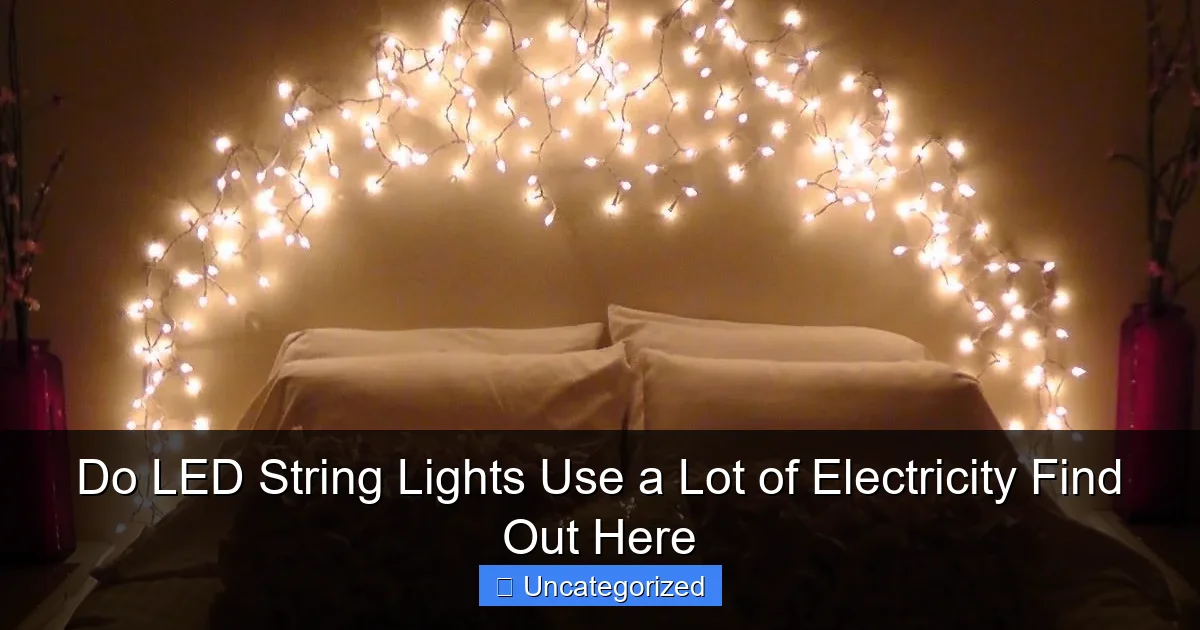
Visual guide about do led string lights use a lot of electicity
Image source: warisanlighting.com
Wattage and Lumens: Understanding the Metrics
When evaluating electricity use, two key metrics matter: wattage (power consumption) and lumens (brightness). LED string lights typically range from 0.05 watts to 0.5 watts per bulb, depending on size and color. For example:
- A standard 100-bulb warm white LED string uses about 4-6 watts total.
- The same 100-bulb incandescent string uses 40-60 watts—up to 10 times more!
- RGB (color-changing) LEDs may use slightly more power (up to 0.7 watts per bulb) due to additional circuitry.
Despite lower wattage, LEDs often produce the same or brighter light (measured in lumens) as incandescent bulbs. A 5-watt LED string can emit 200-400 lumens, equivalent to a 25-40-watt incandescent. This efficiency stems from advanced phosphor coatings and lens designs that focus light more effectively.
Real-World Example: Holiday Lighting
Let’s say you hang 500 LED string lights for Christmas, each using 0.06 watts. Total power = 30 watts. If left on 6 hours nightly for 30 days:
- Total energy use: 30 watts × 6 hours × 30 days = 5,400 watt-hours (5.4 kWh).
- Cost (at $0.12/kWh): 5.4 kWh × $0.12 = $0.65.
Compare this to 500 incandescent mini-lights (0.5 watts each): 150 watts total, costing $32.40 for the same period—a 98% savings with LEDs!
Comparing LED String Lights to Other Lighting Options
LED vs. Incandescent: The Energy Gap
The difference in energy use between LEDs and incandescent string lights is staggering. Here’s a breakdown for a typical 100-bulb setup:
Visual guide about do led string lights use a lot of electicity
Image source: lightdot.com
| Light Type | Wattage per Bulb | Total Watts (100 bulbs) | Annual Cost (6hrs/day, $0.12/kWh) | Lifespan (Hours) |
|---|---|---|---|---|
| LED | 0.06W | 6W | $4.38 | 25,000 |
| Incandescent | 0.5W | 50W | $36.50 | 3,000 |
Key takeaways:
- Energy savings: LEDs use 88% less power.
- Cost savings: $32.12/year per string.
- Lifespan: LEDs last 8+ years vs. incandescent’s 1 year.
This gap widens with larger installations. For a 1,000-bulb outdoor display, LEDs save over $300 annually.
LED vs. CFL and Neon: Where LEDs Shine
Compact Fluorescent (CFL) string lights are rare but occasionally used. While CFLs are 75% more efficient than incandescent, they still lag behind LEDs:
- CFLs use 1-2 watts per bulb (vs. 0.05-0.5 watts for LEDs).
- CFLs contain mercury, making disposal hazardous.
- LEDs turn on instantly; CFLs require warm-up time.
Neon string lights (popular for retro decor) are even less efficient, consuming 20-40 watts per linear foot—making LEDs 5-10x more efficient for the same brightness.
Color Matters: White vs. RGB LEDs
White LEDs are generally more efficient than RGB (color-changing) models. For example:
- A warm white LED: 0.06 watts, 30 lumens.
- An RGB LED (showing red): 0.08 watts, 25 lumens (red light requires less energy to appear bright).
- An RGB LED (showing blue): 0.1 watts, 20 lumens (blue LEDs are less efficient due to semiconductor physics).
For maximum efficiency, use dedicated single-color LEDs (e.g., warm white, red) instead of RGB strings when color-changing isn’t necessary.
Factors That Influence LED String Light Electricity Use
Bulb Density and String Length
The total wattage of a string light depends on how many bulbs it contains. Here’s a quick reference:
| String Length | Bulb Count | Avg. Wattage (White LED) | Avg. Wattage (RGB LED) |
|---|---|---|---|
| 5 ft | 10 | 0.6W | 0.8W |
| 10 ft | 20 | 1.2W | 1.6W |
| 20 ft | 50 | 3W | 4W |
| 33 ft | 100 | 6W | 8W |
| 66 ft | 200 | 12W | 16W |
Pro tip: For large installations, calculate total wattage by adding the wattage of each string. A 500-bulb display (5 strings of 100 bulbs) = 30 watts total (white LEDs).
Usage Duration and Patterns
Electricity use scales directly with usage time. Smart usage habits can drastically reduce consumption:
- Timers: Use dusk-to-dawn or 6-hour timers to avoid overnight use.
- Motion sensors: Ideal for security lighting; activates only when needed.
- Smart plugs: Schedule lights via apps (e.g., “Turn off at 11 PM”).
Example: Reducing daily use from 8 hours to 4 hours cuts energy use by 50%.
Voltage and Driver Efficiency
Most LED strings use 120V (U.S.) or 230V (EU) AC power, converted to low-voltage DC (typically 12V or 24V) via an internal driver. Driver efficiency varies by quality:
- Premium drivers: 90-95% efficient (5-10% power loss).
- Low-cost drivers: 70-80% efficient (20-30% power loss).
Look for strings with Energy Star or UL certification to ensure efficient drivers.
Environmental and Temperature Factors
LEDs perform best in cool environments. High temperatures (e.g., enclosed fixtures, direct sunlight) can reduce efficiency by 10-20%. For outdoor use:
- Choose IP65-rated (weatherproof) strings.
- Avoid covering lights with insulation or fabric.
- Install in shaded areas to prevent overheating.
Calculating the True Cost of LED String Lights
Step-by-Step Cost Calculation
Follow these steps to estimate your LED string lights’ electricity cost:
- Find total wattage: Check the product label or calculate (bulbs × wattage per bulb).
- Determine daily hours: e.g., 5 hours/night.
- Calculate daily kWh: (Total watts × hours) ÷ 1,000.
- Multiply by 30 for monthly cost: Daily kWh × 30 × electricity rate ($/kWh).
Example: A 200-bulb white LED string (12 watts) used 6 hours/night at $0.15/kWh:
- Daily kWh: (12 × 6) ÷ 1,000 = 0.072 kWh.
- Monthly cost: 0.072 × 30 × $0.15 = $0.32.
Hidden Costs to Consider
While electricity costs are low, other factors affect long-term value:
- Replacement bulbs: High-quality LEDs rarely need replacement, but cheap strings may fail in 1-2 years.
- Accessories: Timers ($10-20), extension cords ($5-15), and mounting hardware add upfront costs.
- Energy Star certification: Premium strings cost 20-30% more but last 50% longer.
Over 5 years, a $20 Energy Star LED string saves more than a $10 basic model due to longer lifespan and fewer replacements.
Seasonal vs. Year-Round Use
Usage patterns drastically impact annual costs:
- Holiday lighting (30 days): 100-bulb string = $0.65/year.
- Patio lighting (150 days): Same string = $3.25/year.
- Year-round accent lighting (365 days): Same string = $7.88/year.
For year-round use, consider solar-powered LED strings (discussed below).
Smart Ways to Reduce Electricity Use (Without Losing the Glow)
Choose the Right LED Type for the Job
Not all LEDs are created equal. Optimize efficiency by selecting:
- Micro LEDs: 0.05 watts/bulb, ideal for delicate decor.
- 5mm LEDs: 0.06-0.08 watts/bulb, balanced brightness and efficiency.
- C9/C7 LEDs: 0.5-1 watt/bulb, best for large outdoor displays (still 80% more efficient than incandescent).
Avoid “decorative” LEDs with excessive brightness (e.g., 1 watt/bulb) unless needed.
Leverage Smart Controls and Automation
Technology can slash energy use without sacrificing ambiance:
- Smart plugs/timers: Automatically turn off lights during daylight.
- Dimmer switches: Reduce brightness by 50% to save 40% energy (e.g., from 6W to 3.6W).
- Motion sensors: Activate lights only when people are nearby (saves 60-70% energy).
- Voice control: Use Alexa/Google Home to schedule lights (“Turn off at sunrise”).
Explore Solar-Powered Options
Solar LED strings are ideal for off-grid or remote areas. Modern solar models:
- Use high-efficiency 5-10W solar panels.
- Store energy in lithium-ion batteries (last 2-3 years).
- Provide 8-12 hours of light after a full charge.
Cost comparison: A 100-bulb solar string ($25-35) pays for itself in 3-5 years vs. grid-powered strings (assuming 150 nights/year).
Maintain and Optimize Existing Strings
Prolong the life and efficiency of your lights:
- Clean bulbs: Dust reduces light output by 10-20%.
- Store properly: Avoid tangling to prevent wire damage.
- Check for dead bulbs: A single failed bulb in a series string can dim others.
- Upgrade old strings: Replace pre-2015 LEDs with newer, more efficient models.
Conclusion: LED String Lights Are a Low-Energy Lighting Solution
So, do LED string lights use a lot of electricity? The answer is a resounding no—when used thoughtfully. These modern marvels consume up to 90% less energy than incandescent lights, costing mere cents per month even with daily use. Whether you’re illuminating a cozy bedroom, hosting an outdoor party, or creating a festive holiday display, LEDs offer a perfect blend of beauty, durability, and efficiency.
Key takeaways to remember:
- LEDs are 85-90% more efficient than incandescent string lights.
- A typical 100-bulb LED string uses only 4-8 watts—less than a smartphone charger.
- Smart usage habits (timers, dimmers, solar power) can reduce energy use by 50-70%.
- The initial investment pays for itself in 1-2 years through energy savings.
As technology advances, LED efficiency will only improve. Future trends like organic LEDs (OLEDs) and quantum dot LEDs promise even lower power consumption and brighter, more vibrant colors. For now, by choosing quality LED string lights, optimizing usage, and embracing smart controls, you can enjoy a dazzling display without the energy guilt. Light up your world—responsibly and affordably.
Frequently Asked Questions
Do LED string lights use a lot of electricity compared to traditional bulbs?
No, LED string lights are highly energy-efficient and use up to 80-90% less electricity than incandescent or halogen string lights. Their low wattage makes them ideal for long-term use without spiking your energy bill.
How much electricity do LED string lights typically consume?
Most LED string lights use only 1-10 watts per strand, depending on length and bulb count. For context, a 100-bulb LED strand uses about the same energy as a single 60-watt incandescent bulb.
Can leaving LED string lights on all night increase my electricity bill significantly?
Even if left on overnight, LED string lights consume minimal electricity due to their efficiency. Running a 5-watt LED strand for 8 hours costs less than $0.01 per day (based on average U.S. electricity rates).
Are LED string lights cheaper to run than battery-powered ones?
Yes, LED string lights plugged into an outlet are more cost-effective over time. While battery-powered lights avoid electricity use, frequent battery replacements make them pricier and less eco-friendly.
Do LED string lights with timers save more electricity?
Absolutely! Timers or smart plugs ensure your lights turn off automatically, eliminating unnecessary usage. This feature maximizes energy savings, especially for outdoor or holiday displays.
What factors affect how much electricity LED string lights use?
Key factors include bulb count, wattage, usage duration, and additional features (e.g., color-changing modes). Always check the product’s wattage rating to estimate electricity consumption accurately.