Featured image for do led string lights use a lot of electricity
Image source: neonledstrip.com
LED string lights are incredibly energy-efficient and use up to 80–90% less electricity than traditional incandescent bulbs. Thanks to their low wattage and long lifespan, they’re a cost-effective, eco-friendly choice for both indoor and outdoor lighting. You can enjoy festive, ambient lighting without worrying about skyrocketing energy bills.
Key Takeaways
- LEDs use 80-90% less energy than incandescent bulbs, cutting electricity costs.
- Check wattage before buying—lower watts mean lower energy use and bills.
- Use timers or smart plugs to limit runtime and reduce unnecessary consumption.
- Choose ENERGY STAR-rated LEDs for guaranteed efficiency and performance.
- Long-term savings add up—LEDs last years, reducing replacement and energy costs.
- Avoid leaving lights on overnight to maximize efficiency and minimize waste.
📑 Table of Contents
- Do LED String Lights Use a Lot of Electricity? Find Out Here
- How LED String Lights Work and Why They’re Efficient
- Comparing LED String Lights to Incandescent and Other Alternatives
- How Much Electricity Do LED String Lights Actually Use?
- Factors That Influence LED String Light Electricity Consumption
- Practical Tips to Reduce Energy Use with LED String Lights
- Data Table: LED String Light Energy Consumption Comparison
- Conclusion
Do LED String Lights Use a Lot of Electricity? Find Out Here
When it comes to creating a magical atmosphere, few things rival the charm of LED string lights. Whether you’re draping them across a patio for a summer barbecue, wrapping them around a Christmas tree, or using them to add a soft glow to your bedroom, these versatile lights have become a staple in modern home decor. Their popularity has soared in recent years, not just because of their aesthetic appeal, but also due to their energy efficiency and long lifespan. Yet, a common question lingers in the minds of many homeowners and decorators: Do LED string lights use a lot of electricity?
The short answer is no—but the full picture is far more nuanced. While LED string lights are significantly more energy-efficient than their incandescent or fluorescent counterparts, their actual electricity consumption depends on several factors, including wattage, usage duration, bulb count, and even the type of power source. Understanding these variables can help you make informed decisions about how and when to use your lights, ultimately saving you money and reducing your environmental footprint. In this comprehensive guide, we’ll dive deep into the world of LED string lights, explore how they compare to other lighting options, break down their energy consumption, and provide practical tips to help you maximize efficiency without sacrificing ambiance.
How LED String Lights Work and Why They’re Efficient
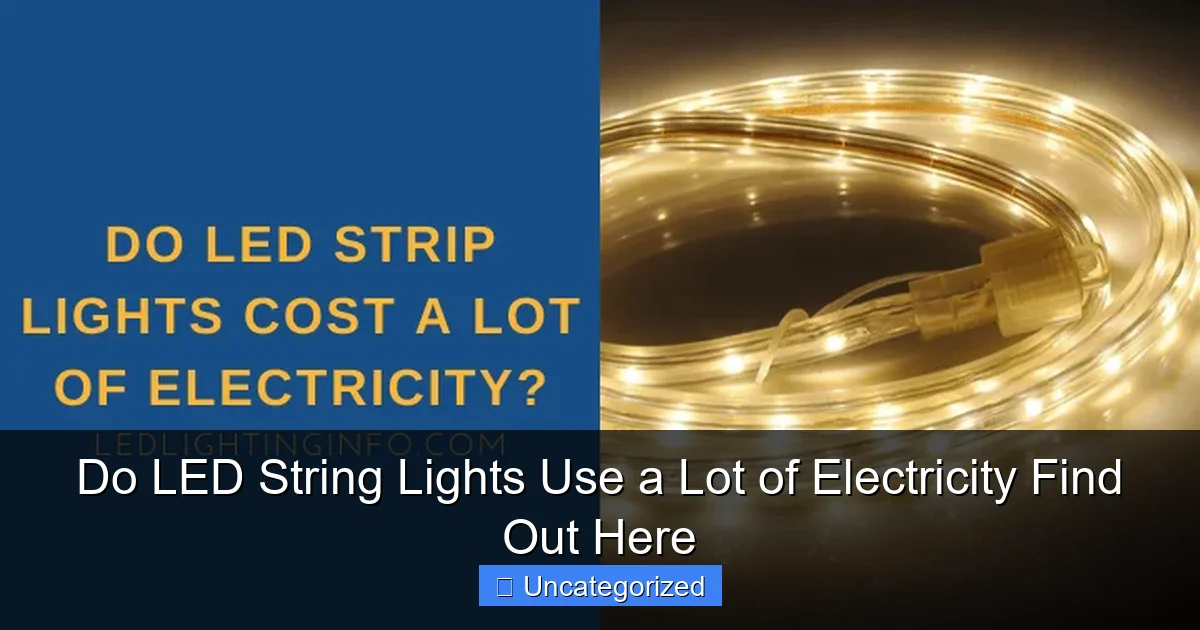
To understand why LED string lights are so energy-efficient, it’s essential to grasp the science behind how they operate. Unlike traditional incandescent bulbs, which generate light by heating a filament until it glows, LEDs (Light Emitting Diodes) produce light through a process called electroluminescence. This means electrons recombine with electron holes within a semiconductor material, releasing energy in the form of photons (light). This method is far more efficient because it converts a much higher percentage of electrical energy into visible light, with minimal energy lost as heat.
Visual guide about do led string lights use a lot of electricity
Image source: ledlightinginfo.com
The Science Behind LED Efficiency
LEDs are inherently more efficient because they emit light in a specific direction, reducing the need for reflectors and diffusers that waste energy. Additionally, they require far less power to produce the same amount of light. For example, a typical 60-watt incandescent bulb can be replaced by an LED bulb using only 8 to 10 watts. In the context of string lights, this efficiency is amplified. A strand of 100 incandescent mini lights might consume around 40 watts, while an equivalent LED string light set uses only 4 to 6 watts—less than one-tenth the energy.
Moreover, LEDs are built with semiconductor technology that allows them to operate at lower voltages and currents, which further reduces energy consumption. They also have a longer lifespan—often rated at 25,000 to 50,000 hours—compared to incandescent bulbs, which typically last 1,000 to 2,000 hours. This longevity means fewer replacements, less waste, and lower long-term costs.
Color Temperature and Efficiency
Another factor contributing to LED efficiency is color temperature. LEDs are available in a range of color temperatures, from warm white (2700K–3000K) to cool white (4000K–6500K), and even RGB (color-changing) options. While the color temperature doesn’t drastically affect energy use, the type of LED chip and phosphor coating can influence efficiency. For instance, warm white LEDs are slightly less efficient than cool white ones due to the phosphor conversion process, but the difference is minimal in real-world applications.
RGB LEDs, which can display multiple colors, are often slightly less efficient than single-color LEDs because they use three separate diodes (red, green, blue) to create different hues. However, advancements in chip design and control systems have narrowed this gap, making even color-changing LED string lights a viable option for energy-conscious users.
Comparing LED String Lights to Incandescent and Other Alternatives
To truly appreciate the energy savings of LED string lights, it’s helpful to compare them to traditional incandescent string lights and other lighting technologies. The differences in energy consumption, heat output, and lifespan are striking—and they have significant implications for your electricity bill and safety.
Visual guide about do led string lights use a lot of electricity
Image source: homestratosphere.com
Energy Consumption: LED vs. Incandescent
Let’s start with the most critical factor: wattage. A standard 100-bulb incandescent mini light string uses approximately 40 watts of power. In contrast, a comparable LED string light with the same number of bulbs consumes only 4 to 6 watts. This means you could run ten LED strings for the same energy cost as one incandescent string. Over a holiday season, where lights might be on for 6 hours a day, this translates to substantial savings.
- Incandescent (100 bulbs): 40 watts × 6 hours × 30 days = 7,200 watt-hours (7.2 kWh)
- LED (100 bulbs): 5 watts × 6 hours × 30 days = 900 watt-hours (0.9 kWh)
Assuming an electricity rate of $0.12 per kWh, the incandescent option would cost $0.86 per month, while the LED version would cost just $0.11—a savings of over 85%.
Heat Output and Safety
Incandescent bulbs generate a significant amount of heat, which can be a fire hazard, especially when used indoors or near flammable materials like curtains or dry trees. LEDs, on the other hand, produce very little heat, making them safer for prolonged use. This reduced heat output also means your home’s cooling system doesn’t have to work as hard to counteract the warmth from the lights, leading to additional indirect energy savings.
Lifespan and Maintenance
Incandescent bulbs typically last 1,000 to 2,000 hours, which means you might need to replace them every year or two. LEDs, with lifespans of 25,000 to 50,000 hours, can last 10 to 20 years under normal use. This not only reduces the frequency of replacements but also lowers the environmental impact associated with manufacturing and disposal. Fewer bulbs in landfills mean a smaller carbon footprint.
Comparison with Other Technologies
While LEDs dominate the market today, it’s worth noting alternatives like fluorescent and halogen string lights. Fluorescent lights are more efficient than incandescents but less so than LEDs and often contain mercury, making disposal hazardous. Halogen lights are slightly more efficient than incandescents but still generate a lot of heat and have shorter lifespans than LEDs. In every category—energy use, safety, lifespan, and environmental impact—LEDs come out on top.
How Much Electricity Do LED String Lights Actually Use?
Now that we’ve established the efficiency of LEDs, let’s answer the core question: How much electricity do LED string lights actually use? The answer depends on several variables, including the number of bulbs, wattage per bulb, usage duration, and whether the lights are connected to a timer or smart plug.
Calculating Energy Use: The Formula
To estimate your LED string lights’ electricity consumption, use this simple formula:
Energy (kWh) = (Wattage × Hours Used Per Day × Days Used) ÷ 1,000
For example, a 5-watt LED string light used for 5 hours a day over 60 days:
(5 watts × 5 hours × 60 days) ÷ 1,000 = 1.5 kWh
At $0.12 per kWh, this would cost just $0.18—less than the price of a cup of coffee.
Real-World Examples
Let’s look at a few practical scenarios:
- Holiday Decor (100-bulb LED string): 5 watts × 6 hours/day × 30 days = 0.9 kWh ($0.11)
- Outdoor Patio (50-bulb LED string): 3 watts × 4 hours/day × 180 days = 2.16 kWh ($0.26)
- Bedroom Ambiance (20-bulb LED string): 2 watts × 3 hours/day × 365 days = 2.19 kWh ($0.26)
Even if you use multiple strands, the total consumption remains remarkably low. For instance, ten 5-watt LED strings used for 6 hours daily over 30 days would consume only 9 kWh ($1.08), compared to 72 kWh ($8.64) for the same setup with incandescent lights.
Smart Features and Energy Savings
Many modern LED string lights come with smart features like timers, motion sensors, or app-based controls. These can further reduce energy use by ensuring lights are only on when needed. For example, a timer that turns lights off at midnight can cut usage by 50% compared to leaving them on all night. Smart plugs or voice-controlled systems (e.g., Alexa, Google Home) allow you to schedule lights remotely, preventing accidental overnight usage.
Factors That Influence LED String Light Electricity Consumption
While LEDs are inherently efficient, several factors can influence their actual electricity consumption. Understanding these variables can help you optimize your setup for maximum savings.
Number of Bulbs
The more bulbs on a string, the higher the total wattage—but not linearly. For example, a 25-bulb LED string might use 2 watts, while a 100-bulb version uses 5 watts. This is because LEDs are often connected in parallel circuits, and manufacturers optimize the power supply to maintain consistent brightness across longer strings.
Wattage and Lumens
Not all LEDs are created equal. A 5-watt LED string might produce 400 lumens, while a 4-watt version could produce 350 lumens. If brightness is a priority, you might opt for a higher-wattage string, but this will increase energy use slightly. Always check the lumens-per-watt ratio to compare efficiency.
Usage Duration
The longer you leave your lights on, the more electricity they consume. However, LEDs’ low wattage means even extended use has a minimal impact. For instance, leaving a 5-watt LED string on 24/7 for a year would consume 43.8 kWh ($5.26)—still far less than a single incandescent bulb used for the same duration (350.4 kWh, $42.05).
Power Source and Voltage
Most LED string lights are designed for standard household voltage (120V in the US), but some use low-voltage systems (e.g., 12V) with a transformer. Low-voltage lights are slightly more efficient because less energy is lost in conversion, but the difference is negligible for most users.
Color-Changing vs. Single-Color
As mentioned earlier, RGB (color-changing) LEDs may use slightly more energy than single-color LEDs due to the need for multiple diodes. However, the difference is usually less than 10%, and many modern RGB LEDs are optimized for efficiency.
Practical Tips to Reduce Energy Use with LED String Lights
Even though LED string lights are already energy-efficient, there are several ways to further reduce their electricity consumption without compromising on ambiance or convenience.
Use Timers and Smart Plugs
Timers are one of the easiest ways to cut energy use. Set your lights to turn off automatically after a few hours, or use a dusk-to-dawn timer so they only come on at night. Smart plugs take this a step further by allowing remote control via smartphone or voice assistant. This prevents lights from being left on accidentally and lets you create custom schedules.
Choose the Right Brightness
Do you really need 100 bulbs for your bedroom? Opt for shorter strings or lower-wattage options where appropriate. For example, a 20-bulb LED string (2 watts) might provide sufficient ambient light for a small room, saving energy compared to a 50-bulb version (3 watts).
Group Lights Strategically
Instead of running multiple long strings, consider grouping shorter strands in key areas. This reduces the total number of bulbs and wattage while still creating a cohesive look. For example, two 25-bulb strings (total 4 watts) can be more effective than one 50-bulb string (3 watts) if placed thoughtfully.
Use Motion Sensors for Outdoor Lights
Outdoor LED string lights can be paired with motion sensors to turn on only when someone is nearby. This is ideal for patios, driveways, or gardens, where lights are often used sporadically. Motion sensors can reduce energy use by up to 70% compared to continuous operation.
Unplug When Not in Use
Even when turned off, some LED strings may draw a tiny amount of “phantom” power. Unplugging them when not in use eliminates this waste. Alternatively, use a power strip with an on/off switch for easy control.
Opt for Solar-Powered Options
For outdoor use, solar-powered LED string lights are an excellent choice. They charge during the day using sunlight and automatically turn on at night, requiring no electricity from the grid. While they may be slightly less bright than wired versions, they’re perfect for eco-conscious users.
Data Table: LED String Light Energy Consumption Comparison
| Light Type | Bulb Count | Wattage | Hours/Day | Days/Month | Monthly kWh | Monthly Cost ($0.12/kWh) |
|---|---|---|---|---|---|---|
| LED | 50 | 3 | 5 | 30 | 0.45 | $0.05 |
| LED | 100 | 5 | 6 | 30 | 0.9 | $0.11 |
| Incandescent | 100 | 40 | 6 | 30 | 7.2 | $0.86 |
| LED (RGB) | 50 | 4 | 4 | 60 | 0.96 | $0.12 |
| LED (Solar) | 30 | 2 | 5 | 30 | 0 (grid-powered) | $0.00 |
Conclusion
So, do LED string lights use a lot of electricity? The resounding answer is no. Thanks to their advanced semiconductor technology, LEDs consume a fraction of the energy used by incandescent or fluorescent lights—often less than 10%. Whether you’re decorating for the holidays, enhancing your outdoor space, or creating a cozy indoor ambiance, LED string lights offer a brilliant combination of beauty, safety, and efficiency.
By understanding the factors that influence energy consumption—such as bulb count, wattage, usage duration, and smart features—you can further optimize your setup for maximum savings. From using timers and motion sensors to choosing solar-powered options, there are countless ways to enjoy stunning lighting without worrying about your electricity bill.
Ultimately, LED string lights are not just a decorative choice—they’re a smart, sustainable investment. They last longer, waste less energy, and reduce your carbon footprint, all while transforming your space into a warm, inviting haven. So go ahead, drape those lights, string those bulbs, and enjoy the glow—knowing you’re making a choice that’s as kind to your wallet as it is to the planet.
Frequently Asked Questions
Do LED string lights use a lot of electricity compared to traditional bulbs?
No, LED string lights are highly energy-efficient and use up to 80-90% less electricity than incandescent or halogen string lights. Their low wattage makes them ideal for long-term use without spiking your energy bill.
How much electricity do LED string lights consume on average?
Most LED string lights consume only 1-10 watts per strand, depending on length and brightness. For context, running 10 strands for 6 hours daily may cost just a few cents per month.
Can leaving LED string lights on all night increase my electricity bill significantly?
Even if left on all night, LED string lights use so little electricity that the cost is minimal—often under $1 per month. Their energy efficiency makes them safer and cheaper for extended use than older lighting types.
Are LED string lights energy-efficient for outdoor holiday displays?
Yes, LED string lights are perfect for holiday displays because they consume far less electricity while offering brighter, longer-lasting illumination. You can connect more strands without overloading circuits or raising costs.
Do solar-powered LED string lights use even less electricity?
Solar-powered LED string lights draw zero electricity from your home grid since they rely on sunlight. They’re the most eco-friendly and cost-effective option, especially for outdoor use.
What’s the best way to reduce electricity usage with LED string lights?
Pair LED string lights with a timer or smart plug to limit usage to specific hours. This further optimizes energy consumption while maintaining ambiance, making their already-low electricity usage even more efficient.