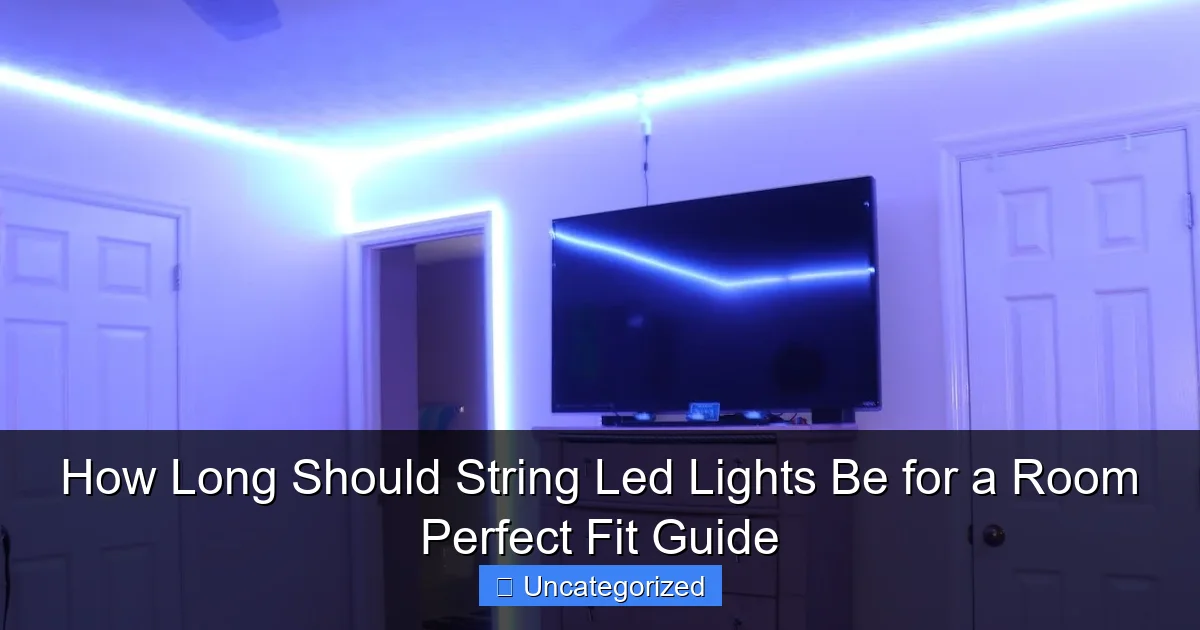
Featured image for how long should string led lights be for a room
Image source: i.ytimg.com
Choose string LED lights that are 1.5 to 2 times the perimeter of your room for a balanced, glowing effect. This ensures even coverage without overcrowding or sparse lighting—ideal for creating ambiance in bedrooms, living rooms, or event spaces. Always measure your space first and opt for adjustable or connectable strands to customize length and layout.
Key Takeaways
- Measure your space first: Always calculate wall or ceiling dimensions before buying string LED lights.
- 1.5x room perimeter: Ideal length is often 1.5x the room’s perimeter for balanced coverage.
- Layer for depth: Use multiple shorter strands to create dimension and avoid overpowering brightness.
- Check plug placement: Ensure lights reach outlets without stretching or leaving awkward gaps.
- Adjustable options win: Choose dimmable or connectable strands for flexible lighting control.
- Highlight focal points: Use extra length to accent mirrors, headboards, or artwork creatively.
📑 Table of Contents
- How Long Should String Led Lights Be for a Room Perfect Fit Guide
- Understanding Room Dimensions and Layout
- Determining the Right Length Based on Purpose
- Choosing the Right Type and Spacing of String Lights
- Installation Tips and Safety Considerations
- Data Table: Recommended String Lengths by Room and Purpose
- Final Thoughts: Creating a Perfectly Lit Space
How Long Should String Led Lights Be for a Room Perfect Fit Guide
String LED lights have become a staple in modern home decor, transforming ordinary spaces into cozy, enchanting environments. Whether you’re draping them around a bedroom headboard, outlining a living room ceiling, or wrapping them around a balcony railing, these versatile lights add a touch of magic and warmth. But one of the most common questions homeowners and renters alike ask is: how long should string LED lights be for a room? The answer isn’t one-size-fits-all. It depends on your room’s dimensions, the desired lighting effect, the placement strategy, and even the type of string lights you choose.
Choosing the right length isn’t just about aesthetics—it’s about functionality, safety, and avoiding the frustration of too-short cords or excessive tangling. A 10-foot strand might be perfect for a small reading nook but woefully inadequate for a 15-foot wall. On the other hand, a 100-foot string might overwhelm a modest bedroom, creating visual clutter and unnecessary energy consumption. In this comprehensive guide, we’ll break down the science, art, and practical considerations behind selecting the perfect length of string LED lights for any room. From measuring techniques to placement ideas and product recommendations, you’ll walk away with the confidence to create a beautifully illuminated space—no guesswork required.
Understanding Room Dimensions and Layout
Measure Your Room Accurately
Before purchasing any string LED lights, the first step is to measure your room thoroughly. This includes not just the floor area but also the perimeter, ceiling height, and any architectural features you plan to highlight. For rectangular or square rooms, calculate the perimeter using the formula: Perimeter = 2 × (Length + Width). For example, a 12-foot by 14-foot room has a perimeter of 52 feet. This number gives you a baseline for how much linear lighting you might need if you’re outlining walls or ceilings.
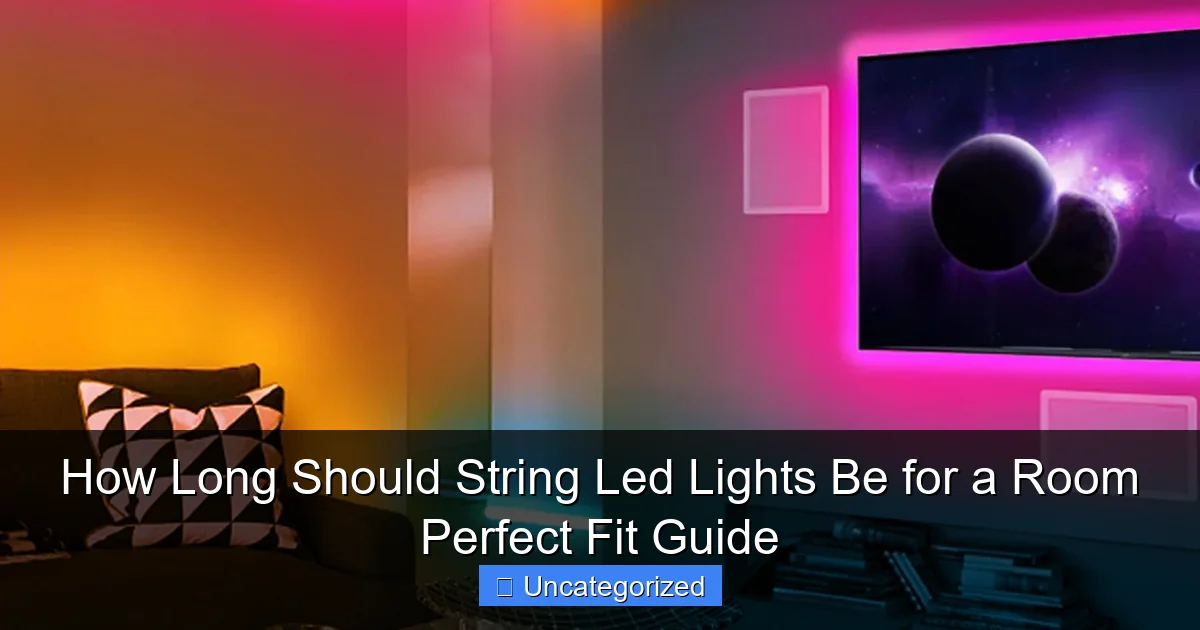
Visual guide about how long should string led lights be for a room
Image source: i5.walmartimages.com
However, don’t stop at the perimeter. Consider vertical elements. If you’re wrapping lights around a headboard, a curtain rod, or a bookshelf, measure those separately. A queen-sized headboard might be 60 inches wide, but if you’re wrapping lights in a spiral pattern, the total length needed could be 1.5 to 2 times that due to the added path length.
Pro tip: Use painter’s tape to simulate the light path on walls or furniture before buying. This gives you a visual of how much coverage you need and helps avoid under- or over-purchasing.
Account for Furniture and Obstructions
Furniture placement dramatically affects lighting needs. A large sectional sofa in the center of a living room may block wall-mounted lights, while a freestanding bookshelf could create a perfect backdrop for a vertical string display. Always measure around or over obstacles. For instance, if you’re planning to drape lights from a ceiling to a bookshelf 6 feet below, you’ll need at least 8–9 feet of string to allow for a gentle arc and connection to a power source.
Also, consider the distance between power outlets and your intended light placement. If your outlet is 10 feet away from the starting point of your lights, you’ll need a string that’s at least that long—or plan for an extension cord (which we’ll discuss later).
Example: In a 10′ x 12′ bedroom with a bed against one wall and a nightstand on each side, you might want to outline the headboard (60″) and run lights down each side of the bed frame (about 75″ each). Total minimum length: 60 + 75 + 75 = 190 inches, or ~16 feet. But to create a cascading effect with loops, you’d likely need a 25-foot string to avoid tight, unnatural bends.
Ceiling Height and Vertical Applications
Ceiling height plays a crucial role, especially if you’re hanging lights from the ceiling to the floor (e.g., in a bedroom canopy, living room corner accent, or bathroom mirror setup). A standard 8-foot ceiling requires at least 8 feet of string for a straight drop. But for a more dramatic, draped effect, add 20–30% extra length. So for an 8-foot drop, aim for 9.6 to 10.4 feet (round up to 10 or 12 feet for safety).
For multi-level rooms—like a loft bedroom or a split-level living area—measure each vertical segment separately. A 12-foot wall in a two-story foyer might need a 15-foot string to account for gentle curves and secure anchoring points.
Determining the Right Length Based on Purpose
Accent Lighting vs. Ambient Lighting
Your lighting purpose directly influences how much string you need. Accent lighting is used to highlight specific areas—like a headboard, artwork, or a plant shelf. Here, shorter, targeted strings work best. For example:
Visual guide about how long should string led lights be for a room
Image source: homebnc.com
- Headboard accent: 10–15 feet for a queen/king bed with side loops
- Wall art highlight: 3–6 feet per piece
- Bookshelf backlighting: 2–3 feet per shelf
In contrast, ambient lighting aims to fill the entire room with a soft glow. This requires longer strings, often spanning the ceiling perimeter or crisscrossing the space. For ambient lighting:
- Small room (10′ x 10′): 30–40 feet total (can be multiple strands)
- Medium room (12′ x 15′): 50–70 feet
- Large room (15′ x 20′): 80–100+ feet
Note: Ambient lighting often uses multiple shorter strands connected via plug-and-play connectors or extension cords to avoid voltage drop and ensure even brightness.
Decorative vs. Functional Use
Are your lights purely decorative (e.g., holiday decor, photo backdrops), or do they serve a functional role (e.g., reading nook lighting, nightlight)? Decorative strings can be shorter and more focused. For example, a 5-foot string behind a TV console adds sparkle without overwhelming the space.
Functional lighting requires more coverage and brightness. A reading nook might need a 10-foot string wrapped around a corner bookshelf and a floor lamp, ensuring the light reaches your book without glare. For a child’s room used as a nightlight, a 15–20 foot string along the ceiling perimeter provides gentle, all-night illumination.
Tip: For functional use, choose warm white (2700K–3000K) LEDs with higher lumens (e.g., 15–20 lumens per bulb) and ensure the string is long enough to reach a nearby outlet without strain.
Specialty Applications: Canopies, Curtains, and More
Creative installations require extra planning:
- Bed canopy: Measure from ceiling to bed frame (e.g., 8 feet), then multiply by 2–3 for a draped, romantic look. A 16-foot string is ideal for a king bed.
- Curtain string lights: Measure the height of the window (e.g., 6 feet) and add 1–2 feet for a slight sag. For a full wall of curtains, use multiple 8-foot strands.
- Staircase wrapping: Measure the rise and run of each step. For a 10-step staircase with 7″ rise and 10″ run, you’d need ~12 feet of string per side.
Always add 10–15% extra length for secure mounting (e.g., using hooks, clips, or adhesive mounts).
Choosing the Right Type and Spacing of String Lights
Bulb Spacing and Density
Not all string lights are created equal. The spacing between bulbs (measured in inches) affects how much coverage you get per foot of string:
- 2″ spacing: 6 bulbs per foot — ideal for bright, continuous glow (e.g., outdoor patios, party backdrops)
- 4″ spacing: 3 bulbs per foot — balanced brightness and visibility (e.g., bedroom headboards, living room accents)
- 6″–8″ spacing: 1–2 bulbs per foot — subtle, twinkling effect (e.g., canopy lights, holiday trees)
Example: A 20-foot string with 4″ spacing has ~60 bulbs, providing even illumination. The same length with 8″ spacing has only ~30 bulbs, creating a sparser, more romantic look. For ambient lighting, denser spacing (2″–4″) is better. For accent lighting, wider spacing (6″–8″) reduces visual clutter.
Bulb Size and Brightness
Bulb size (e.g., mini, globe, Edison) and brightness (measured in lumens) also impact length needs. Larger bulbs (e.g., 1″ diameter) are more visible from a distance, so you can space them further apart or use shorter strings. Mini bulbs (e.g., 0.25″) require more bulbs and longer strings to achieve the same effect.
Brightness matters too. A 50-lumen bulb is brighter than a 20-lumen one. If you’re using low-lumen bulbs (e.g., for a nightlight), you may need a longer string or multiple strands to avoid dark spots.
Rule of thumb: For ambient lighting, aim for at least 15 lumens per square foot. A 120 sq ft room needs ~1,800 lumens total. A 20-foot string with 40 bulbs at 50 lumens each provides 2,000 lumens—perfect for ambient use.
Connectable vs. Non-Connectable Strands
Connectable strings have male/female plugs at each end, allowing you to link multiple strands. This is ideal for long runs (e.g., ceiling outlines) without voltage drop. Most brands limit connections to 2–3 strands (e.g., 50–75 feet total) to prevent overheating.
Non-connectable strings require separate power sources. For large rooms, use extension cords or multi-outlet power strips. Pro tip: Choose strings with built-in fuses and UL certification for safety.
Example: For a 60-foot ceiling perimeter, use two 30-foot connectable strings (if within the brand’s max limit) or three 20-foot non-connectable strings with a 6-outlet power strip.
Installation Tips and Safety Considerations
Measuring for Mounting Hardware
Mounting hardware (e.g., hooks, adhesive clips, nails) adds extra length needs. Each mounting point typically requires 2–4 inches of extra string for secure attachment. For a 20-foot string with 10 mounting points, add 1.5–2 feet to your total length.
Use removable adhesive hooks for renters or delicate walls. For permanent installations, use small nails or picture hooks. Always test the hardware on a small section first.
Power Source and Extension Cords
Never stretch a string light beyond its intended length to reach an outlet—this can cause overheating and fire hazards. Instead:
- Use a heavy-duty extension cord (rated for indoor/outdoor use)
- Choose a cord with a built-in fuse
- Keep cords away from high-traffic areas to prevent tripping
For long runs, consider a plug-in timer or smart plug to automate on/off times and save energy.
Voltage Drop and Brightness Consistency
Long strings (over 50 feet) can experience voltage drop, where bulbs at the end are dimmer than those near the plug. To prevent this:
- Use shorter, connectable strands (e.g., three 20-foot strings)
- Choose LED strings with built-in voltage regulators
- Avoid daisy-chaining more than the manufacturer’s recommended number of strands
Example: A 100-foot string with 100 bulbs may have a 30% brightness drop at the end. Three 33-foot strings provide even illumination.
Data Table: Recommended String Lengths by Room and Purpose
| Room Type | Size (ft) | Primary Purpose | Recommended Length (ft) | Bulb Spacing | Notes |
|---|---|---|---|---|---|
| Bedroom (Queen/King) | 10 x 12 | Headboard Accent | 10–15 | 4″–6″ | Use warm white; add 2 ft for side loops |
| Bedroom (Queen/King) | 10 x 12 | Canopy | 16–20 | 6″–8″ | Drape from ceiling to bed frame |
| Living Room | 12 x 15 | Ambient Ceiling | 50–70 (2–3 strands) | 2″–4″ | Outline perimeter or crisscross |
| Living Room | 12 x 15 | TV Console Backlight | 5–8 | 4″ | Use cool white for contrast |
| Kitchen | 8 x 10 | Under-Cabinet | 15–20 (per cabinet run) | 2″–3″ | Choose waterproof (IP65) LEDs |
| Bathroom | 6 x 8 | Mirror Frame | 8–10 | 4″ | Use IP44-rated lights for moisture resistance |
| Dining Room | 10 x 12 | Chandelier Alternative | 25–30 (hanging cluster) | 6″–8″ | Hang from ceiling hook; add 3 ft for drop |
| Kids’ Room | 9 x 11 | Nightlight | 15–20 (ceiling perimeter) | 4″–6″ | Use soft white (2700K); dimmable |
Final Thoughts: Creating a Perfectly Lit Space
Choosing the right length of string LED lights for a room is both an art and a science. It requires careful measurement, an understanding of your lighting goals, and attention to technical details like bulb spacing, voltage drop, and safety. But the reward is a space that feels warm, inviting, and uniquely yours. Whether you’re creating a cozy bedroom retreat, a vibrant living room for entertaining, or a functional kitchen workspace, the right string lights can elevate your decor and mood.
Remember: start small. Test a 10-foot string in your intended area before committing to a longer purchase. Use painter’s tape to map out the path, and don’t be afraid to mix and match lengths for layered lighting. For large rooms, multiple shorter strands often provide better control and safety than one ultra-long string.
Finally, invest in quality. Look for UL-certified, energy-efficient LEDs with warranties. Brands like Philips Hue, GE, and Twinkle Star offer reliable, connectable options with dimmers and smart controls. With the right length, type, and placement, your string LED lights won’t just illuminate a room—they’ll transform it into a haven of light and comfort. So measure twice, plan creatively, and let your space shine.
Frequently Asked Questions
How long should string LED lights be for a room to cover the ceiling perimeter?
For ceiling perimeter coverage, measure the room’s length and width (in feet) and multiply by 2. A 12- to 24-foot string LED light set works well for most standard rooms (10×12 ft). Always add 10% extra length for draping or slack.
What’s the ideal length of string LED lights for accent lighting a bedroom?
For accent lighting, opt for 10–15 feet of string LED lights to wrap around headboards, windows, or wall art. Shorter lengths (under 10 ft) are better for minimalist decor or smaller spaces like reading nooks.
How do I choose the right string LED lights length for a room with high ceilings?
For high ceilings, select longer strands (30+ ft) or use extension connectors to drape lights vertically along walls or from ceiling corners. Ensure the lights are spaced closely enough (≤12″ apart) to avoid dark gaps.
Can I cut string LED lights to fit my room’s size?
Only cut string LED lights if the product explicitly states they’re “cuttable” (usually with marked cut points). Otherwise, use zip ties or hooks to adjust the layout without damaging the wiring or voiding warranties.
How long should string LED lights be for a room with irregular dimensions?
Map the irregular layout first—measure nooks, alcoves, or furniture placements. A 20–30 ft flexible string LED light set lets you customize placement. Use adhesive clips to secure excess length in curves or corners.
Do longer string LED lights use more energy than shorter ones?
Yes, but the difference is minimal. A 20 ft LED strand uses roughly double the power of a 10 ft set, but energy consumption remains low (often under 10 watts). Opt for energy-efficient LED bulbs to save costs long-term.