Featured image for how many strings of led lights can you connect
Image source: anotherdriver.com
Most standard LED light strings can be safely connected up to 25 strands in a single run, depending on wattage and manufacturer guidelines. Always check the product’s UL rating and total amperage to avoid overloading circuits—safety starts with knowing your lights’ limits.
Key Takeaways
- Check wattage limits: Always verify the manufacturer’s maximum wattage to avoid overloads.
- Use a power meter: Measure actual draw to ensure safe connection of multiple strings.
- Limit daisy-chaining: Connect no more than 3-5 strings unless rated for more.
- Inspect for damage: Damaged wires or bulbs can increase fire risk—replace immediately.
- Distribute evenly: Plug into multiple circuits to prevent tripped breakers.
- Choose LED-rated fuses: Ensure fuses match LED load to prevent overheating.
- Prioritize quality: Invest in commercial-grade lights for longer, safer connections.
📑 Table of Contents
- How Many Strings of LED Lights Can You Connect Safely
- Understanding LED Light Specifications
- Calculating the Safe Limit for LED String Connections
- Safety Risks and How to Avoid Them
- Advanced Techniques for Large Installations
- Real-World Examples and Best Practices
- Data Table: LED String Connection Limits by Type
- Conclusion
How Many Strings of LED Lights Can You Connect Safely
The magic of LED lights has transformed the way we illuminate our homes, offices, and outdoor spaces. Whether you’re decking the halls for the holidays, setting the mood for a romantic dinner, or creating a vibrant atmosphere for a party, LED lights offer versatility, energy efficiency, and a wide range of colors and styles. However, one of the most common questions that arise when working with LED lights—especially when planning large installations—is: How many strings of LED lights can you connect safely?
Connecting multiple LED light strings can create stunning visual effects, but doing so incorrectly can lead to overheating, flickering, or even fire hazards. Understanding the limits of your lighting setup is crucial for both safety and performance. This guide will walk you through the technical aspects, safety considerations, and practical tips for connecting LED lights, whether you’re working with indoor holiday lights, outdoor landscape lighting, or commercial-grade installations. By the end, you’ll have a clear understanding of the maximum number of LED strings you can safely connect, how to avoid common pitfalls, and how to extend your lighting display without compromising safety.
Understanding LED Light Specifications
Voltage and Wattage Basics
Before connecting multiple LED light strings, it’s essential to understand the core specifications: voltage and wattage. Most LED light strings operate at either 120 volts (standard household voltage in North America) or 240 volts (common in other regions). The wattage indicates how much power each string consumes. For example, a typical 100-bulb LED string might use 4.8 watts, while a longer 200-bulb string could use 9.6 watts.
Visual guide about how many strings of led lights can you connect
Image source: iphonelife.com
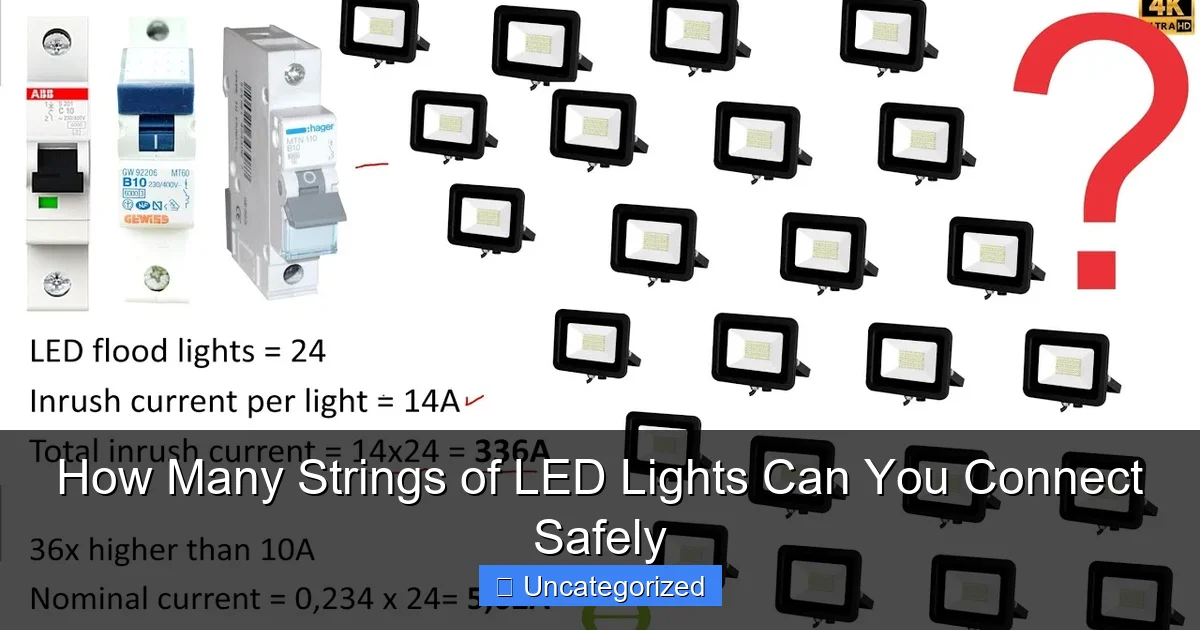
When connecting strings, the total wattage becomes critical. Most household circuits are rated for 15 or 20 amps, which translates to a maximum load of 1,800 watts (15A × 120V) or 2,400 watts (20A × 120V). Exceeding this limit can trip your circuit breaker or, worse, cause overheating in the wiring.
Manufacturer’s Maximum Connection Rating
Every LED light string comes with a maximum number of connectable strings listed on the packaging or in the user manual. This rating is determined by the manufacturer based on the string’s design, internal wiring, and safety testing. For example, a box of holiday LED lights might state: “Up to 25 strings can be connected end-to-end.” This is your safest starting point.
Why does this number vary? Some strings use thicker internal wires, better insulation, or built-in fuses, allowing for more connections. Others, especially cheaper models, may only support 3–5 strings before overheating. Always follow the manufacturer’s guidelines—they’ve tested the product under real-world conditions.
LED vs. Incandescent: Why the Difference Matters
LED lights are far more efficient than incandescent bulbs. A 100-bulb incandescent string might consume 40 watts, while an equivalent LED string uses only 4–6 watts. This efficiency allows you to connect many more LED strings than incandescent ones. For instance, you might safely connect 25 LED strings (totaling ~120 watts) but only 5 incandescent strings (200 watts) before hitting the same power limit.
However, this doesn’t mean you should push LED strings to their absolute limit. LED efficiency also means heat is concentrated in the drivers and connectors, which can degrade over time if overloaded. Always leave a 10–20% power buffer for safety.
Calculating the Safe Limit for LED String Connections
Step-by-Step Power Calculation
To determine how many LED strings you can safely connect, follow these steps:
Visual guide about how many strings of led lights can you connect
Image source: i.ytimg.com
- Check the wattage of a single string (usually printed on the tag or manual).
- Divide your circuit’s maximum wattage by the wattage per string. For example: 1,800W ÷ 4.8W = 375 strings.
- Apply the 80% rule: Never load a circuit beyond 80% of its capacity. So, 375 × 0.8 = 300 strings.
- Compare with the manufacturer’s limit. If the manufacturer says “max 25 strings,” that’s your hard cap—even if the math allows more.
Example: You have 50 LED strings, each using 5 watts. Total load = 250 watts. On a 1,800-watt circuit, 250W is only ~14% of capacity. However, if the manufacturer limits you to 30 strings, you must stop there—even though 50 strings wouldn’t overload the circuit.
Using a Power Strip or Extension Cord
Many people use power strips or extension cords to connect multiple LED strings. Here’s what to consider:
- Amperage rating: Most power strips are rated for 15 amps (1,800W). Never exceed this.
- Wire gauge: Extension cords with 16-gauge wire can handle up to 1,440W; 14-gauge up to 1,800W. Using a thin cord (e.g., 18-gauge) with high-wattage loads risks overheating.
- Length matters: Long extension cords (50+ feet) can cause voltage drop, reducing light brightness and increasing fire risk.
Tip: Use a power distribution block or outdoor-rated outlet box for large installations. These devices split power safely and often include surge protection.
Accounting for Other Appliances
Don’t forget that your circuit powers more than just lights. A typical living room circuit might also run TVs, lamps, and chargers. Add up the wattage of all devices on the same circuit before connecting LED strings. For example:
- LED lights: 200W
- TV: 150W
- Lamp: 60W
- Total: 410W (still under 1,800W, but close to 23% of capacity)
If you plan to add more lights later, consider using a dedicated circuit or splitting loads across multiple outlets on different circuits.
Safety Risks and How to Avoid Them
Overloading and Overheating
Connecting too many LED strings is the #1 cause of lighting-related fires. Overloaded circuits generate excess heat in wires, outlets, and connectors. Signs of overheating include:
- Warm or hot outlets
- Flickering lights
- Burning smell
- Tripped breakers
Prevention: Use a circuit breaker calculator or consult an electrician to verify your circuit’s capacity. For outdoor installations, use GFCI (Ground Fault Circuit Interrupter) outlets to prevent shocks and short circuits.
Using Damaged or Non-Weatherproof Lights
Damaged cords, frayed wires, or cracked insulation can cause shorts, sparks, or fires. This risk increases with outdoor use, where moisture, wind, and temperature fluctuations degrade materials faster.
Safety checklist:
- Inspect strings for damage before connecting.
- Use only outdoor-rated LED lights for exterior installations.
- Replace any string with loose bulbs, exposed wires, or melted plugs.
Daisy-Chaining vs. Using Multiple Power Sources
Daisy-chaining (connecting strings end-to-end) is common but risky if overdone. Instead, use parallel connections with a power distribution hub. This reduces strain on the first string and ensures even power distribution.
Example: Instead of connecting 20 strings in a single line, plug 10 into one outlet and 10 into another. Or use a multi-port LED controller that powers strings independently.
Fire-Resistant Materials and Spacing
LED lights generate heat, even if minimal. Avoid placing strings against flammable materials like curtains, dry foliage, or paper. Maintain at least 6 inches of space around lights, and use UL-listed or ETL-certified products (these meet strict safety standards).
Advanced Techniques for Large Installations
Using LED Controllers and Timers
For large installations (e.g., commercial buildings, holiday displays), LED controllers offer precise power management. These devices:
- Limit total wattage to safe levels.
- Schedule on/off times to reduce circuit load.
- Monitor temperature and shut off if overheating is detected.
Pro tip: Smart LED controllers (e.g., Philips Hue, LIFX) let you manage lights via apps, reducing the need for physical switches and minimizing overload risks.
Splitting Loads Across Multiple Circuits
For installations exceeding 1,500 watts, split lights across multiple circuits. For example:
- Circuit 1: 15 strings (72W) → Living room
- Circuit 2: 15 strings (72W) → Dining room
- Circuit 3: 10 strings (48W) → Outdoor patio
This ensures no single circuit is overloaded. Use a circuit map of your home (usually in the electrical panel) to identify which outlets are on which circuits.
Using Transformers for Low-Voltage Systems
Low-voltage LED lights (12V or 24V) are common in landscape lighting. These use transformers to step down household voltage. Key benefits:
- Lower fire risk (less current).
- Longer string connections (up to 50+ lights per transformer).
- Flexible placement (no need for GFCI outlets).
Calculation: If a 12V transformer is rated for 60 watts, and each LED string uses 5 watts, you can connect up to 12 strings (60W ÷ 5W).
Professional Installation for Commercial Projects
For large-scale projects (e.g., stadiums, malls, festivals), hire a licensed electrician. They can:
- Install dedicated circuits.
- Use commercial-grade LED drivers.
- Perform load testing to ensure safety.
Real-World Examples and Best Practices
Holiday Lighting: A Case Study
Let’s say you’re decorating a 20-foot-tall Christmas tree with 200 LED strings (5 watts each). Total load: 1,000 watts. Here’s how to proceed:
- Check the manufacturer’s limit (e.g., “max 25 strings”).
- Divide 200 strings into 8 groups of 25 (each group = 125W).
- Plug each group into a separate outlet on different circuits.
- Use a timer to turn lights off at midnight, reducing circuit load overnight.
Result: Safe, even power distribution with no risk of overloading.
Landscape Lighting: Pathway and Tree Illumination
For a backyard with 50 LED path lights (2 watts each) and 10 tree lights (10 watts each):
- Total load: (50 × 2W) + (10 × 10W) = 200W.
- Use a 12V transformer rated for 300W (200W + 50% buffer).
- Connect all lights to the transformer using waterproof connectors.
- Install a photocell to turn lights on at dusk automatically.
Commercial Building Facade Lighting
A 10-story building with 500 LED strings (8 watts each) requires:
- Total load: 4,000 watts.
- Dedicated 30-amp circuit (3,600W capacity at 80%).
- LED drivers with thermal cutoffs.
- Monthly inspections for wear and tear.
Data Table: LED String Connection Limits by Type
| LED Type | Typical Wattage per 100 Bulbs | Max Connectable Strings (Manufacturer) | Max Total Wattage (1,800W Circuit) | Recommended Limit (80% Rule) |
|---|---|---|---|---|
| Mini LED (Indoor) | 4.8W | 25 | 375 strings (1,800W) | 25 strings (120W) |
| LED Rope Lights | 10W | 10 | 180 strings (1,800W) | 10 strings (100W) |
| LED Net Lights | 7.2W | 15 | 250 strings (1,800W) | 15 strings (108W) |
| Outdoor LED (Weatherproof) | 6W | 20 | 300 strings (1,800W) | 20 strings (120W) |
| Low-Voltage Landscape LED | 2W | 50 | 900 strings (1,800W) | 50 strings (100W) |
Note: Always follow the manufacturer’s limit, even if the circuit allows more. The “Recommended Limit” column prioritizes safety over maximum capacity.
Conclusion
Connecting multiple LED light strings can create breathtaking displays, but safety must always come first. The key takeaways are:
- Respect the manufacturer’s limit—it’s based on rigorous testing.
- Calculate total wattage and never exceed 80% of your circuit’s capacity.
- Use parallel connections and multiple power sources for large installations.
- Inspect lights regularly for damage, and replace worn-out strings immediately.
- For complex projects, consult an electrician or use professional-grade equipment.
By following these guidelines, you can enjoy dazzling LED lighting displays—indoors or outdoors—without compromising safety. Whether you’re lighting a small apartment balcony or a city landmark, a well-planned, properly connected LED system will shine brightly for years to come. So go ahead, get creative, but remember: when in doubt, less is always more when it comes to electrical safety.
Frequently Asked Questions
How many strings of LED lights can you connect without overloading the circuit?
The number of LED light strings you can safely connect depends on the wattage per string and your circuit’s capacity (typically 15-20 amps for most homes). Always check the manufacturer’s guidelines—most recommend daisy-chaining no more than 2-3 strings to avoid tripping the breaker.
Can I connect multiple LED light strings end-to-end safely?
Yes, but only up to the manufacturer’s specified limit, usually found on the packaging or product manual. Exceeding this limit can cause overheating, voltage drop, or fire hazards, even if the LEDs draw less power than incandescent lights.
What happens if I connect too many LED light strings together?
Overloading the circuit can lead to flickering, reduced brightness, or even melted wiring and fire risks. The keyword “how many strings of LED lights can you connect” is critical here—always follow UL-listed safety standards and never exceed the recommended count.
Does the length of the LED light string affect how many I can connect?
Yes, longer strings draw more cumulative wattage, reducing the total number you can safely link. For example, 10-foot strings may allow 3 connections, while 50-foot strings might only support 1-2 to stay within safe load limits.
Are there LED light strings designed for connecting more than others?
Yes, some commercial-grade LED strings are built for longer connections (e.g., 10+ strings) with thicker wiring and higher-quality drivers. Look for products labeled “connectable” or “end-to-end” with explicit maximum connection specs.
How do I calculate how many LED light strings I can connect?
Divide your circuit’s amperage (e.g., 15A) by the amperage per string (listed on packaging). For 120V circuits, a 0.5A string allows ~30 strings, but always prioritize the manufacturer’s “how many strings of LED lights can you connect” warning for safety.

