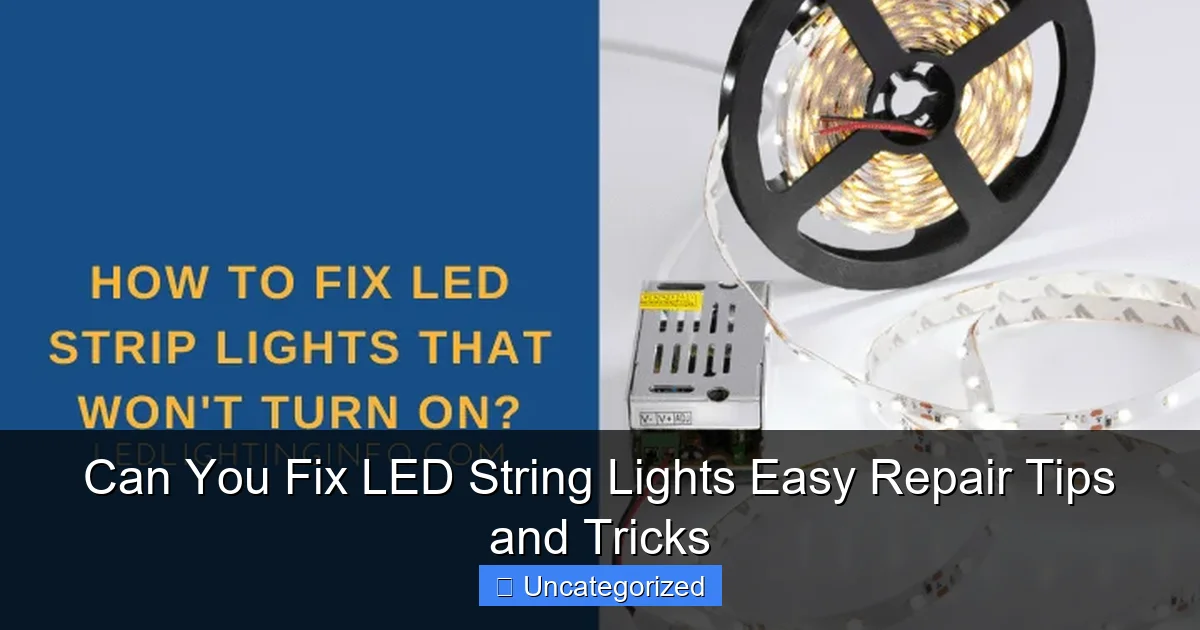
Featured image for can you fix led string lights
Image source: ledlightinginfo.com
Yes, you can fix LED string lights with simple tools and basic troubleshooting—most issues like flickering, dim lights, or complete failure are caused by loose connections, damaged bulbs, or faulty wiring. With a few DIY tricks like checking for breaks, replacing LEDs, or using electrical tape, you can restore your lights without replacing the entire strand.
Key Takeaways
- Inspect first: Check for loose bulbs or frayed wires before attempting repairs.
- Test each bulb: Use a multimeter to identify faulty LEDs quickly.
- Solder carefully: Replace broken bulbs with proper soldering for long-lasting results.
- Check the controller: A malfunctioning control box often causes light failure.
- Use waterproof sealant: Protect connections from moisture to prevent future damage.
- Know when to replace: Severe damage may require new lights for safety.
📑 Table of Contents
- Can You Fix LED String Lights? Easy Repair Tips and Tricks
- Understanding How LED String Lights Work
- Diagnosing the Problem: Step-by-Step Troubleshooting
- Common Repairs and How to Fix Them
- Advanced Tips and Tools for DIY Repairers
- Preventive Maintenance and Long-Term Care
- Repair Success Rates and Cost Comparison
- Conclusion: Empower Yourself to Repair, Not Replace
Can You Fix LED String Lights? Easy Repair Tips and Tricks
LED string lights have become a staple in modern lighting, offering energy efficiency, durability, and versatility. Whether used for holiday decorations, ambient room lighting, or outdoor ambiance, these lights add a magical touch to any space. However, like any electronic device, they can fail over time. A single burnt-out bulb or a frayed wire can render an entire string unusable—leading many to wonder: Can you fix LED string lights? The good news is, in many cases, the answer is a resounding yes. With a little patience, the right tools, and some basic troubleshooting knowledge, you can often restore your LED string lights to full functionality without having to toss them in the trash.
Many people assume that when LED string lights stop working, they’re beyond repair. This misconception leads to unnecessary waste and extra spending on replacements. In reality, LED string lights are often more repairable than traditional incandescent strings. Their solid-state design means fewer moving parts and less susceptibility to vibration damage. Plus, many models are designed with replaceable bulbs and modular wiring, making repairs accessible even for beginners. This guide will walk you through the most common issues, diagnostic techniques, and step-by-step repair methods. Whether you’re dealing with flickering, partial outages, or complete failure, you’ll learn how to identify the root cause and implement a fix—saving money, reducing waste, and keeping your favorite lights glowing for years to come.
Understanding How LED String Lights Work
The Basics of LED Circuitry
Before diving into repairs, it’s essential to understand how LED string lights function. Unlike traditional incandescent bulbs, which rely on a filament that heats up to produce light, LEDs (Light Emitting Diodes) operate using semiconductor technology. When an electric current passes through the semiconductor material, electrons recombine with electron holes, releasing energy in the form of photons—light. This process is highly efficient, converting up to 90% of energy into light rather than heat, which contributes to their long lifespan and energy savings.
Visual guide about can you fix led string lights
Image source: lightingcraze.com
LED string lights are typically wired in either series or parallel configurations. In a series circuit, all LEDs are connected end-to-end, so the same current flows through each bulb. If one LED fails (especially if it burns out open-circuit), the entire string may go dark. In a parallel circuit, each LED is connected independently to the power source, so the failure of one bulb doesn’t affect the others. Many modern LED strings use a combination—called a series-parallel design—where small groups of LEDs are wired in series, and those groups are then connected in parallel. This provides redundancy and makes troubleshooting easier.
Common Components in LED Strings
Understanding the components inside your LED string lights is crucial for effective repair. Most strings include:
- LED bulbs: The light source, usually encased in plastic with a built-in resistor to regulate current.
- Wiring: Thin copper or aluminum wires connecting the LEDs. Often coated with insulation.
- Resistors: Small components that limit current to prevent LED burnout.
- Controller/PCB (Printed Circuit Board): Found in programmable or color-changing strings, this manages brightness, color, and effects.
- Power adapter (if plug-in): Converts household voltage (120V AC) to a lower DC voltage (e.g., 3V, 6V, 12V).
- Plug and socket connectors: Allow daisy-chaining of multiple strings.
For example, a 50-light warm white LED string might use 3 LEDs wired in series (each rated for 3V), connected to a 9V power source via a small PCB. If one LED fails open, that trio goes dark, but the rest of the string remains lit. This modularity is a key advantage when it comes to repairability.
Why LEDs Fail: Common Causes
Despite their durability, LED string lights aren’t immune to failure. Common causes include:
- Moisture damage: Especially in outdoor strings, water can corrode connections or short circuits.
- Overheating: Poor ventilation or overuse can degrade the semiconductor material.
- Voltage spikes: Power surges can damage LEDs or the controller board.
- Physical damage: Kinked wires, crushed bulbs, or frayed insulation.
- Manufacturing defects: Poor solder joints or substandard components.
Understanding these failure modes helps you target your repair efforts more effectively. For instance, if your lights flicker during storms, a surge protector might be the real fix—not replacing the entire string.
Diagnosing the Problem: Step-by-Step Troubleshooting
Step 1: Check the Power Source
Before assuming the lights themselves are broken, verify that power is reaching the string. Start by:
Visual guide about can you fix led string lights
Image source: i.ytimg.com
- Testing the outlet with another device (e.g., a lamp).
- Checking the fuse or circuit breaker if the string is plugged into a wall.
- Inspecting the power adapter (if used) for damage, overheating, or loose connections.
- Using a multimeter to test voltage at the plug. A 12V string should read ~12V DC when unplugged from the wall but connected to the adapter.
Tip: Many LED strings have a small fuse inside the plug. If the fuse is blown (common after power surges), you can replace it with a 0.5A or 1A glass fuse. Look for a tiny access panel on the plug casing.
Step 2: Inspect for Physical Damage
Examine the entire length of the string, paying close attention to:
- Bulbs: Look for cracked lenses, blackened bases, or loose connections.
- Wires: Check for kinks, cuts, or fraying. Even a tiny break in insulation can cause a short.
- Connectors: Ensure male/female plugs aren’t bent or corroded.
For example, if you notice a section of lights is dark but the rest works, the issue might be a broken wire between two bulbs. Gently wiggle the wire near the dead section—if lights flicker, you’ve found the problem.
Step 3: Test Individual Bulbs and Circuits
To isolate the issue:
- Use a bulb tester or multimeter to check each LED. Set the multimeter to diode test mode. Touch the probes to the LED’s metal pins (not the base). A working LED will light up and show a voltage drop (1.8V–3.3V, depending on color).
- Swap suspected bad bulbs with known good ones from a working string. If the problem moves with the bulb, replace it.
- Check continuity in the wiring using a multimeter’s continuity setting. A beep indicates a complete circuit; no beep means a break.
Practical example: You have a 100-light string with 10 dark bulbs clustered together. Testing reveals that the 5th bulb in the cluster is dead. Since these 10 are likely in series, replacing that one bulb should restore the entire group.
Step 4: Evaluate the Controller or PCB
For programmable or color-changing strings:
- Check for visible damage on the PCB (burn marks, swollen capacitors).
- Test the output voltage from the controller to the LED strings using a multimeter.
- Ensure the remote control has working batteries and isn’t the issue.
If the controller is faulty, you may need to replace the entire PCB. However, some models allow PCB replacement—check the manufacturer’s website for spare parts.
Step 5: Assess Moisture and Corrosion
For outdoor strings that fail after rain or snow:
- Look for white powdery residue (oxidation) on metal contacts.
- Check for water inside bulb sockets. If present, dry the string thoroughly (use a hairdryer on low heat).
- Apply dielectric grease to connections to prevent future corrosion.
Tip: Store outdoor strings in a sealed bag with silica gel packets when not in use.
Common Repairs and How to Fix Them
Replacing a Burnt-Out LED Bulb
One of the most frequent issues is a single dead bulb. Here’s how to replace it:
- Remove the bad bulb: Gently pull it from the socket. Some bulbs have locking tabs—press them to release.
- Identify the bulb type: Note the color, voltage, and base size (e.g., 3mm, 5mm). Check the manufacturer’s label or compare to a working bulb.
- Insert the new bulb: Ensure correct polarity. Most LEDs have a flat side or shorter leg for the negative (cathode). Match it to the socket’s markings.
- Test the string: Plug it in. If the group lights up, you’re done! If not, double-check polarity.
Pro tip: Buy replacement bulbs in bulk (available online) to save money. For example, a pack of 50 3V warm white LEDs costs ~$15—much cheaper than a new string.
Repairing Broken Wires
A broken wire can cut power to a section of lights. To fix:
- Locate the break: Use the continuity test method from earlier.
- Cut out the damaged section: Use wire cutters to remove 1–2 inches around the break.
- Strip the insulation: Expose ~0.5 inches of copper on each end.
- Twist and solder: Connect the wires with a twist, then apply solder to create a strong, conductive joint.
- Insulate the repair: Wrap with electrical tape or use heat-shrink tubing. Ensure no copper is exposed.
Example: You find a break 10 bulbs from the plug. After soldering, the entire string works again. Use heat-shrink tubing for a professional finish.
Fixing a Faulty Power Adapter or Plug
If the string isn’t receiving power:
- Test the adapter: Use a multimeter to check output voltage. If it reads 0V or significantly lower than rated (e.g., 3V instead of 12V), replace it.
- Repair the plug: If the plug is loose or damaged, cut it off and splice in a new one. Match wire colors (typically black to black, white to white).
- Replace the fuse: Open the plug’s fuse compartment and swap the blown fuse with an identical one.
Caution: Always unplug the string before working on the adapter or plug.
Addressing Corrosion and Moisture Damage
For corroded connections:
- Clean with isopropyl alcohol and a cotton swab to remove oxidation.
- Use a wire brush on heavily corroded metal.
- Re-solder connections if corrosion has weakened joints.
- Seal with silicone sealant or heat-shrink tubing for outdoor use.
Tip: For future protection, apply a thin layer of petroleum jelly to metal contacts before storing.
Repairing a Damaged Controller or PCB
If the controller fails (e.g., no response to remote, flickering, or color errors):
- Replace the PCB: Order a replacement from the manufacturer or third-party sellers (search by model number).
- Check solder joints: Reflow any cracked joints with a soldering iron.
- Inspect for blown capacitors: If the PCB has swollen or leaking capacitors, replace them.
Note: PCB replacement is best for advanced users. If the board is soldered to the LEDs, consider replacing the entire string.
Advanced Tips and Tools for DIY Repairers
Essential Tools for LED String Repairs
Invest in these tools to make repairs easier and more effective:
- Multimeter: For testing voltage, continuity, and diode function (~$20).
- Soldering iron and solder: For secure wire joints (~$30).
- Wire strippers: For cleanly removing insulation (~$10).
- Heat-shrink tubing and a heat gun: For professional insulation (~$15).
- Needle-nose pliers and tweezers: For handling small bulbs and wires.
- Bulb tester: Specifically designed for LED strings (~$10).
Pro Tips for Efficient Repairs
- Work in good lighting: Use a magnifying lamp for detailed work.
- Label sections: Use masking tape to mark working vs. non-working bulbs during troubleshooting.
- Use a repair station: A magnetic mat or tray keeps small parts organized.
- Test as you go: Plug in the string frequently to verify progress.
- Document your process: Take photos before disassembly to aid reassembly.
When to Use a “Jumper Wire” Trick
In series-wired strings, a dead LED can break the circuit. A quick (but temporary) fix is to bypass it with a jumper wire:
- Remove the dead bulb.
- Twist a short wire between the two socket contacts.
- Insulate with tape.
Warning: This bypasses the LED’s resistor, which can cause overcurrent in the remaining LEDs. Use only as a short-term solution until you can replace the bulb.
Upgrading and Modifying LED Strings
Repairs can be an opportunity to upgrade:
- Replace with higher-quality LEDs: Use 5mm LEDs instead of 3mm for brighter output.
- Add a dimmer or controller: Install a remote-controlled dimmer module.
- Convert to battery power: Replace the plug with a battery pack for portable use.
Example: You repair a holiday string and replace the power adapter with a rechargeable 12V battery pack, making it usable for camping.
Preventive Maintenance and Long-Term Care
Proper Storage Techniques
How you store LED strings significantly impacts their lifespan:
- Wind loosely: Avoid tight coils that can stress wires. Use a figure-8 pattern or a storage reel.
- Keep dry: Store in a moisture-proof container with silica gel packets.
- Protect bulbs: Use cardboard tubes or bubble wrap for fragile bulbs.
- Label and date: Note the string’s length and color for easy identification.
Regular Inspection and Cleaning
Before each use:
- Inspect for damage: Check bulbs, wires, and plugs.
- Clean gently: Wipe with a dry microfiber cloth. For outdoor strings, use mild soap and water, then dry thoroughly.
- Test functionality: Plug in the string to catch issues early.
Using Surge Protectors and Timers
Prevent electrical damage:
- Plug into a surge protector: Especially important for outdoor or holiday lights.
- Use a timer: Reduces wear from constant use. A 6-hour on/18-hour off cycle is ideal.
- Avoid overloading circuits: Follow manufacturer guidelines for maximum strings per outlet (usually 2–3).
Choosing Durable, Repairable Lights
When buying new strings, prioritize:
- Replaceable bulbs: Avoid “sealed” strings with non-removable LEDs.
- Waterproof ratings: For outdoor use, look for IP65 or higher.
- Modular connectors: Allows easy daisy-chaining and repair.
- Warranty: Brands offering 2+ year warranties often use higher-quality components.
Repair Success Rates and Cost Comparison
Below is a table comparing repair outcomes for common LED string light issues, including estimated costs and success rates:
| Issue | Repair Method | Estimated Cost | Success Rate | Time Required |
|---|---|---|---|---|
| Single burnt-out bulb | Replace LED | $0.20–$1.00 per bulb | 90% | 5–10 minutes |
| Broken wire | Solder and insulate | $0 (if you have tools) | 85% | 15–20 minutes |
| Blown fuse | Replace fuse | $0.10–$0.50 | 95% | 5 minutes |
| Corrosion | Clean and re-solder | $0 (if you have alcohol) | 75% | 20–30 minutes |
| Faulty power adapter | Replace adapter | $10–$20 | 90% | 10 minutes |
| Damaged PCB | Replace PCB | $15–$30 | 60% | 30–60 minutes |
This table shows that most common issues have high success rates and low costs, making repairs far more economical than replacement. For example, fixing a single bulb costs less than 1% of a new $30 string, and even PCB replacement is often cheaper than buying a new set.
Conclusion: Empower Yourself to Repair, Not Replace
So, can you fix LED string lights? Absolutely—and in most cases, it’s easier and more cost-effective than you might think. By understanding the basics of LED circuitry, following systematic troubleshooting steps, and using the right tools, you can resolve the majority of issues that cause these lights to fail. From replacing a single bulb to soldering a broken wire or swapping a power adapter, the skills you’ve learned here can save you money, reduce electronic waste, and extend the life of your favorite lighting.
Remember, prevention is just as important as repair. Proper storage, regular inspections, and using surge protectors can dramatically reduce the risk of damage. When purchasing new strings, choose models designed for durability and repairability—features like replaceable bulbs and modular connectors make future fixes much simpler. And when a problem does arise, don’t rush to replace the entire string. Take a moment to diagnose the issue. You might be just one solder joint or bulb swap away from restoring full functionality.
Repairing LED string lights isn’t just about saving a few dollars—it’s about embracing a sustainable mindset. Every repaired string is one less piece of e-waste in a landfill. It’s a small but meaningful step toward reducing your environmental footprint. So the next time your holiday lights go dark or your patio ambiance flickers out, don’t despair. Grab your multimeter, roll up your sleeves, and remember: with the right knowledge and a bit of patience, you can bring those lights back to life. After all, a little light in the darkness is always worth the effort.
Frequently Asked Questions
Can you fix LED string lights with a simple DIY repair?
Yes, many common LED string light issues—like broken bulbs or frayed wires—can be fixed at home with basic tools like wire cutters, electrical tape, or a soldering iron. Always disconnect the lights from power before starting repairs.
Why do LED string lights stop working, and how can I troubleshoot them?
LED string lights often fail due to loose bulbs, damaged wiring, or a faulty plug. To troubleshoot, check each bulb connection, inspect for visible wire breaks, and test the power supply with a multimeter.
Is it possible to replace individual LEDs in string lights?
Yes, if you have steady hands and a soldering iron, you can replace individual dead LEDs. However, ensure the replacement LED matches the voltage and color temperature of the original for consistent lighting.
How do I fix LED string lights that flicker or dim unexpectedly?
Flickering or dimming often points to a poor connection or low voltage. Tighten loose bulbs, check for corroded contacts, or ensure the power source meets the required voltage (e.g., 12V vs. 24V).
What tools do I need to fix LED string lights safely?
Essential tools include wire strippers, electrical tape, a soldering iron, a multimeter, and heat-shrink tubing. Safety gear like gloves and eye protection is also recommended during repairs.
Can water damage ruin LED string lights, and can you fix them?
Yes, water exposure can corrode wires or cause short circuits. If lights get wet, unplug them immediately, dry thoroughly, and inspect for damage—repair or replace affected sections before reuse.