Featured image for how long do battery operated led string lights last
Image source: lightsden.com
Battery-operated LED string lights typically last 30 to 100 hours on a single set of batteries, depending on LED quality, battery type, and usage patterns. High-efficiency LEDs with lithium batteries can extend runtime up to 200 hours, while frequent on/off cycles and alkaline batteries may reduce lifespan significantly.
Key Takeaways
- Battery life varies: Expect 10–50 hours, depending on battery type and LED count.
- Use lithium batteries: They last longer and perform better in extreme temperatures.
- Switch to rechargeables: Saves money and reduces waste over time.
- Turn off when not in use: Extend runtime by avoiding unnecessary usage.
- Lower brightness = longer life: Dim settings significantly increase battery longevity.
- Store properly: Remove batteries during long storage to prevent leaks and damage.
📑 Table of Contents
- How Long Do Battery Operated LED String Lights Last? Find Out Now
- Understanding LED Lifespan vs. Battery Life
- Factors That Affect Battery Operated LED String Light Longevity
- How to Extend the Life of Your Battery Operated LED String Lights
- Comparing Different Types of Battery Operated LED String Lights
- When to Replace Your Battery Operated LED String Lights
- Conclusion
How Long Do Battery Operated LED String Lights Last? Find Out Now
There’s something undeniably magical about battery operated LED string lights. Whether you’re draping them around a patio for a cozy evening, wrapping them around a Christmas tree, or adding a touch of whimsy to your bedroom decor, these lights transform any space into a warm, inviting haven. Their portability, ease of use, and energy efficiency have made them a staple in homes, events, and even outdoor adventures. But as enchanting as they are, one burning question remains: How long do battery operated LED string lights last?
Understanding the lifespan of your LED string lights isn’t just about knowing when to replace the batteries or the unit itself—it’s about maximizing your investment, ensuring safety, and making informed decisions for your lighting needs. From battery types and usage patterns to environmental factors and quality indicators, this comprehensive guide dives deep into everything that influences the longevity of your favorite battery-powered lights. Whether you’re a DIY decorator, an event planner, or simply someone who loves a well-lit ambiance, you’ll find practical insights, real-world examples, and data-backed advice to keep your lights shining bright for years to come.
Understanding LED Lifespan vs. Battery Life
What Determines the Lifespan of an LED?
When people ask, “How long do battery operated LED string lights last?” they often conflate two separate but related concepts: LED lifespan and battery life. Let’s break them down.
Visual guide about how long do battery operated led string lights last
Image source: lightsden.com
LEDs (Light Emitting Diodes) are semiconductor devices that emit light when an electric current passes through them. Unlike traditional incandescent bulbs, which burn out due to filament failure, LEDs degrade slowly over time. A high-quality LED can last anywhere from 25,000 to 50,000 hours—that’s roughly 3 to 6 years of continuous use. Even after this time, the LED doesn’t “burn out”; instead, it reaches a point called L70, where its brightness has dropped to 70% of the original output. This is known as lumen depreciation.
For example, a premium set of battery operated LED string lights using Cree or Samsung LEDs might maintain 90% brightness for 30,000 hours, while cheaper models with generic LEDs may degrade faster due to poor thermal management or lower-grade materials.
Battery Life: The Real Limiting Factor
While the LEDs themselves can last decades, the battery life is usually the bottleneck. Most battery operated LED string lights run on standard AA or AAA alkaline, lithium, or rechargeable NiMH batteries. The actual runtime depends on several variables:
- Number of LEDs: A string with 50 LEDs will drain batteries faster than one with 20.
- Brightness settings: Many modern lights have multiple modes (steady, twinkle, fade). Higher brightness = faster battery drain.
- Battery capacity: Measured in milliampere-hours (mAh). A 2,500 mAh battery lasts longer than a 1,200 mAh one.
- LED efficiency: Some LEDs use less power for the same brightness (lumens per watt).
For instance, a 30-LED string powered by two AA alkaline batteries (2,800 mAh total) might last 20–30 hours on steady mode, but only 8–12 hours if set to twinkle or flash. In contrast, using two high-capacity lithium batteries (3,000 mAh) could extend runtime to 35–40 hours on steady mode.
The Myth of “Infinite” Battery Life
It’s common to see product descriptions claiming “lasts for months!” or “batteries included last 100 hours!” But these claims are often misleading. They usually assume:
- The lights are used for only a few hours per day (e.g., 3 hours nightly).
- The batteries are fresh and of high quality.
- The lights are not left on continuously.
So while a 100-hour battery life sounds impressive, if you use the lights 5 hours a night, they’ll last just 20 days. That’s not “months” unless you’re using them sparingly. Always calculate real-world usage to avoid disappointment.
Factors That Affect Battery Operated LED String Light Longevity
1. Battery Type and Quality
Not all batteries are created equal. The type you choose dramatically impacts how long your LED string lights stay lit.
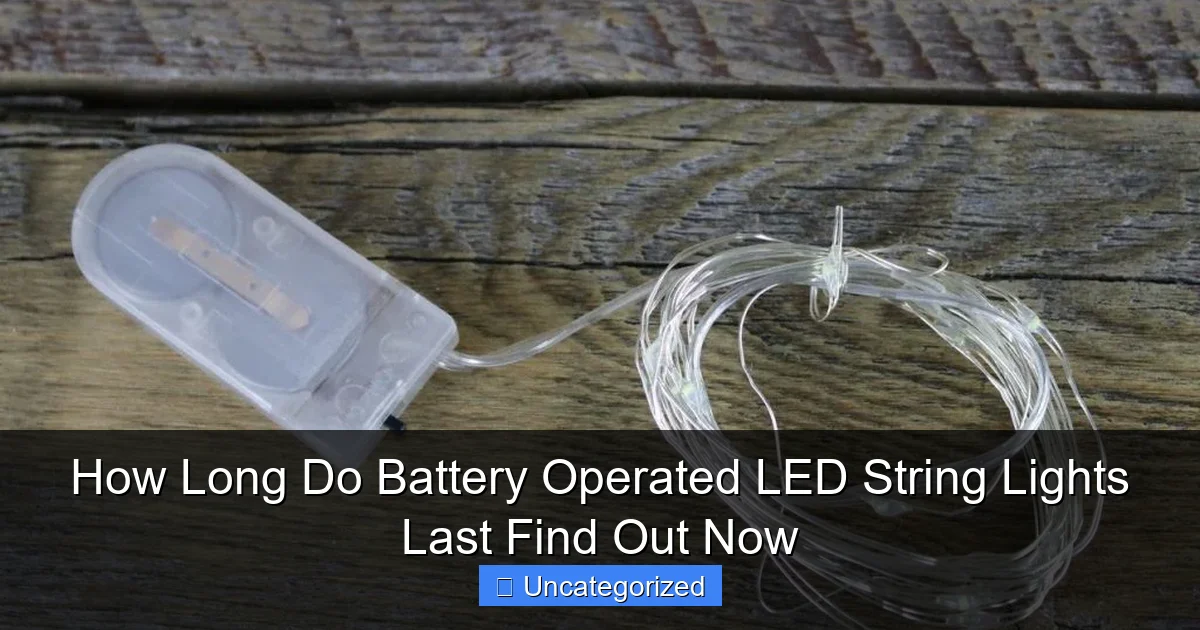
Visual guide about how long do battery operated led string lights last
Image source: cdn.shopify.com
- Alkaline batteries: Common, affordable, and widely available. However, they perform poorly in cold temperatures and have a shelf life of 3–5 years. Expect 20–40 hours of runtime depending on LED count and usage.
- Lithium batteries: More expensive but superior in performance. They last 2–3 times longer than alkaline, work well in extreme temperatures (-40°F to 140°F), and have a 10-year shelf life. Ideal for outdoor or winter use.
- Rechargeable NiMH batteries: Eco-friendly and cost-effective over time. Typical capacity: 1,800–2,500 mAh. Runtime: 15–30 hours. Best paired with a smart charger to avoid overcharging.
- Rechargeable Li-ion batteries: Found in higher-end models with built-in USB charging. Offer consistent output and longer cycle life (500+ charges).
Tip: For holiday lighting used nightly, invest in lithium AA/AAA or high-capacity NiMH batteries. For occasional use, alkaline may suffice.
2. LED Quality and Efficiency
LED efficiency is measured in lumens per watt (lm/W). A 50-lumen LED using 0.5 watts is more efficient than a 50-lumen LED using 1 watt. Higher efficiency means less heat, longer battery life, and better color stability.
Look for brands that specify:
- LED brand (e.g., Philips, Nichia, Cree)
- Color Rendering Index (CRI) > 80 for true color representation
- Thermal management features (e.g., aluminum backing, heat sinks)
Cheap LED strings often use low-CRI LEDs that appear dull or flicker under certain conditions. They may also lack proper insulation, leading to overheating and premature failure.
3. Usage Patterns and Duty Cycle
How you use your lights matters. Continuous 24/7 operation drastically shortens battery life and increases wear on internal components.
Consider this real-world scenario:
- Scenario A: 50-LED string, 2 AA alkaline batteries, used 4 hours per night for 30 days = 120 hours total use. Batteries likely need replacement after 3–4 weeks.
- Scenario B: Same string, but with 2 lithium batteries and a timer (auto-off after 6 hours). Used 6 hours per night for 60 days = 360 hours. Batteries last 2–3 months.
Pro Tip: Use a timer or smart plug to automate on/off times. This reduces energy waste, extends battery life, and prevents overuse.
4. Environmental Conditions
Battery operated LED string lights are often used outdoors—on patios, in gardens, or during winter holidays. Harsh conditions can shorten their lifespan.
- Temperature extremes: Alkaline batteries lose capacity below 32°F (0°C). Lithium performs better but still degrades in prolonged heat (>100°F/38°C).
- Moisture and humidity: Even “waterproof” lights can corrode if not IP65-rated or higher. Condensation inside the battery compartment is a common cause of failure.
- Sunlight exposure: UV rays can degrade plastic casings and cause yellowing of lenses over time.
Example: A string used on a covered porch with partial sun and occasional rain (IP44 rating) may last 2–3 seasons. The same string left uncovered in direct sunlight and heavy rain (IP20) may fail within one season due to moisture ingress.
5. Build Quality and Circuitry
Not all LED strings are built the same. Poorly constructed units may have:
- Thin, brittle wires that break easily
- Weak solder joints that fail under vibration
- Inadequate insulation leading to short circuits
- No surge protection or polarity safeguards
High-quality models feature:
- Reinforced wire sheathing
- Gold-plated contacts
- Overcurrent and overvoltage protection
- Modular design for easy replacement of faulty LEDs
Spending $20–$30 on a premium set often pays off in longevity compared to $8–$12 budget options.
How to Extend the Life of Your Battery Operated LED String Lights
Choose the Right Batteries
As mentioned earlier, lithium or high-capacity NiMH batteries are your best bet for longevity. But there’s more to it:
- Match battery voltage to requirements: Most lights need 3V (2xAA) or 4.5V (3xAA). Don’t use higher-voltage batteries unless specified.
- Use fresh, matched batteries: Mixing old and new batteries can cause leakage and uneven drain.
- Store batteries properly: Keep in a cool, dry place away from metal objects to prevent short circuits.
Bonus Tip: For NiMH batteries, fully discharge and recharge every few months to maintain capacity (“battery conditioning”).
Use Timers and Smart Controls
Leaving lights on all night wastes battery and reduces lifespan. Instead, use:
- Built-in timers: Many LED strings have 6-hour on/18-hour off cycles. Ideal for holidays.
- External timers: Plug the battery pack into a mechanical or digital timer.
- Smart plugs with app control: Schedule on/off times remotely via Wi-Fi (e.g., Kasa, TP-Link).
For example, setting a timer to turn on at 6 PM and off at 10 PM gives you 4 hours of light per night. Over a 30-day period, that’s 120 hours—well within the capacity of most battery systems.
Optimize Brightness and Modes
Dimmer isn’t always better for ambiance, but it is better for battery life. Use the lowest brightness setting that meets your needs. Avoid flashy modes (twinkle, fade, chase) unless necessary—they draw more power than steady-on mode.
Example: A 100-LED string in “steady warm white” might use 150 mA. In “twinkle” mode, it could spike to 300 mA during transitions, cutting battery life in half.
Protect from the Elements
Even weather-resistant lights need protection:
- Use zip ties or clips to secure lights and prevent wind damage.
- Install gutter hooks or adhesive mounts to keep battery packs elevated and dry.
- For outdoor use, choose IP65 or IP67-rated models (dust-tight, water-resistant).
- During off-seasons, store lights indoors in a sealed plastic bin with desiccant packs to absorb moisture.
Real-Life Example: A homeowner in Colorado uses battery LED strings on their deck year-round. By switching to IP67-rated lights and storing them in a climate-controlled shed during winter, they’ve extended the average lifespan from 1.5 to 4 years.
Inspect and Maintain Regularly
Preventative maintenance goes a long way:
- Check for loose connections, frayed wires, or corrosion every few weeks.
- Clean the battery contacts with a cotton swab and rubbing alcohol if they appear dirty.
- Replace any blown or dim LEDs—a single dead LED can affect the entire circuit in series-wired strings.
Tool Tip: Use a multimeter to test battery voltage and continuity. A fully charged AA should read ~1.5V (alkaline) or ~1.2V (NiMH).
Comparing Different Types of Battery Operated LED String Lights
Standard vs. USB-Rechargeable Models
Traditional battery lights rely on disposable or replaceable batteries. Newer models feature built-in lithium-ion batteries with USB charging ports (Micro-USB or USB-C).
| Feature | Standard Battery (AA/AAA) | USB-Rechargeable |
|---|---|---|
| Battery Type | Alkaline, Lithium, NiMH | Lithium-ion (built-in) |
| Runtime (per charge) | 20–50 hours (varies widely) | 20–100 hours (depends on capacity) |
| Recharge Cycles | N/A (replace batteries) | 500–1,000 |
| Charging Time | N/A | 2–6 hours |
| Lifespan (total use) | Limited by battery replacements | 5,000–10,000 hours (LED + battery) |
| Best For | Occasional use, remote locations | Frequent use, eco-conscious users |
Analysis: USB-rechargeable lights are more expensive upfront but offer lower long-term costs and less waste. They’re ideal for indoor decor, weddings, or events where access to power is easy. Standard battery models win when you need portability and don’t want to worry about charging.
Indoor vs. Outdoor Rated Lights
Indoor lights are typically IP20 or IP40—suitable for dry environments. Outdoor lights should be IP65 or higher to withstand rain, dust, and temperature swings.
- IP20: No dust protection, not waterproof. For bedrooms, closets.
- IP44: Splash-resistant. Suitable for covered patios.
- IP65: Dust-tight, low-pressure water jets. Ideal for gardens, porches.
- IP67: Submersible up to 1m for 30 minutes. For extreme weather or poolside.
Example: A wedding planner uses IP65-rated battery LED strings for an outdoor reception. Despite light rain, the lights function perfectly all night. A cheaper IP20 set would have shorted out immediately.
Smart LED Strings with App Control
High-end models connect to smartphones via Bluetooth or Wi-Fi, allowing:
- Color and brightness adjustments
- Scene presets (e.g., “romantic,” “party”)
- Remote on/off and scheduling
- Integration with voice assistants (Alexa, Google Assistant)
While these features enhance convenience, they slightly reduce battery life due to wireless module power draw. Expect 10–20% less runtime compared to non-smart equivalents.
When to Replace Your Battery Operated LED String Lights
Signs of Wear and Tear
Even with proper care, all LED strings eventually need replacement. Watch for these red flags:
- Flickering or intermittent lighting – Could indicate failing batteries, loose connections, or damaged circuitry.
- Dim or uneven brightness – May signal lumen depreciation, dead LEDs, or voltage drop.
- Corroded battery contacts – White or green crust on terminals. Clean with vinegar and a toothbrush.
- Brittle or cracked wire insulation – Especially common in cold climates.
- Water damage or mold – If the battery pack or LEDs show signs of moisture ingress, discard immediately for safety.
Rule of Thumb: If more than 10% of LEDs are dead or the string won’t stay lit for more than a few hours, it’s time for a replacement.
Expected Lifespan by Quality Tier
Not all LED strings are equal. Here’s a rough estimate based on price and quality:
- Budget ($5–$15): 1–2 years (500–1,000 hours of use). Prone to early failure.
- Mid-Range ($15–$30): 3–5 years (2,000–4,000 hours). Good value for money.
- Premium ($30–$60+): 5–8 years (4,000–8,000 hours). Durable, efficient, weather-resistant.
Example: A $25 set from a reputable brand like GE, Philips, or Twinkle Star may last 4 years with 2 hours of nightly use (2,920 hours). A $10 no-name brand might fail after one holiday season.
Safety and Disposal Considerations
When replacing old lights:
- Remove batteries before disposal. Recycle at designated battery drop-off sites.
- Do not incinerate or puncture batteries. Risk of fire or toxic fumes.
- Check local e-waste regulations. Many communities have programs for recycling electronics.
Bonus: Some manufacturers offer take-back programs for used LED lights. Check the packaging or website for details.
Conclusion
So, how long do battery operated LED string lights last? The answer isn’t a simple number—it’s a combination of LED technology, battery type, usage habits, environmental exposure, and build quality. While the LEDs themselves can last 25,000 to 50,000 hours, the real-world lifespan of your string lights is often limited by battery performance and external factors.
With proper care—choosing high-quality components, using timers, protecting from the elements, and maintaining your lights—you can expect 3 to 5 years of reliable service from mid-range to premium models. USB-rechargeable options offer even longer total use times, while budget lights may require annual replacement.
Ultimately, investing in quality over quantity pays off. Spend a little more upfront on well-built, efficient LED strings with lithium batteries or built-in charging, and you’ll save money, reduce waste, and enjoy beautiful, dependable lighting for years to come. Whether you’re illuminating a wedding arch, decorating a dorm room, or creating a magical backyard oasis, your battery operated LED string lights can shine brightly—just follow the tips in this guide to make every watt count.
Frequently Asked Questions
How long do battery operated LED string lights last on average?
Battery operated LED string lights typically last 30 to 60 hours on a single set of batteries, depending on battery quality and LED brightness. High-efficiency LEDs and lithium batteries can extend this lifespan significantly.
What factors affect how long battery powered LED string lights last?
Key factors include battery type (alkaline vs. lithium), LED count, brightness settings, and usage frequency. Lower brightness settings and intermittent use can dramatically increase battery life.
Do battery operated LED string lights last longer with rechargeable batteries?
Yes, rechargeable batteries (like NiMH) can extend the runtime of LED string lights and reduce long-term costs. However, they may provide slightly less initial brightness compared to alkaline batteries.
How long do LED string lights last in terms of years or overall lifespan?
While batteries need replacement every few weeks of use, the LED bulbs themselves last 25,000–50,000 hours. With occasional holiday use, they can last 10+ years without degradation.
Can I increase the lifespan of my battery operated LED string lights?
Yes—use timers to limit daily operation, switch to lithium batteries, and store lights in cool, dry conditions. These practices help preserve both batteries and LEDs over time.
Why do my battery powered LED string lights fade or die quickly?
Quick battery drain is often caused by low-quality batteries, high brightness settings, or leaving lights on continuously. Switching to lithium batteries and using a timer can resolve most issues.

