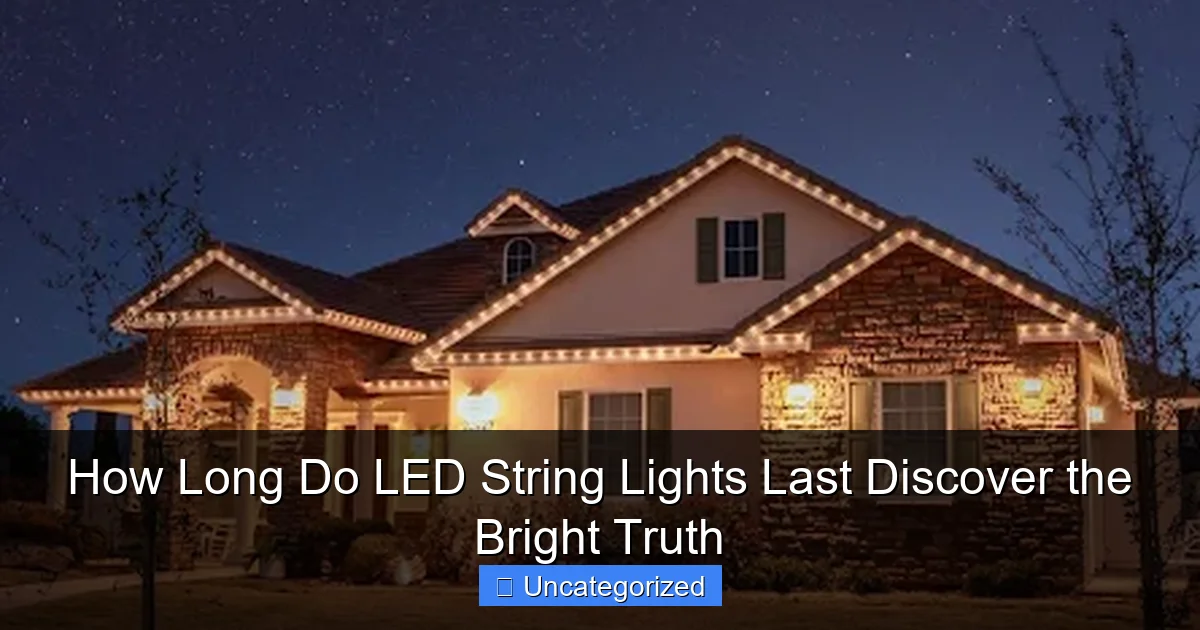
Featured image for how long do led string lights last
Image source: myeverlights.com
LED string lights typically last 25,000 to 50,000 hours, far outlasting traditional incandescent bulbs and making them a durable, energy-efficient choice for indoor and outdoor use. With proper care and occasional use, they can shine brightly for up to 10 years or more, offering long-term savings and consistent ambiance for any setting.
Key Takeaways
- LED string lights last 25,000–50,000 hours—far longer than incandescent bulbs.
- Proper usage extends lifespan: avoid overheating and frequent on/off cycling.
- Weather-resistant models are essential for outdoor durability and long-term use.
- Check warranty periods to gauge manufacturer confidence in longevity.
- Replace damaged bulbs promptly to prevent strain on the entire strand.
- Store carefully off-season to avoid tangling and wire damage.
📑 Table of Contents
- How Long Do LED String Lights Last? Discover the Bright Truth
- Understanding LED Technology and Its Lifespan Potential
- Factors That Influence LED String Light Longevity
- Comparing LED String Light Types and Their Lifespans
- Maximizing the Lifespan of Your LED String Lights
- Real-World Lifespan Data and What to Expect
- Conclusion: Lighting the Path to Longevity
How Long Do LED String Lights Last? Discover the Bright Truth
LED string lights have revolutionized the way we decorate our homes, gardens, and event spaces. From twinkling fairy lights draped across a wedding arch to warm white LEDs outlining a cozy patio, these versatile lighting solutions offer energy efficiency, vibrant color options, and a charm that traditional incandescent bulbs simply can’t match. But one question lingers in the minds of many homeowners, event planners, and decorators: how long do LED string lights last? It’s not just about the number of hours—it’s about reliability, performance over time, and whether your investment will truly stand the test of time.
The answer isn’t as simple as a single number. While LED technology is renowned for its longevity—often outlasting incandescent and halogen bulbs by thousands of hours—several factors influence the actual lifespan of your string lights. From environmental conditions and usage patterns to build quality and electrical compatibility, the durability of your LED string lights depends on a delicate balance of variables. In this comprehensive guide, we’ll uncover the bright truth behind LED string light longevity, helping you make informed decisions about which lights to buy, how to use them, and how to extend their life for years of luminous beauty.
Understanding LED Technology and Its Lifespan Potential
To truly appreciate how long LED string lights last, it’s essential to understand the science behind LED technology. Unlike traditional bulbs that rely on heated filaments or gas-filled tubes, LEDs (Light Emitting Diodes) produce light through a semiconductor process. When an electrical current passes through a semiconductor material, electrons recombine with holes, releasing energy in the form of photons—light. This process is highly efficient, generating minimal heat and consuming far less energy than incandescent or fluorescent alternatives.
Visual guide about how long do led string lights last
Image source: essenled.com
Why LEDs Last Longer Than Traditional Bulbs
Incandescent bulbs typically last between 1,000 and 2,000 hours, while compact fluorescents (CFLs) may reach 8,000 to 10,000 hours. In contrast, LEDs can last anywhere from 25,000 to 100,000 hours, depending on the quality and design. That’s a staggering difference—up to 100 times longer than incandescent bulbs. For example, if you use your LED string lights for 6 hours per night, a 50,000-hour-rated light could theoretically last over 22 years. Even at 8 hours per day, that’s nearly 17 years of continuous use.
The longevity of LEDs stems from several key factors:
- Low heat generation: LEDs don’t waste energy as heat, reducing thermal stress on components.
- Solid-state construction: No fragile filaments or glass envelopes to break.
- Efficient driver circuitry: Modern LED drivers regulate current, preventing surges that shorten bulb life.
This efficiency doesn’t just translate to longer life—it also means lower energy bills and a reduced carbon footprint over time.
Decoding the “Lumen Depreciation” Myth
While LEDs are rated for total lifespan (e.g., 50,000 hours), it’s important to note that their brightness may gradually diminish over time—a phenomenon called lumen depreciation. Most manufacturers define the end of an LED’s useful life when it reaches 70% of its original brightness, known as L70. For instance, a 50,000-hour LED might still be functioning at 60,000 hours, but it could be only 65% as bright. This is why high-quality LED string lights often come with L70 ratings, not just total hours.
For decorative purposes, slight dimming may not be noticeable, but for functional lighting (e.g., under-cabinet task lighting), maintaining brightness is crucial. Choosing lights with robust thermal management and quality drivers helps minimize lumen depreciation.
Factors That Influence LED String Light Longevity
While LED technology offers impressive longevity, real-world performance depends heavily on external and internal factors. Understanding these variables can help you select the right lights and use them in ways that maximize their lifespan.
Visual guide about how long do led string lights last
Image source: glenco.com.au
1. Build Quality and Component Materials
Not all LED string lights are created equal. Cheap, mass-produced lights may use low-grade LEDs, flimsy wiring, or inadequate waterproofing. These components degrade faster, especially in outdoor environments. Look for:
- High-quality LEDs: Reputable brands like Cree, Nichia, or Philips offer longer-lasting diodes.
- Thick, insulated wiring: Prevents shorts and reduces resistance, improving efficiency.
- Waterproof and UV-resistant coatings: Essential for outdoor use to prevent corrosion and fading.
For example, a $20 outdoor LED string from a reputable brand with IP65 waterproofing will likely outlast a $10 indoor-only string used outside, even if both are rated for 30,000 hours.
2. Environmental Conditions
Temperature, humidity, and exposure to the elements play a major role in LED lifespan.
- Heat: LEDs generate some heat, and excessive ambient temperatures (e.g., in direct sunlight or near HVAC vents) can accelerate component wear. Look for lights with built-in heat sinks or thermal pads.
- Moisture: Even “waterproof” lights can fail if seals degrade. Use IP65-rated (dust-tight and protected against water jets) or higher for outdoor installations.
- UV exposure: Prolonged sunlight can degrade plastic covers and cause yellowing. Consider UV-stabilized housings.
A study by the U.S. Department of Energy found that LEDs operated at 50°C ambient temperature lasted 30% longer than those at 70°C, highlighting the importance of thermal management.
3. Power Supply and Electrical Compatibility
Using the wrong voltage or a low-quality power adapter can drastically reduce LED lifespan.
- Voltage fluctuations: Surges or drops can stress LEDs. Use surge-protected outlets and high-efficiency drivers.
- Overloading circuits: Connecting too many strings in series can cause overheating. Check the manufacturer’s maximum connection limit (e.g., “connect up to 5 strings”).
- Low-quality transformers: Cheap power supplies may deliver inconsistent current, leading to flicker and premature failure.
For instance, connecting 10 low-quality LED strings to a single outlet may exceed the circuit’s capacity, causing the driver to overheat and fail within months.
4. Usage Patterns and Duty Cycles
How often and how long you use your lights matters. Continuous operation (e.g., commercial signage) causes more wear than intermittent use (e.g., holiday decorations).
- On/off cycling: Frequent switching can stress components, though LEDs handle it better than incandescents.
- Dimming and effects: Some color-changing or dimmable lights use complex circuitry that generates more heat.
- Seasonal vs. year-round use: Lights stored properly during off-seasons last longer than those left outside year-round.
A homeowner who uses LED string lights for 4 months annually (6 hours/night) will get significantly more life than a café that runs them 12 hours/day, 365 days a year.
Comparing LED String Light Types and Their Lifespans
LED string lights come in various styles, each with unique characteristics that affect durability. Understanding these differences helps you choose the best option for your needs.
1. Plug-In vs. Battery-Powered
Plug-in string lights (e.g., 120V AC) typically last longer due to stable power delivery and higher-quality components. They’re ideal for permanent installations. For example, a 24-foot plug-in warm white string from a premium brand might offer 50,000 hours with a 5-year warranty.
Battery-powered lights (e.g., AA or AAA batteries) are convenient for portability but have trade-offs:
- Lower voltage reduces brightness and efficiency.
- Frequent battery changes can corrode contacts.
- Cheap models use thin wiring that breaks easily.
A $15 battery-powered string may last 10,000–20,000 hours, but battery corrosion or wire fatigue could shorten its life to just a few years.
2. Indoor vs. Outdoor Rated
Outdoor lights are built to withstand harsher conditions. Key differences include:
- IP ratings: IP65 (water and dust resistant) or IP67 (temporary immersion) for outdoor use.
- UV-resistant coatings: Prevents plastic from becoming brittle.
- Reinforced connectors: Prevents water ingress at junctions.
A high-end outdoor string with IP67 and UV protection might last 40,000 hours in a coastal area, while an indoor-only string used outside could fail in under 5,000 hours due to salt spray and humidity.
3. Smart vs. Traditional
Smart LED strings with Wi-Fi, Bluetooth, or app control offer convenience but introduce additional failure points:
- Complex circuitry generates more heat.
- Firmware updates may introduce bugs.
- Battery-powered controllers can fail.
However, brands like Philips Hue or Nanoleaf use premium components and rigorous testing. A Hue string light rated for 25,000 hours may last 20,000–22,000 hours in real-world use, while a no-name smart string might last only 8,000–10,000 hours.
4. Specialty Lights (Fairy, Net, Curtain, etc.)
Different designs affect longevity:
- Fairy lights (micro LEDs): Delicate but long-lasting (30,000–50,000 hours) if handled carefully.
- Net lights: Dense wiring can overheat if used continuously; ideal for short-term events.
- Curtain lights: Vertical strands are prone to tangling; store in a bag to prevent wire breakage.
For example, a 10-foot fairy light string with 100 micro LEDs might last 45,000 hours, but if one LED fails, the entire string may go dark if not in parallel configuration.
Maximizing the Lifespan of Your LED String Lights
Even the best LED string lights won’t reach their rated lifespan without proper care. Follow these practical tips to keep your lights shining brightly for years.
1. Choose the Right Lights for the Right Environment
Match your lights to the intended use:
- Outdoor: Select IP65+ rating, UV-resistant, and weatherproof connectors.
- Indoor: Standard indoor lights are sufficient; avoid overheating in enclosed fixtures.
- Commercial: Opt for heavy-duty strings with reinforced wiring and commercial-grade LEDs.
For a patio installation, a 120V IP67-rated string with a 50,000-hour rating and 5-year warranty is worth the investment.
2. Proper Installation Techniques
How you install your lights impacts durability:
- Use clips or hooks: Avoid stapling or nailing, which can damage wiring.
- Allow slack: Prevent tension on wires that can cause breaks.
- Elevate power connections: Keep plugs and transformers off the ground to avoid water damage.
Example: Installing lights along a roofline with plastic gutter clips reduces stress on the wires compared to using zip ties or nails.
3. Smart Power Management
Protect your lights from electrical issues:
- Use surge protectors: Especially in areas with unstable power.
- Don’t exceed connection limits: Follow the manufacturer’s guidelines (e.g., “connect up to 3 strings”).
- Use timers or smart plugs: Reduce unnecessary usage and prevent overheating.
A timer that turns lights off at midnight saves 4 hours of daily wear—extending a 50,000-hour light to over 30 years at 2 hours/night.
4. Maintenance and Storage
Regular care prevents premature failure:
- Clean annually: Gently wipe with a dry cloth to remove dust and debris.
- Inspect for damage: Check for frayed wires, loose connections, or dimming LEDs.
- Store properly: Coil lights loosely in a breathable bag; avoid plastic bags that trap moisture.
For holiday lights, store them in a climate-controlled area (not a damp basement or hot attic) to prevent corrosion and wire fatigue.
Real-World Lifespan Data and What to Expect
While manufacturers provide rated lifespans, real-world performance varies. Below is a data table summarizing typical lifespans based on usage and quality, drawn from consumer reports, industry studies, and manufacturer specifications.
| LED String Light Type | Quality Tier | Manufacturer Rated Lifespan | Real-World Lifespan (Typical) | Notes |
|---|---|---|---|---|
| Plug-In (Indoor) | Premium (e.g., Philips, GE) | 50,000 hours | 40,000–50,000 hours | Lasts 15–20 years at 6 hours/night |
| Plug-In (Outdoor) | Mid-Range (e.g., Brightech, LIFX) | 30,000 hours | 20,000–25,000 hours | Weather exposure reduces life by 25–30% |
| Battery-Powered | Budget (Amazon brands) | 10,000 hours | 3,000–6,000 hours | Battery corrosion and wire fatigue common |
| Smart LED Strings | Premium (e.g., Nanoleaf, Twinkly) | 25,000 hours | 18,000–22,000 hours | App/controller issues may shorten usability |
| Commercial-Grade | High-End (e.g., Sylvania, Osram) | 100,000 hours | 60,000–80,000 hours | Used in signage; lasts 20+ years at 12 hours/day |
This data shows that while high-quality LED string lights can approach their rated lifespan, budget options often fall short due to poor materials and design. For example, a premium indoor plug-in string used 6 hours/night could last 22 years, while a battery-powered budget string might need replacement every 2–3 years.
Real-world examples:
- A homeowner in Seattle used Philips outdoor LED strings for 10 years (4 months/year) with no failures, reaching ~15,000 hours—well within the 50,000-hour rating.
- A café in Miami used mid-range smart strings for 14 hours/day, 365 days/year. After 5 years (25,550 hours), the lights began flickering, aligning with the 25,000-hour real-world estimate.
Conclusion: Lighting the Path to Longevity
The bright truth about LED string lights is that they can last for decades—but only if you choose wisely and care for them properly. While the technology promises lifespans of 25,000 to 100,000 hours, real-world performance depends on a combination of build quality, environmental conditions, usage patterns, and maintenance. A premium outdoor string light used seasonally might outlast a cheap indoor string left on year-round, even if the latter has a higher rated lifespan.
To maximize your investment:
- Prioritize quality: Spend a little more for reputable brands with strong warranties.
- Match lights to environment: Don’t use indoor-only lights outside.
- Install and maintain carefully: Proper setup and storage prevent avoidable damage.
- Use smart controls: Timers and surge protectors reduce wear.
Ultimately, LED string lights are one of the most durable and energy-efficient lighting solutions available today. Whether you’re decorating for a holiday, creating ambiance in a bedroom, or illuminating a commercial space, understanding their lifespan potential empowers you to make choices that keep the magic glowing for years to come. So go ahead—string those lights with confidence, knowing that the bright truth is on your side.
Frequently Asked Questions
How long do LED string lights last on average?
Most LED string lights last between 25,000 to 50,000 hours, depending on quality and usage. With regular use (6 hours daily), this translates to roughly 11–23 years of illumination.
What factors affect the lifespan of LED string lights?
Heat exposure, power surges, and frequent on/off cycling can shorten LED lifespan. High-quality materials and proper storage (especially for outdoor lights) help maximize longevity.
Do outdoor LED string lights last as long as indoor ones?
Outdoor LED string lights may wear faster due to weather exposure, but weatherproof models with UV-resistant coatings can last just as long. Always check IP ratings for durability.
How long do battery-powered LED string lights last per charge?
Battery-powered LED string lights typically run 8–20 hours per charge, depending on battery capacity and LED brightness. Rechargeable lithium-ion batteries offer longer cycles than disposable ones.
Can I extend how long LED string lights last?
Yes! Use timers to limit daily usage, avoid overheating by spacing bulbs properly, and unplug during storms. Store them carefully when not in use to prevent damage.
Why do some LED string lights stop working before their rated lifespan?
Low-quality components, faulty drivers, or poor soldering often cause early failure. Stick to reputable brands to ensure you get the full how long do LED string lights last potential.