Featured image for how many led christmas lights can i string together
Image source: elitechristmasinstall.com
You can safely string up to 25 LED Christmas light sets together on a single circuit, thanks to their low energy draw and minimal heat output—far more than traditional incandescent bulbs. Always check the manufacturer’s rating and use a circuit breaker to avoid overloading and ensure a hazard-free holiday display.
Key Takeaways
- Check manufacturer limits: Always follow the max string count listed on the packaging.
- Use a power meter: Measure actual wattage to avoid overloading circuits.
- Limit daisy-chaining: Never exceed 2-3 high-wattage strings in one chain.
- Prioritize low-wattage LEDs: They allow more lights per circuit safely.
- Split across outlets: Distribute strings to different circuits to prevent tripped breakers.
- Inspect for damage: Damaged cords can cause hazards even within safe limits.
📑 Table of Contents
- How Many LED Christmas Lights Can I String Together Safely
- Understanding LED Christmas Light Specifications
- Calculating Safe Connection Limits for Your Setup
- Indoor vs. Outdoor LED Lights: Key Differences
- Advanced Tips for Large-Scale LED Displays
- Data Table: Maximum Safe LED Light Connections
- Conclusion: Prioritizing Safety for a Brighter Holiday
How Many LED Christmas Lights Can I String Together Safely
The magic of the holiday season often comes alive with the warm, twinkling glow of Christmas lights. Whether you’re draping them across your roofline, wrapping them around a tree, or outlining your front porch, LED Christmas lights have become the go-to choice for their energy efficiency, durability, and vibrant colors. But as you plan your festive display, a critical question arises: How many LED Christmas lights can I string together safely? It’s a question that goes beyond aesthetics—it’s about electrical safety, preventing fire hazards, and ensuring your holiday cheer doesn’t turn into a holiday emergency.
While LED lights generate less heat and use significantly less power than traditional incandescent bulbs, they’re not immune to electrical risks when overloaded. The number of strands you can safely connect depends on several factors, including the wattage of each strand, your home’s electrical circuit capacity, the length of the light strings, and whether they’re indoor or outdoor-rated. In this comprehensive guide, we’ll break down the science and safety behind connecting LED Christmas lights, provide practical examples, and equip you with the tools and knowledge to create a dazzling, hazard-free display that keeps your home and family safe all season long.
Understanding LED Christmas Light Specifications
Wattage and Amperage: The Core of Electrical Load
Before stringing a single strand, it’s essential to understand the electrical specifications of your LED lights. Unlike incandescent bulbs, which consume high wattage due to heat generation, LED lights use far less power—typically between 0.1 to 0.5 watts per bulb. For example, a 100-light LED string might consume only 4 to 10 watts, compared to 40 watts for a similar incandescent strand. This lower wattage is a major reason why you can string more LED lights together safely.
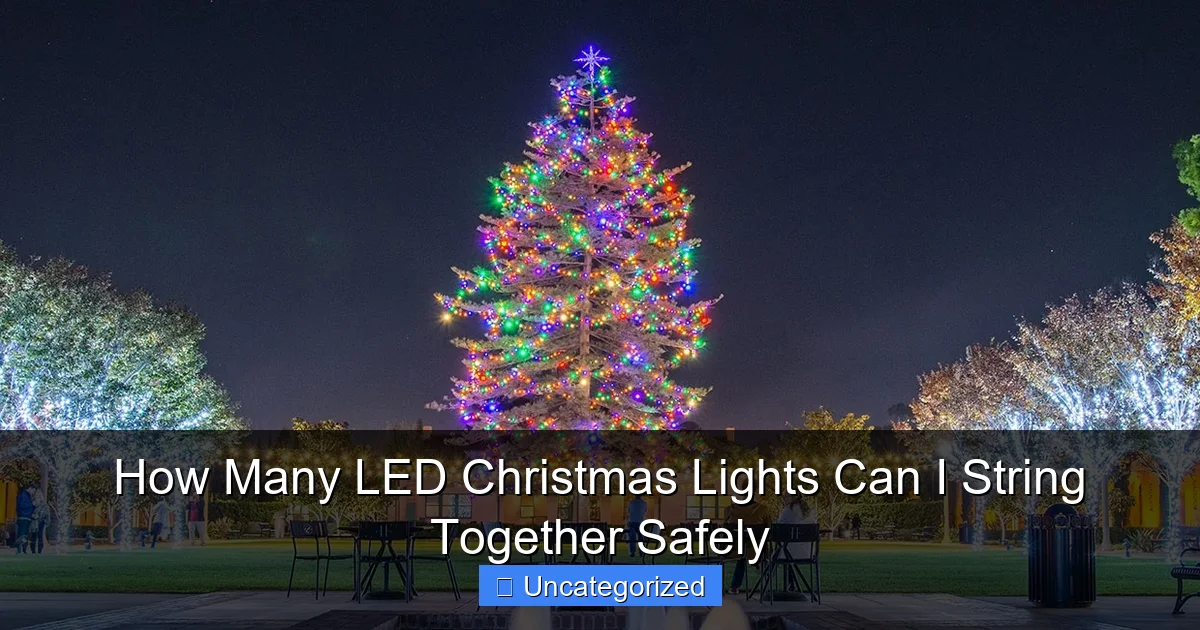
Visual guide about how many led christmas lights can i string together
Image source: cdn.christmaslightsetc.com
However, wattage alone isn’t enough to determine safe connection limits. You also need to consider amperage (amps), which measures the flow of electricity. Most household circuits in North America are rated for 15 or 20 amps. Since power (watts) = voltage (volts) × amperage (amps), and standard household voltage is 120V, you can calculate the maximum wattage your circuit can handle:
- 15-amp circuit: 15 × 120 = 1,800 watts
- 20-amp circuit: 20 × 120 = 2,400 watts
But here’s the catch: the National Electrical Code (NEC) recommends not exceeding 80% of a circuit’s capacity for continuous loads. That means:
- Max safe load on 15-amp: 1,800 × 0.8 = 1,440 watts
- Max safe load on 20-amp: 2,400 × 0.8 = 1,920 watts
Checking Your Light Packaging and Labels
Manufacturers are required to provide critical safety information on packaging or attached tags. Look for:
- Wattage per strand (e.g., “4.8W per 100 lights”)
- Maximum number of strings that can be connected end-to-end (e.g., “Connect up to 45 sets”)
- UL or ETL certification (indicates compliance with safety standards)
- Indoor/outdoor rating (outdoor lights have weather-resistant coatings)
Example: A box of 100 mini LED lights states: “4.8W per set. Connect up to 45 sets end-to-end.” This means you can safely plug 45 strands into one outlet, totaling 216 watts (45 × 4.8W), well under the 1,440W safe limit for a 15-amp circuit.
Why Manufacturer Limits Matter
Manufacturers set connection limits based on internal wiring gauge, plug design, and thermal testing. Exceeding these limits—even if the total wattage seems low—can cause:
- Overheating at connection points
- Insulation melting
- Short circuits
- Fire hazards
Always follow the manufacturer’s instructions—they’re based on real-world safety testing, not just theoretical calculations.
Calculating Safe Connection Limits for Your Setup
Step-by-Step Wattage Calculation
To determine how many LED strands you can safely connect, follow this process:
Visual guide about how many led christmas lights can i string together
Image source: backyardboss.net
- Find the wattage per strand (from packaging or online specs)
- Divide your circuit’s safe wattage limit (1,440W for 15A; 1,920W for 20A) by the strand wattage
- Round down to the nearest whole number (never round up!)
Example 1: You have 100-light LED strands rated at 6W each, and a 15-amp circuit.
- 1,440W ÷ 6W = 240 strands
- But manufacturer says: “Max 35 sets end-to-end”
- Safe limit: 35 strands (follow manufacturer, not math)
Example 2: 50-light LED net lights at 2.4W each, 20-amp circuit.
- 1,920W ÷ 2.4W = 800 strands
- Manufacturer: “Connect up to 20 sets”
- Safe limit: 20 strands
Accounting for Other Devices on the Circuit
Your Christmas lights aren’t the only thing using the circuit. Common household devices that share outlets include:
- Refrigerators (100–200W)
- Microwaves (1,000–1,500W)
- Space heaters (1,500W)
- TVs (100–400W)
- Lamps (60–100W)
Pro Tip: Use a circuit breaker finder or check your home’s electrical panel to identify which outlets are on the same circuit. Then, calculate the total load:
- TV: 200W + Laptop: 100W + LED lights: 300W = 600W (safe on 15A circuit)
- But add a space heater: 600W + 1,500W = 2,100W → Overload!
To avoid tripped breakers or fires, plug Christmas lights into circuits with low existing loads, or use dedicated outdoor circuits if available.
Using Extension Cords and Power Strips Safely
Extension cords and power strips add complexity. Key rules:
- Use outdoor-rated cords for exterior decorations
- Check cord gauge: 16-gauge for ≤10A; 14-gauge for ≤15A; 12-gauge for ≤20A
- Never “daisy-chain” power strips (connecting one to another)
- Limit cord length: Long cords reduce voltage and increase resistance
Example: A 100-foot 16-gauge cord can safely carry ~1,200W. If your LED display uses 1,300W, the cord may overheat. Use shorter, thicker cords (e.g., 50-foot 14-gauge) or split the load across multiple circuits.
Indoor vs. Outdoor LED Lights: Key Differences
Weather Resistance and Safety Ratings
Outdoor LED lights are built for harsh conditions. Look for:
- IP44 or higher rating: Resists water splashes and dust
- UV-resistant wire coating: Prevents brittleness in sunlight
- Weatherproof plugs: Rubber seals prevent moisture ingress
Indoor lights lack these features. Using them outside risks:
- Short circuits from rain/snow
- Frayed wires from temperature changes
- Fire hazards from overheating
Never mix indoor and outdoor lights in a single chain—even if the wattage is low.
Thermal Management in Different Environments
LEDs generate heat, but far less than incandescent bulbs. Still, heat buildup matters:
- Indoor: Heat dissipates easily in air-conditioned spaces. You can string more strands (e.g., 40–50) on a single circuit.
- Outdoor: Cold temperatures reduce resistance, but enclosed spaces (e.g., gutters) trap heat. Limit connections to manufacturer’s recommendation (often 20–30 strands).
Tip: For outdoor trees, use cool-burning LED rope lights (0.2W per foot) instead of mini lights to reduce thermal load.
Special Considerations for Large Displays
For expansive setups (e.g., rooflines, yard sculptures):
- Use multiple circuits: Don’t rely on one outlet. Run separate extension cords to different areas.
- Install GFCI outlets: Protect against ground faults (common in wet areas).
- Use timers: Limit runtime to 6–8 hours/day to reduce heat and energy use.
- Label connections: Use colored tags to track which strands are on which circuit.
Example: A 100-foot roofline with 500 mini LEDs (2.4W each) uses 1,200W. Instead of one chain, split into 4 zones (250 lights each, 300W) on separate circuits.
Advanced Tips for Large-Scale LED Displays
Using LED Light Controllers and Smart Systems
For professional-level displays, smart controllers offer safety and convenience:
- Smart plugs: Monitor energy use in real-time and shut off if overloaded (e.g., TP-Link Kasa, Wemo).
- DMX controllers: For synchronized light shows, but require separate power supplies per zone.
- Voltage regulators: Prevent dimming/overheating in long chains.
Pro Tip: Use a multimeter to check voltage drop in long chains. If voltage falls below 110V, the last lights may flicker or fail.
Power Distribution with Multi-Outlet Adapters
For large displays, avoid overloading a single outlet. Instead:
- Use a 6-outlet outdoor-rated power strip (rated for 15A/1,800W)
- Split your display into 3–4 zones: e.g., roofline (400W), trees (600W), porch (300W)
- Label each zone with its wattage and circuit
Example: A 2,000W display uses three 15A circuits: Roofline (700W), Trees (800W), Porch (500W). Each zone has its own power strip.
Preventing Overheating in Tight Spaces
Heat buildup is a risk when lights are:
- Wrapped tightly around branches
- Packed into garlands
- Enclosed in plastic covers
Solutions:
- Use low-heat LED types (e.g., “cool white” vs. “warm white”)
- Space lights 6–8 inches apart on trees
- Ventilate enclosed displays with mesh covers instead of solid plastic
- Turn off displays during high-temperature days (e.g., >85°F/29°C)
Data Table: Maximum Safe LED Light Connections
| LED Strand Type | Wattage per Strand | Manufacturer Max (End-to-End) | 15A Circuit (1,440W Safe Limit) | 20A Circuit (1,920W Safe Limit) | Notes |
|---|---|---|---|---|---|
| 100 Mini LED (Indoor) | 4.8W | 45 | 300 | 400 | Follow manufacturer limit |
| 50 LED Net Lights (Outdoor) | 2.4W | 20 | 600 | 800 | Use GFCI outlet |
| LED Rope Lights (10 ft) | 6.0W | 25 | 240 | 320 | Check for voltage drop |
| LED Icicle Lights | 3.6W | 30 | 400 | 533 | Hang with clips, not nails |
| LED C9 Bulbs (25 ct) | 1.2W | 50 | 1,200 | 1,600 | Ideal for large rooflines |
Conclusion: Prioritizing Safety for a Brighter Holiday
Creating a dazzling LED Christmas display is a joy, but it must never come at the cost of safety. The answer to “How many LED Christmas lights can I string together safely?” lies in a balance of three key factors: manufacturer guidelines, circuit capacity, and environmental conditions. While the math might suggest you can connect hundreds of strands, always defer to the manufacturer’s end-to-end limit—it’s based on rigorous safety testing that accounts for real-world variables like heat, moisture, and wiring quality.
Remember these golden rules for a hazard-free holiday:
- Check labels: Know your lights’ wattage and max connection limit.
- Respect circuit capacity: Stay under 80% of your circuit’s rated load.
- Split large displays: Use multiple circuits and zones to distribute power.
- Use the right tools: Outdoor-rated cords, GFCI outlets, and smart timers.
- Inspect annually: Replace frayed, cracked, or non-working strands.
By following this guide, you’ll not only create a stunning, energy-efficient display but also protect your home from electrical hazards. After all, the true magic of the holidays isn’t just in the lights—it’s in the peace of mind that comes from knowing your family and home are safe. So string those lights with confidence, let the glow shine bright, and enjoy a season filled with warmth, wonder, and worry-free cheer.
Frequently Asked Questions
How many LED Christmas lights can I string together safely?
The number of LED Christmas lights you can safely string together depends on the manufacturer’s specifications, but most LED sets allow up to 25-30 strands end-to-end. Always check the product label or manual to confirm the maximum recommended connections.
Can I connect different brands of LED Christmas lights?
Mixing brands of LED Christmas lights is not recommended, as voltage and wiring standards may vary. Sticking to one brand ensures consistent performance and reduces fire or electrical hazards.
What happens if I exceed the recommended number of LED lights?
Exceeding the manufacturer’s limit for LED Christmas lights can overload circuits, causing overheating, flickering, or even fire hazards. It may also void warranties and trip your home’s circuit breaker.
How do I calculate the maximum LED Christmas lights for a circuit?
Check the wattage of each strand (listed on packaging) and divide your circuit’s total wattage capacity (usually 1,800 watts for a 15-amp circuit) by the per-strand wattage. Never exceed 80% of a circuit’s load for safety.
Are LED Christmas lights safer to string together than incandescent?
Yes, LED Christmas lights are safer because they use less power, generate minimal heat, and often support more end-to-end connections than incandescent strands. This makes them ideal for large displays.
Can I use an extension cord with multiple LED light strands?
Yes, but ensure the cord is rated for outdoor use (if applicable) and the total wattage of your LED lights doesn’t exceed the cord’s capacity. Avoid daisy-chaining multiple cords to prevent overheating.