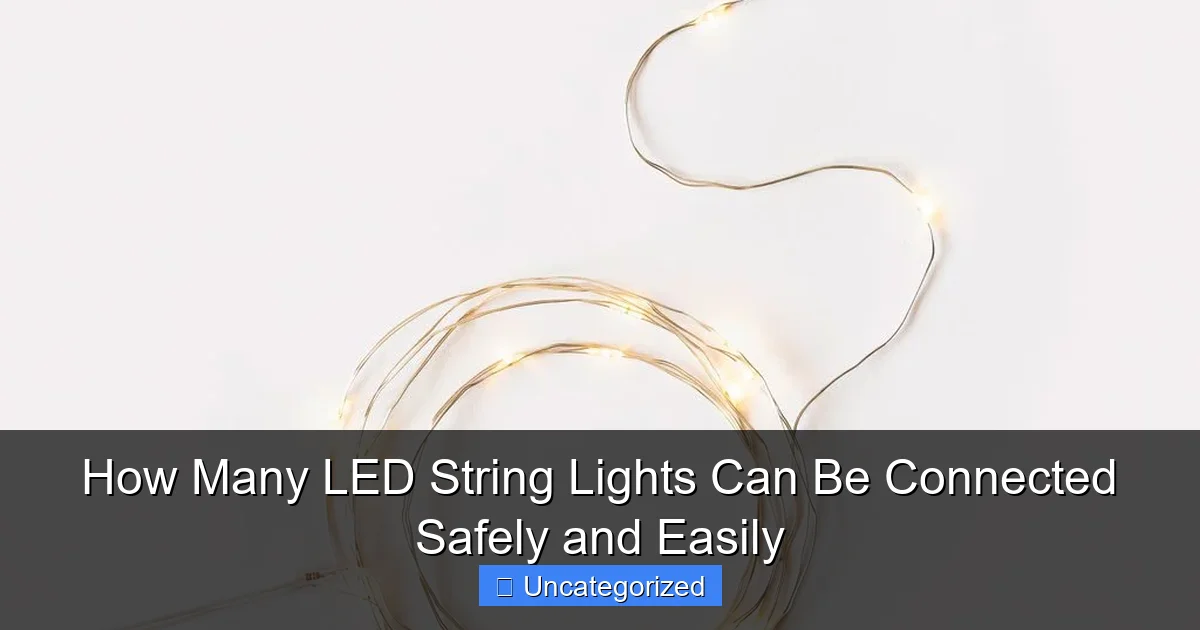
Featured image for how many led string lights can be conected
Image source: i00.eu
Most LED string lights can be safely connected up to 210 watts on a single circuit, but always check manufacturer limits—typically 4–6 strands—to avoid overloading. Using in-line fuses and low-voltage LED sets ensures both safety and easy expansion for any space.
Key Takeaways
- Check wattage first: Always verify the max wattage your circuit can handle before connecting.
- Follow manufacturer limits: Never exceed the recommended number of connected strings in the product manual.
- Use in-line fuses: Add fuses to prevent overheating and reduce fire risk during long connections.
- Opt for LED efficiency: LEDs draw less power, letting you safely connect more strings than incandescents.
- Measure voltage drop: Long chains may dim; test brightness at the end of the line.
- Use a power strip: Distribute load across multiple outlets to avoid overloading a single circuit.
📑 Table of Contents
- How Many LED String Lights Can Be Connected Safely and Easily
- Understanding the Basics: Voltage, Wattage, and Amperage
- Manufacturer Specifications and Safety Ratings
- Circuit Load and Home Electrical System Limits
- Types of LED String Lights and Their Connectivity
- Practical Tips for Safe and Easy Connection
- Conclusion: Balancing Safety, Functionality, and Aesthetics
How Many LED String Lights Can Be Connected Safely and Easily
Imagine transforming your outdoor patio, wedding venue, or holiday display into a magical wonderland with the soft, warm glow of LED string lights. These versatile and energy-efficient decorations have become a staple in home and event decor, offering everything from cozy ambiance to vibrant, colorful lighting effects. However, as you string together more and more lights to cover larger spaces, a crucial question arises: How many LED string lights can be connected safely and easily?
Connecting multiple LED string lights can be a simple task—or a dangerous one, depending on how well you understand the technical limitations and safety guidelines. Overloading circuits, using incompatible products, or ignoring manufacturer instructions can lead to blown fuses, overheating wires, or even fire hazards. On the other hand, when done correctly, daisy-chaining lights can create stunning, seamless lighting displays that last for years. This guide will walk you through the essential factors that determine how many LED string lights you can safely connect, including wattage, amperage, circuit load, product specifications, and best practices. Whether you’re planning a holiday light show or setting up ambient lighting in your backyard, this comprehensive resource will help you illuminate your space safely and effectively.
Understanding the Basics: Voltage, Wattage, and Amperage
What Do Voltage, Wattage, and Amperage Mean?
Before connecting multiple LED string lights, it’s vital to understand the three core electrical concepts: voltage (V), wattage (W), and amperage (A). These determine how much power your lights consume and how much your circuit can handle.
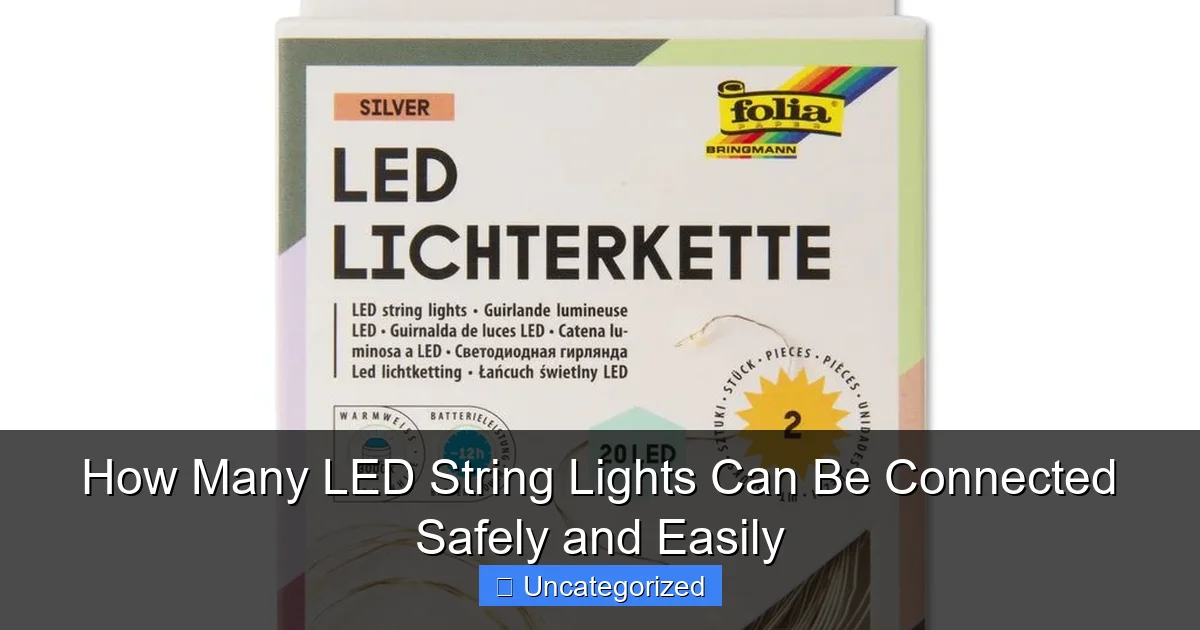
Visual guide about how many led string lights can be conected
Image source: i00.eu
- Voltage (V): This is the electrical “pressure” that pushes current through the circuit. Most household outlets in the U.S. provide 120 volts, while some countries use 220–240V. LED string lights are typically designed for 120V (North America) or 230V (Europe).
- Wattage (W): This measures the total power consumed by the lights. It’s calculated by multiplying voltage and amperage (W = V × A). LED lights are highly efficient, using far fewer watts than incandescent bulbs. For example, a 100-bulb LED string might use only 6–10 watts, whereas an incandescent string of the same length could use 40+ watts.
- Amperage (A): This is the amount of electrical current flowing through the circuit. Standard household circuits in the U.S. are rated for 15 or 20 amps. Exceeding this limit trips the breaker.
How These Factors Affect Connectivity
The number of LED string lights you can connect depends primarily on the total wattage and how much of your circuit’s amperage it consumes. For example:
- A 15-amp circuit at 120V can handle up to 1,800 watts (15A × 120V).
- Most electricians recommend using only 80% of a circuit’s capacity for safety, so 1,440 watts on a 15A circuit.
- If each 100-bulb LED string uses 8 watts, you could theoretically connect up to 180 strings (1,440W ÷ 8W = 180). However, this is rarely practical or safe due to other limitations (see below).
Tip: Always check the wattage per string on the product label or packaging. Never assume all “100-bulb” strings use the same power.
Practical Example: Holiday Light Setup
Suppose you’re decorating your home for Christmas with 50 LED string lights. Each string is 100 bulbs, uses 8 watts, and has a “connect up to 45 strings” rating on the box. Even though your 15-amp circuit could handle 180 strings based on wattage, the manufacturer’s limit caps it at 45. Why? Because of internal wiring, plug design, and safety testing. Always follow the manufacturer’s maximum connection limit—it’s based on real-world testing, not just theoretical math.
Manufacturer Specifications and Safety Ratings
Why Manufacturer Limits Matter
Every set of LED string lights comes with a manufacturer-specified maximum number of connectable strings. This limit isn’t arbitrary—it’s determined by:
Visual guide about how many led string lights can be conected
Image source: 4.bp.blogspot.com
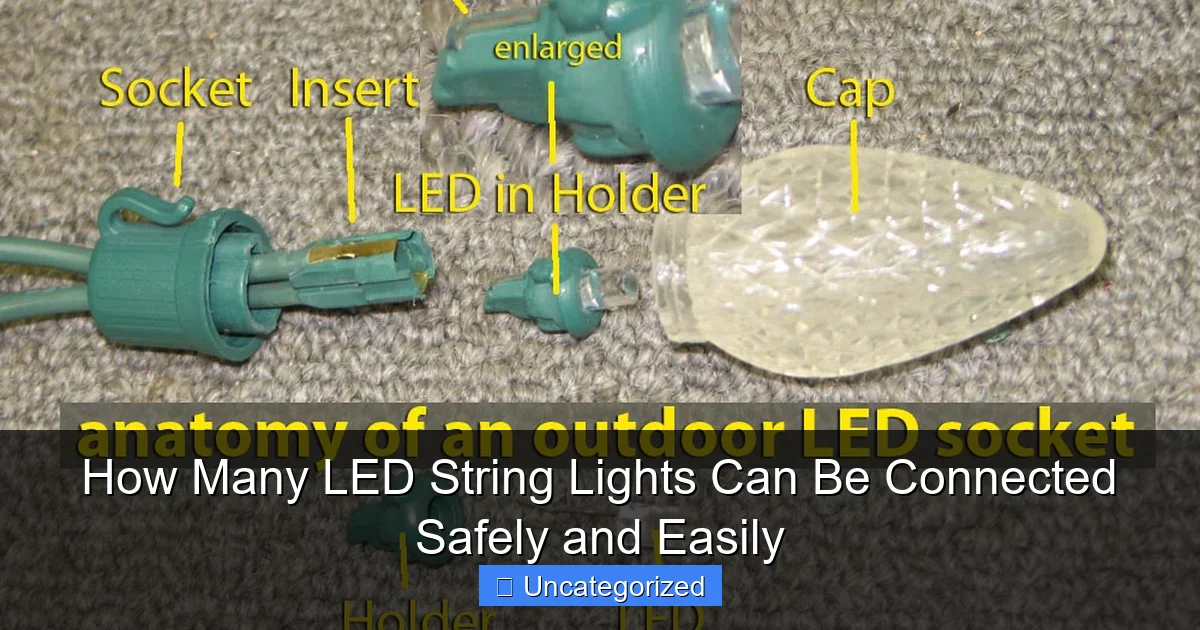
- Internal wire gauge: Thinner wires can’t carry as much current without overheating.
- Plug and socket design: Some connectors are rated for only a few amps. Overloading can melt the plastic or cause arcing.
- Thermal testing: Lights are tested to ensure they don’t get too hot when connected in series.
- Certifications: UL (Underwriters Laboratories), ETL, or CSA listings mean the product meets safety standards.
Ignoring the manufacturer’s limit—even if your circuit can handle more—can void warranties and create fire risks. For example, a 20-foot string with 100 LEDs might have a max of 25 strings in series, while a 50-foot commercial-grade string might allow 50 or more.
Reading the Product Label
Always check the product label for:
- “Max connectable” or “Do not connect more than X strings” warnings.
- Wattage per string (e.g., “6W per 100 bulbs”).
- Voltage rating (120V, 230V, etc.).
- Indoor/outdoor use and IP rating (e.g., IP44 for splash resistance).
Example: A box of GE LED string lights states: “Connect up to 35 strings. 8W per string. 120V. Indoor/Outdoor. IP44.” This means you can safely connect 35 strings, totaling 280 watts (35 × 8W), as long as your circuit can handle it.
When Manufacturer Limits Are Conservative
Sometimes, the manufacturer’s limit is overly conservative. For instance, a brand might rate a string for 20 connections, but independent tests show it’s safe up to 30. However, never exceed the printed limit unless you have professional electrical testing equipment and expertise. Safety should always come first.
Circuit Load and Home Electrical System Limits
Understanding Your Circuit Capacity
Your home’s electrical panel distributes power through circuits, each protected by a circuit breaker. Most lighting circuits are 15 or 20 amps. To calculate how many LED string lights you can connect without tripping the breaker:
- Determine your circuit’s amperage (check the breaker label).
- Multiply by voltage (120V in the U.S.) to get max wattage: 15A × 120V = 1,800W; 20A × 120V = 2,400W.
- Use only 80% of capacity: 1,440W (15A) or 1,920W (20A).
- Divide by the wattage per string to get the theoretical max.
Example: 15A circuit, 10W per string → 1,440W ÷ 10W = 144 strings. But if the manufacturer limits to 40 strings, you’re capped at 40.
Other Devices on the Same Circuit
Most circuits power more than just lights. A living room might have a TV, sound system, and phone chargers on the same circuit. If these devices draw 800 watts, your available wattage drops to 640W (1,440W – 800W). Suddenly, your 144-string theoretical max becomes 64 strings (640W ÷ 10W). Always account for other loads before connecting lights.
Using Multiple Circuits and Outlets
To connect more lights safely:
- Spread lights across multiple circuits. Use one circuit for outdoor lights and another for indoor.
- Use outdoor-rated power strips with built-in circuit breakers (e.g., 15A max).
- Install dedicated lighting circuits for large installations (e.g., weddings, commercial displays).
Tip: Label your circuits at the breaker box. This makes it easy to turn off power when adding or removing lights.
Ground Fault Circuit Interrupters (GFCIs)
Outdoor and bathroom circuits should be protected by GFCIs, which cut power if a ground fault is detected (e.g., water contact). GFCIs are essential for outdoor LED string lights. If your outdoor outlet isn’t GFCI-protected, install one or use a GFCI extension cord.
Types of LED String Lights and Their Connectivity
Plug-In vs. Battery-Operated vs. Solar
Not all LED string lights are designed for daisy-chaining:
- Plug-in lights: Most have male/female connectors for series connection. Ideal for large, permanent setups.
- Battery-operated: Rarely connectable. Each string is self-contained. Use multiple strings but avoid overloading batteries.
- Solar-powered: Typically not connectable. Each unit has its own solar panel and battery. Use for small, independent displays.
Example: A 20-foot plug-in string with 100 LEDs (8W) can connect to 35 others. A 10-foot battery string (3W) usually can’t connect to another string.
Commercial vs. Residential Grade
Commercial-grade lights are built for heavy use and higher connectivity:
- Residential: Max 25–40 strings. Often 20 AWG wire. Suitable for homes and small events.
- Commercial: Max 50–100+ strings. Thicker 18 AWG wire. Used in hotels, restaurants, and public spaces.
Tip: For large installations, invest in commercial-grade lights. They last longer, handle more connections, and are safer under load.
Smart LED Strings and Controllers
Smart lights (e.g., Philips Hue, Twinkly) often have lower connectivity due to built-in electronics:
- Hue Lightstrip: Max 10 meters (32 feet) per power supply. Use a repeater for longer runs.
- Twinkly Strings: Max 4 strings in a group, but up to 8 groups via app control.
Smart lights may require a hub or controller, which draws additional power. Factor this into your total wattage.
Practical Tips for Safe and Easy Connection
Step-by-Step Connection Guide
- Read the manual: Check max connectable strings and wattage.
- Plan your layout: Measure the area and calculate total length needed.
- Use a wattage calculator: Add wattage of all devices on the circuit. Ensure it’s under 80% of capacity.
- Start with one string: Plug in and test before adding more.
- Connect in series: Plug male end of first string into outlet, female end to male end of second, and so on.
- Use extension cords wisely: Choose cords rated for outdoor use and the total load. A 16 AWG cord is fine for 10A; use 14 AWG for 15A.
- Inspect connections: Ensure plugs are snug and no wires are exposed.
Tools and Accessories
- Watt meter: Measures actual power draw (e.g., P3 P4400 Kill A Watt).
- Timer or smart plug: Automatically turn lights on/off to reduce wear.
- Light clips and hooks: Secure lights without damaging wires.
- Weatherproof covers: Protect outdoor plugs from rain and snow.
Common Mistakes to Avoid
- Mixing brands/models: Different wattages and connectors can cause overheating.
- Overloading extension cords: A 10-amp cord can’t handle 15 amps. Use a cord with a higher rating than your total load.
- Using damaged lights: Frayed wires or broken bulbs increase fire risk.
- Ignoring heat buildup: If a plug feels hot, unplug immediately.
Data Table: Max Connectable LED String Lights (Examples)
| Brand & Model | Bulb Count | Wattage per String | Max Connectable | Total Max Wattage | Use Case |
|---|---|---|---|---|---|
| GE Indoor/Outdoor LED | 100 | 8W | 35 strings | 280W | Home, holidays |
| Philips Hue Lightstrip | 1,000 LEDs (33 ft) | 20W | 10 meters (32 ft) | 20W | Smart home, accent lighting |
| Twinkly Strings (RGB) | 250 | 12W | 4 strings | 48W | Smart events, parties |
| Commercial Grade (18 AWG) | 200 | 15W | 80 strings | 1,200W | Hotels, restaurants, large venues |
| Battery-Operated (3 AA) | 50 | 3W | Not connectable | N/A | Small decor, crafts |
Conclusion: Balancing Safety, Functionality, and Aesthetics
Connecting LED string lights is a blend of art and science. While the allure of a dazzling, seamless light display is strong, safety must always come first. By understanding the interplay between voltage, wattage, amperage, and manufacturer limits, you can create stunning lighting installations without risking your home’s electrical system.
Remember the key takeaways:
- Follow the manufacturer’s maximum connection limit—it’s your primary safety guardrail.
- Respect your circuit’s capacity and use only 80% of its rated load.
- Choose the right type of lights for your project (plug-in, commercial, smart, etc.).
- Use proper tools and accessories to ensure secure, weatherproof connections.
- Inspect and maintain your lights regularly to prevent hazards.
Whether you’re wrapping a tree with 10 strings or lighting a ballroom with 100, the principles remain the same: plan carefully, calculate wisely, and prioritize safety. With the right approach, your LED string lights will not only look beautiful but also stand the test of time—illuminating your space for years to come.
Frequently Asked Questions
How many LED string lights can be connected end-to-end safely?
Most LED string lights can be safely connected up to 21-25 sets end-to-end, but always check the manufacturer’s rating (usually listed on the packaging or product manual). Exceeding the recommended limit may cause overheating or circuit failure.
What happens if I connect too many LED string lights together?
Connecting too many LED string lights beyond the specified limit can overload the circuit, leading to dimming, overheating, or even fire hazards. Always follow the manufacturer’s guidelines to ensure safe operation.
Can I connect different types of LED string lights together?
It’s not recommended to mix different brands, voltages, or types (e.g., 24V with 12V) of LED string lights. Doing so can damage the lights or create uneven brightness due to incompatible power requirements.
How many LED string lights can I connect to one power outlet?
The number of LED string lights you can connect to one outlet depends on their total wattage and the outlet’s capacity (typically 15-20 amps). For example, 100-watt lights on a 1500-watt circuit allow up to 15 sets.
Are there special extension cords for connecting multiple LED string lights?
Yes, use heavy-duty, outdoor-rated extension cords with a sufficient amperage rating (e.g., 16-gauge for longer runs). Avoid daisy-chaining multiple cords, as this can reduce power and increase risks.
How can I connect multiple LED string lights without overloading the circuit?
Use a power strip with overload protection, distribute lights across multiple circuits, or opt for low-voltage LED string lights. Always calculate total wattage (amps = watts/volts) to stay within safe limits.