Featured image for how many watts do led fairy string lights use
Image source: auxgrow.com
LED fairy string lights typically use between 0.5 to 6 watts per strand, making them far more energy-efficient than traditional incandescent lights, which can consume 20–30 watts or more. Exact wattage depends on bulb count, brightness, and length, but most standard 50–100-bulb LED sets draw under 5 watts—ideal for cost-effective, long-lasting ambiance.
Key Takeaways
- LED fairy lights use 1-5 watts, far less than incandescent bulbs.
- Check product labels for wattage to ensure accurate energy estimates.
- Longer strings consume more power, but still remain highly efficient.
- Use a watt meter for precise measurement of actual energy usage.
- Lower wattage means safer operation for extended indoor or outdoor use.
- Energy savings add up with daily use over holiday seasons.
📑 Table of Contents
- The Magic Behind LED Fairy String Lights: A Wattage Deep Dive
- Understanding LED Technology and Why Wattage Matters
- How Many Watts Do LED Fairy String Lights Use? A Detailed Breakdown
- Comparing LED Fairy Lights to Traditional Lighting
- Calculating Energy Use and Cost: A Step-by-Step Guide
- Choosing the Right LED Fairy Lights: A Buyer’s Guide
- Maximizing Efficiency and Safety with LED Fairy Lights
The Magic Behind LED Fairy String Lights: A Wattage Deep Dive
Few things capture the whimsy and warmth of the holidays or a cozy evening quite like LED fairy string lights. These delicate strands of illumination have become a staple in home decor, weddings, and festive celebrations—transforming ordinary spaces into enchanting realms. Whether draped across a headboard, wrapped around a tree, or strung along a patio, their soft glow adds an undeniable charm. But as their popularity grows, so do questions about their practicality—particularly regarding energy consumption. One of the most common inquiries from homeowners, decorators, and eco-conscious consumers is: How many watts do LED fairy string lights use?
Understanding the wattage of these lights isn’t just about saving on your electricity bill—it’s about making informed, sustainable choices. LED technology has revolutionized lighting by offering brightness with minimal energy draw, but not all fairy lights are created equal. From battery-powered mini sets to 100-foot commercial-grade strands, the wattage can vary significantly. In this comprehensive guide, we’ll break down everything you need to know about LED fairy light wattage, including how to calculate usage, compare different types, and choose the most energy-efficient options for your needs. Whether you’re planning a holiday display or designing ambient lighting for your living room, this guide will illuminate the facts—no guesswork required.
Understanding LED Technology and Why Wattage Matters
What Makes LED Lights Different?
LED stands for Light Emitting Diode, a semiconductor device that emits light when an electric current passes through it. Unlike traditional incandescent or halogen bulbs, which generate light by heating a filament, LEDs produce light through electroluminescence—making them far more efficient. This fundamental difference is why LED fairy string lights use significantly fewer watts than older lighting technologies.
Visual guide about how many watts do led fairy string lights use
Image source: lighttrybe.ng
For example, a standard 60-watt incandescent bulb might be replaced by a 6–10 watt LED bulb to achieve the same brightness (measured in lumens). In the case of fairy lights, this efficiency is even more pronounced. Most LED fairy lights operate at just 0.06 to 0.5 watts per bulb, depending on size, color, and design.
Why Wattage Is Important for Consumers
Wattage directly impacts three key areas: energy consumption, safety, and cost. Here’s how:
- Energy Consumption: Lower wattage means less power drawn from the grid or batteries, which is crucial for long-term use and eco-friendliness.
- Safety: High-wattage lighting can generate heat, posing fire risks—especially with flammable materials like fabric or paper. LEDs run cool, reducing this hazard.
- Cost: Even small differences in wattage add up over time. A 1-watt string running 10 hours a day costs far less than a 5-watt version doing the same.
Moreover, knowing the wattage helps you avoid overloading circuits, especially when connecting multiple strands. This is particularly important for holiday displays where dozens of lights may be plugged into the same outlet.
How LEDs Achieve High Efficiency
LEDs are inherently efficient, but several design factors enhance their performance in fairy lights:
- Low Voltage Operation: Most fairy lights run on 3–5 volts (DC), reducing energy waste.
- Directed Light Emission: Unlike incandescent bulbs that emit light in all directions, LEDs focus light where needed, minimizing loss.
- Minimal Heat Output: Up to 90% of energy in LEDs goes to light, not heat—unlike incandescent bulbs, which waste ~90% as heat.
These features make LED fairy lights ideal for both indoor and outdoor use, especially in enclosed spaces or near sensitive materials.
How Many Watts Do LED Fairy String Lights Use? A Detailed Breakdown
Wattage by Bulb Type and Size
The wattage of LED fairy string lights depends heavily on the size, shape, and type of LED bulbs used. Here’s a breakdown of common configurations:
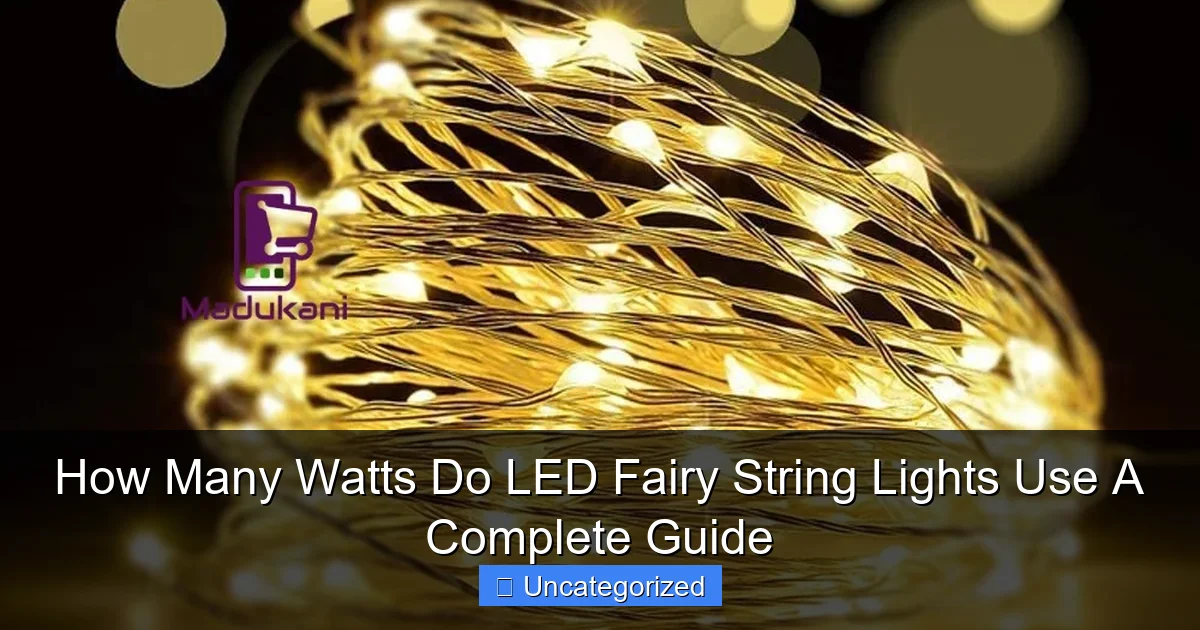
Visual guide about how many watts do led fairy string lights use
Image source: madukani.co.ke
- Micro LED (2mm or 3mm): These tiny bulbs use just 0.06 to 0.1 watts each. A 100-bulb strand would consume only 6 to 10 watts total.
- Mini LED (5mm): Slightly larger and brighter, these use 0.2 to 0.3 watts per bulb. A 50-bulb strand uses 10 to 15 watts.
- Globe or Faceted LED: Designed for higher visibility, these use 0.4 to 0.5 watts per bulb. A 40-bulb strand uses 16 to 20 watts.
- RGB Color-Changing LEDs: These use more power due to internal circuitry—typically 0.3 to 0.6 watts per bulb.
For example, a popular 100-bulb warm white micro LED string (like those from GE or Twinkle Star) uses only 9 watts total, while a 50-bulb RGB color-changing strand might use 25 watts due to the added complexity of color control.
Wattage by Power Source
The power source also affects wattage and efficiency:
- Plug-In (AC to DC Adapter): Most common for indoor use. Wattage is determined by the adapter’s output. A 12V, 1A adapter supplies 12 watts, which can power up to 200 micro LEDs.
- Battery-Powered: Uses AA or AAA batteries. A 3xAA battery pack (4.5V) powers ~30–50 LEDs at 0.08–0.1 watts per bulb. Total draw: 2.5 to 5 watts.
- Solar-Powered: Equipped with a small solar panel and rechargeable battery. Typically uses 3–6 watts for a 50–100 bulb strand, with auto-shutoff to conserve energy.
Tip: Battery-powered lights often have lower wattage per bulb to extend battery life. If you need brighter lights, opt for plug-in or solar models.
Wattage by Strand Length and Bulb Density
Longer strands with more bulbs naturally use more watts, but bulb density (spacing) also plays a role. For instance:
- A 33-foot strand with 200 micro LEDs (10 bulbs per foot) uses ~20 watts.
- A 66-foot strand with 400 micro LEDs (6 bulbs per foot) uses ~24 watts due to lower density.
Manufacturers often list total wattage on packaging or product descriptions. Always check this before purchasing to avoid surprises.
Comparing LED Fairy Lights to Traditional Lighting
Wattage Comparison: LED vs. Incandescent
To truly appreciate LED efficiency, compare fairy lights to traditional incandescent string lights:
- Incandescent Fairy Lights: Use ~0.5 to 1 watt per bulb. A 100-bulb strand uses 50 to 100 watts.
- LED Fairy Lights: Use ~0.06 to 0.5 watts per bulb. The same 100-bulb strand uses 6 to 50 watts.
This means LED lights use up to 90% less energy for similar brightness. For a 30-day holiday display running 8 hours daily, an LED strand could save over 100 kWh compared to incandescent—translating to $10–$15 in electricity savings (based on $0.12/kWh).
Heat Output and Safety
Incandescent lights get hot—sometimes hot enough to melt plastic or ignite paper. In contrast, LEDs emit almost no heat, making them safe for:
- Wrapping around fabric, wood, or paper crafts
- Use in children’s rooms or nurseries
- Outdoor use in hot climates
This safety advantage is especially valuable for holiday decorations, where lights are often left on for extended periods.
Longevity and Maintenance
LEDs last 25,000 to 50,000 hours (2.8 to 5.7 years of continuous use), while incandescent bulbs last only 1,000 to 2,000 hours. Fewer replacements mean less waste and lower long-term costs. Additionally, LEDs are more durable—resistant to vibration and temperature changes—making them ideal for outdoor installations.
Real-World Example: Holiday Display
Imagine a 20-foot Christmas tree with 300 lights:
- Incandescent: 300 bulbs × 0.8 watts = 240 watts. Cost per day (8 hours): ~$0.23.
- LED: 300 bulbs × 0.1 watts = 30 watts. Cost per day: ~$0.03.
Over a 30-day season, the LED option saves $6 in electricity and requires no bulb replacements.
Calculating Energy Use and Cost: A Step-by-Step Guide
Step 1: Find the Total Wattage
Check the product label or manual for the total wattage of your LED fairy lights. If only voltage and amperage are listed, use this formula:
Wattage (W) = Voltage (V) × Amperage (A)
Example: A 12V, 0.75A adapter = 9 watts.
If wattage isn’t listed, estimate by multiplying the number of bulbs by average wattage per bulb (see earlier section).
Step 2: Calculate Daily Energy Use
Use this formula to find kilowatt-hours (kWh) used per day:
Daily kWh = (Total Wattage × Hours Used) ÷ 1,000
Example: 20-watt lights used 6 hours/day = 0.12 kWh/day.
Step 3: Estimate Monthly or Seasonal Cost
Multiply daily kWh by your electricity rate (per kWh) and number of days:
Cost = Daily kWh × Rate × Days
Example: 0.12 kWh/day × $0.13/kWh × 30 days = $0.47/month.
Practical Tips for Reducing Energy Use
- Use Timers: Set lights to turn on at dusk and off after 4–6 hours. This cuts usage by 50% or more.
- Opt for Lower-Density Strands: Fewer bulbs = less wattage, but still visually appealing.
- Choose Warm White Over RGB: Color-changing LEDs use more power; warm white is most efficient.
- Unplug When Not in Use: Even low-wattage lights draw power when plugged in (phantom load).
- Use Solar-Powered Lights: Ideal for outdoor patios, gardens, or pathways—zero grid energy.
Pro Tip: For large displays, use a smart plug with scheduling and energy monitoring (e.g., TP-Link Kasa) to track real-time usage.
Choosing the Right LED Fairy Lights: A Buyer’s Guide
Key Factors to Consider
When selecting LED fairy lights, balance wattage with these features:
- Brightness (Lumens): Not all LEDs are equally bright. Check lumens per bulb or total lumens. For ambient lighting, 5–10 lumens per bulb is sufficient.
- Color Temperature: Warm white (2700K–3000K) creates cozy ambiance; cool white (4000K–5000K) is brighter and modern.
- Waterproof Rating: For outdoor use, look for IP65 or higher (dust and water-resistant).
- Control Options: Dimmable, remote-controlled, or app-connected lights offer flexibility but may use slightly more power.
- Connectivity: Some brands (e.g., Philips Hue) allow linking multiple strands. Ensure the total wattage doesn’t exceed your circuit’s capacity (15–20 amps).
Recommended Wattage by Use Case
| Use Case | Recommended Wattage | Bulb Type | Example Product |
|---|---|---|---|
| Indoor Decor (bedroom, shelf) | 3–8 watts | Micro LED (2mm) | Twinkle Star 100-LED String |
| Holiday Tree (10–15 ft) | 15–30 watts | Mini LED (5mm) | GE 300-LED Tree Lights |
| Outdoor Patio | 10–25 watts | Globe LED, waterproof | Brightown 200-LED Outdoor String |
| Wedding/Event Lighting | 20–50 watts | RGB or warm white cluster | KooPower 100-LED Color-Changing |
| DIY Crafts (frames, jars) | 1–5 watts | Battery-powered micro LED | YIHONG 50-LED Battery String |
Budget vs. Premium Options
- Budget ($10–$20): Look for 100–200 micro LED strands with basic features (steady on/off). Brands like Brightown or LITOM offer reliable, low-wattage options.
- Premium ($25–$50): Higher-quality materials, waterproofing, and advanced controls (e.g., app, voice). Philips Hue and Nanoleaf offer smart, energy-efficient designs.
Note: Premium lights often have better heat dissipation and longer lifespans, justifying the higher upfront cost.
Maximizing Efficiency and Safety with LED Fairy Lights
Smart Usage Tips
- Layer Lighting: Combine low-wattage fairy lights with other light sources (e.g., candles, floor lamps) to reduce reliance on high-output strands.
- Use Reflectors: Place lights near mirrors or shiny surfaces to amplify brightness without increasing wattage.
- Group by Zone: Control lights in zones (e.g., tree, mantel, windows) with separate timers or smart plugs.
- Inspect Annually: Check for frayed wires or damaged bulbs, especially with outdoor sets.
Safety Precautions
- Never Overload Circuits: A 15-amp circuit can handle up to 1,800 watts. Limit plug-in lights to 10–15 strands per outlet.
- Use Outdoor-Rated Lights: Indoor-only lights lack waterproofing and may short-circuit in rain.
- Avoid Extension Cords: If necessary, use heavy-duty (14-gauge) cords and don’t daisy-chain more than 2–3.
- Turn Off When Unattended: Especially for battery-powered lights, which can overheat if left on for days.
Eco-Friendly Practices
- Recycle Old Lights: Many retailers (e.g., Home Depot) offer recycling for holiday lights.
- Choose Recyclable Packaging: Support brands with minimal plastic and cardboard packaging.
- Donate Unused Lights: Give to schools, community centers, or craft groups.
LED fairy string lights are a marvel of modern lighting—offering beauty, safety, and sustainability in one tiny package. By understanding how many watts they use and making informed choices, you can create dazzling displays while minimizing your environmental footprint and energy bills. Whether you’re decorating a tree, a wedding arch, or your living room, the key is to match the right wattage to your needs, use smart controls, and prioritize quality over quantity. With this guide, you’re now equipped to illuminate your world—efficiently, safely, and magically.
Frequently Asked Questions
How many watts do LED fairy string lights typically use?
Most LED fairy string lights consume between 1 to 5 watts per 100 bulbs, making them highly energy-efficient. The exact wattage depends on bulb count, brightness, and design (e.g., warm vs. RGB color).
Do LED fairy lights use less power than traditional incandescent string lights?
Yes, LED fairy lights use up to 80-90% less power than incandescent versions. For example, a 200-bulb LED strand may use 4-6 watts, while incandescents could draw 40-60 watts for the same length.
How many watts do battery-powered LED fairy string lights use?
Battery-powered LED fairy lights typically use 1-3 watts, depending on voltage and bulb density. Their low wattage ensures longer battery life, often lasting 12-24 hours on a single charge.
Can I calculate the wattage of my LED fairy lights from the label?
Yes, check the product packaging or plug for the rated wattage (e.g., “3W”). If only volts and amps are listed, multiply them (Volts × Amps = Watts) to find the total power draw.
How many LED fairy string lights can I safely plug into one outlet?
Most household outlets handle up to 15-20 amps (1800-2400 watts). Since LED fairy lights use minimal watts (e.g., 5W), you can safely connect 10-20 strands. Always check manufacturer guidelines.
Do higher-wattage LED fairy lights last longer?
No, LED lifespan isn’t tied to wattage. Most LEDs last 25,000+ hours regardless of power use. Higher wattage may mean brighter output, but efficiency depends on quality, not wattage alone.