Featured image for how many watts do led string lights use
Image source: cdn.christmaslightsetc.com
LED string lights typically use 1 to 10 watts per strand, making them a highly energy-efficient lighting option for both indoor and outdoor use. Exact wattage depends on bulb count, size, and brightness settings, but they consume up to 80% less power than incandescent alternatives—ideal for cost savings and eco-friendly ambiance.
Key Takeaways
- LED string lights use 1-5 watts per strand, far less than incandescent bulbs.
- Check wattage labels to compare energy use and brightness before buying.
- Longer strands need more power but still stay under 20 watts total.
- Use timers or smart plugs to cut energy waste and extend bulb life.
- Lower wattage means lower bills—ideal for year-round decorative lighting.
📑 Table of Contents
- Understanding LED String Light Power Consumption
- What Determines the Wattage of LED String Lights?
- Comparing LED String Light Wattage by Type and Use
- How to Calculate and Estimate LED String Light Wattage
- Energy Efficiency and Cost Comparison: LED vs. Incandescent
- Tips to Maximize Efficiency and Minimize Energy Use
- Final Thoughts: Smart Lighting for Every Occasion
Understanding LED String Light Power Consumption
Imagine transforming your backyard into a magical wonderland with twinkling lights, or creating a cozy, warm ambiance in your living room for a holiday celebration. LED string lights have become a staple for decorators, event planners, and everyday homeowners because of their versatility, energy efficiency, and long lifespan. But one of the most common questions people ask is: How many watts do LED string lights use?
The answer isn’t as simple as a single number because wattage can vary widely depending on the type, length, brightness, color, and additional features of the LED string lights. While older incandescent string lights could consume anywhere from 40 to 120 watts for a single strand, modern LED lights use significantly less power—often as little as 1 to 10 watts per strand. This dramatic reduction in energy use not only lowers your electricity bill but also makes LED lights safer and more eco-friendly. In this guide, we’ll dive deep into the factors that influence wattage, compare different types of LED string lights, and provide practical tips to help you choose the right lighting for your needs while keeping energy consumption in check.
What Determines the Wattage of LED String Lights?
When shopping for LED string lights, wattage is a key metric that helps you understand how much electricity the lights will consume. But it’s not just about the number on the label—several factors influence how many watts your LED string lights will use. Understanding these variables can help you make smarter purchasing decisions and avoid unexpected energy spikes.
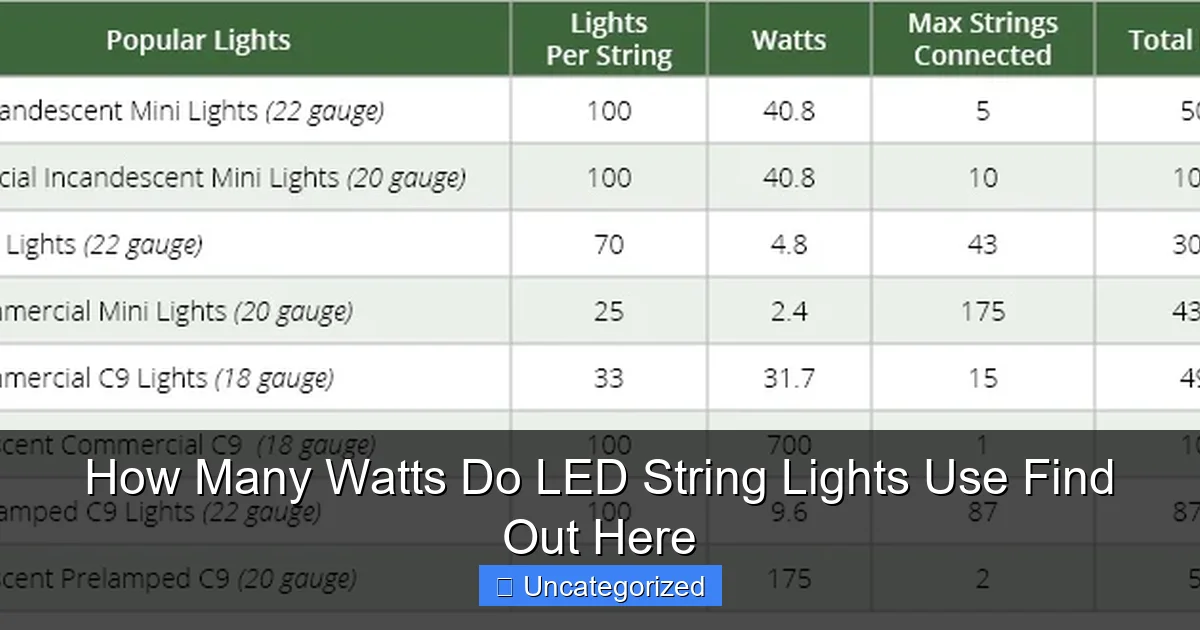
Visual guide about how many watts do led string lights use
Image source: alconlighting.com
1. Number of LEDs per Strand
One of the most direct factors affecting wattage is the number of LEDs on the string. A strand with 50 LEDs will naturally use more power than one with 25 LEDs, assuming all other variables are equal. For example, a 50-LED warm white string might use around 4.5 watts, while a 100-LED version could use 9 watts. However, this isn’t always a linear relationship—some manufacturers use more efficient LEDs that deliver more light per watt, so a 100-LED strand might still use only 7 watts if the diodes are high-efficiency.
Tip: Always check the product specifications for both the number of LEDs and the total wattage. A higher LED count doesn’t always mean higher energy use if the LEDs are optimized for efficiency.
2. LED Type and Brightness (Lumens)
Not all LEDs are created equal. Some are designed for high brightness (measured in lumens), while others are softer and more decorative. High-lumen LEDs, such as those used in commercial or outdoor lighting, may draw more power per diode. For instance, a bright “daylight white” LED used in outdoor path lighting might consume 0.1 watts per diode, whereas a softer “warm white” decorative LED might use only 0.06 watts per diode.
Additionally, some LED string lights use SMD (Surface-Mounted Device) LEDs, which are more energy-efficient and produce less heat than older DIP (Dual In-Line Package) LEDs. SMD LEDs are commonly found in modern, high-quality string lights and can reduce overall wattage by 10–20% compared to similar-length DIP-based strands.
3. Color of the LEDs
Believe it or not, the color of the LEDs affects power consumption. White LEDs, especially cool white and daylight, tend to use slightly more power than colored LEDs like red, green, or blue. This is because white LEDs are often created by combining blue LEDs with phosphor coatings, which requires more energy than simply emitting a single color directly.
For example, a 50-LED red string might use 3 watts, while the same number of cool white LEDs could use 4.5 watts. If you’re decorating for a themed event or want to save energy, choosing colored LEDs can be a smart strategy—especially for long-term installations.
4. String Length and Voltage
Longer strings naturally require more LEDs and therefore consume more watts. However, voltage also plays a role. Most LED string lights operate at low voltage (12V or 24V), especially if they’re powered by a transformer or plug adapter. This is safer and more energy-efficient than 120V AC strings. Some battery-powered or solar-powered lights use even lower voltage (3V–6V), which drastically reduces wattage.
For instance, a 120V plug-in string with 100 LEDs might use 9 watts, while a 12V version of the same design could use only 7 watts due to improved circuit efficiency. Always check the voltage rating—it can significantly impact both safety and energy use.
5. Special Features (Flashing, Color-Changing, Smart Controls)
LED string lights with advanced features like color-changing modes, twinkling effects, remote controls, or smartphone app integration often use more power due to the added circuitry and microcontrollers. For example, a basic static white string might use 5 watts, while a color-changing RGB string with multiple modes could use 8–10 watts for the same number of LEDs.
Smart LED strings (like those compatible with Alexa or Google Assistant) may also have a small standby power draw (0.5–1 watt) even when turned off, due to Wi-Fi or Bluetooth connectivity. While this is minimal, it can add up over time if you have multiple smart strands.
Comparing LED String Light Wattage by Type and Use
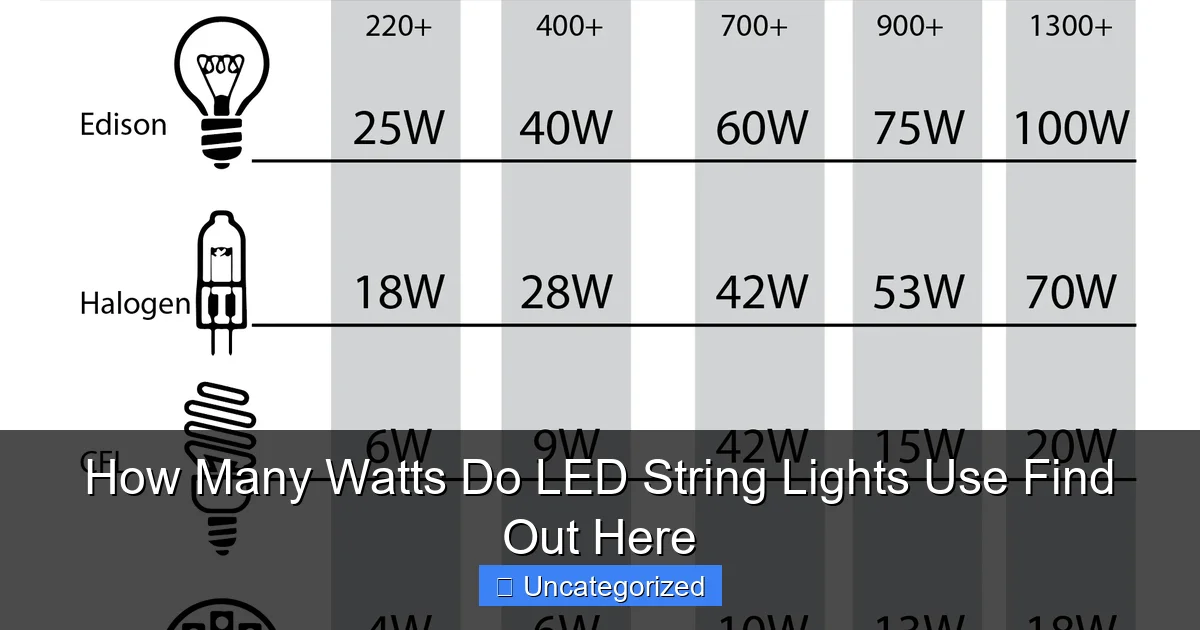
Now that we understand the factors that influence wattage, let’s explore how different types of LED string lights compare in real-world use. From indoor holiday lights to outdoor garden installations, each category has unique energy profiles.
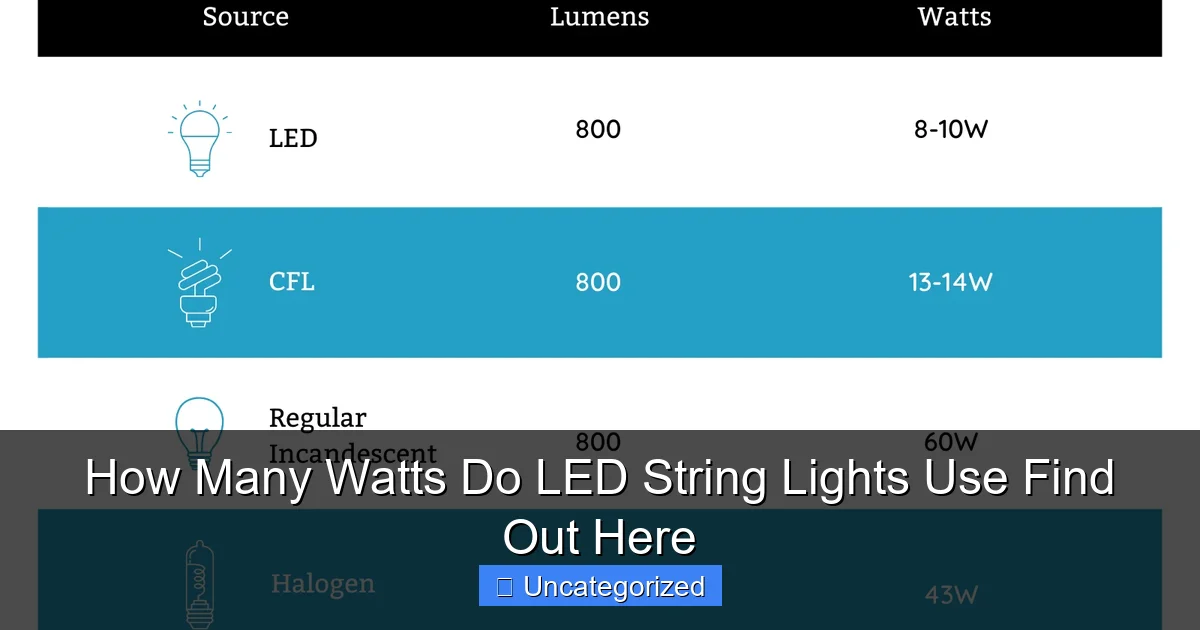
Visual guide about how many watts do led string lights use
Image source: cdn.shopify.com
1. Holiday and Christmas String Lights
These are perhaps the most popular use case for LED string lights. A standard 50-LED warm white Christmas light strand typically uses 4–5 watts. A 100-LED version uses about 8–10 watts, and a 200-LED strand might use 16–20 watts. Compare this to older incandescent Christmas lights, which could use 40–50 watts for just 50 bulbs—LEDs are up to 90% more efficient.
Practical Tip: If you’re decorating a large tree with 10 strands of 100-LED lights, your total consumption would be around 80–100 watts. That’s less than a single 100-watt incandescent bulb! This efficiency allows you to run holiday lights for 8–10 hours per night without significantly impacting your electric bill.
2. Outdoor and Garden String Lights
Outdoor LED string lights are built to withstand weather and often have brighter, more durable LEDs. A 50-foot strand of outdoor LED lights with 150 LEDs (e.g., Edison-style bulbs) typically uses 12–15 watts. These are often rated for wet locations and may include waterproof connectors and shatterproof bulbs.
For landscape lighting, such as path lights or string lights wrapped around trees, wattage can vary. A 30-foot strand with 30 warm white LEDs might use only 3 watts, making it ideal for subtle, energy-efficient illumination. Some outdoor lights are solar-powered and use 0.5–2 watts when charging and 1–3 watts when lit—perfect for off-grid use.
3. Indoor Decorative and Accent Lighting
Indoor LED string lights are often softer and more decorative. Fairy lights, curtain lights, and net lights fall into this category. A 16-foot curtain light with 300 LEDs might use 18–22 watts, while a delicate 3-foot fairy light strand with 20 LEDs uses just 1–1.5 watts.
These lights are often used for weddings, bedrooms, or photo backdrops. Because they’re used indoors, safety is less of a concern, but energy efficiency is still important—especially if you leave them on for hours. Many indoor lights are USB-powered or battery-operated, drawing as little as 0.5 watts.
4. Commercial and Event Lighting
For large-scale events like weddings, festivals, or storefronts, LED string lights are often used in massive quantities. Commercial-grade LED strands (e.g., 250–500 LEDs per strand) can use 25–50 watts per strand, but they’re designed for durability and brightness. However, because they use high-efficiency LEDs, they still consume far less than equivalent incandescent setups.
Example: A wedding venue using 20 strands of 250-LED commercial lights (50 watts each) would use 1,000 watts total. That’s equivalent to ten 100-watt bulbs, but spread across thousands of tiny LEDs—resulting in a stunning, energy-efficient display.
5. Battery-Powered and USB LED Strings
These are the most energy-efficient options. A typical 20-LED battery-powered string uses 0.6–1 watt and can run for 10–20 hours on 2 AA batteries. USB-powered strings (e.g., for laptops or power banks) use similar wattage and are ideal for temporary setups.
While they’re not suitable for long-term outdoor use, they’re perfect for camping, travel, or temporary decor. Some even come with motion sensors or timers to further reduce energy use.
How to Calculate and Estimate LED String Light Wattage
Knowing how to estimate or calculate wattage can help you avoid overloading circuits, manage electricity costs, and plan your lighting setup effectively. Here’s how to do it with confidence.
1. Check the Product Label and Specifications
The easiest and most accurate way to find wattage is to look at the packaging or product description. Reputable manufacturers always list the total wattage, number of LEDs, voltage, and amperage. For example, a label might read: “50 LEDs, 4.8W, 120V, 0.04A.” This tells you everything you need to know.
If wattage isn’t listed, look for amperage (A) and voltage (V). Use the formula: Watts = Volts × Amps. For instance, a 12V string drawing 0.4A uses 4.8 watts (12 × 0.4 = 4.8).
2. Estimate Based on LED Count and Type
You can make a rough estimate using average watt-per-LED values:
- Standard white or warm white LED: 0.06–0.1 watts per LED
- Colored LED (red, green, blue): 0.03–0.05 watts per LED
- High-brightness or RGB LED: 0.1–0.2 watts per LED
Example: A 100-LED warm white string (0.08 watts per LED) would use about 8 watts (100 × 0.08 = 8).
3. Measure with a Kill A Watt or Energy Monitor
For precise measurement, use a plug-in energy monitor like the Kill A Watt. Plug your LED string into the device, and it will display real-time wattage, voltage, amperage, and even cumulative energy use (in kWh). This is especially useful for testing multiple strands or smart lights with standby modes.
4. Calculate Total Energy Use and Cost
Once you know the wattage, you can estimate monthly energy use and cost:
- Multiply wattage by hours used per day to get watt-hours (Wh)
- Divide by 1,000 to get kilowatt-hours (kWh)
- Multiply by your electricity rate (e.g., $0.15/kWh)
Example: A 10-watt LED string used 8 hours per night for 30 days:
10W × 8h × 30 = 2,400 Wh = 2.4 kWh
2.4 kWh × $0.15 = $0.36 per month
This calculation shows how affordable LED lighting truly is—especially compared to incandescent alternatives.
5. Avoid Overloading Circuits
Most household circuits are rated for 15 or 20 amps. At 120V, that’s 1,800 or 2,400 watts. To stay safe, don’t exceed 80% of the circuit’s capacity (1,440W for a 15A circuit).
Tip: You can safely connect up to 144 strands of 10-watt LED lights on a 15A circuit (1,440W ÷ 10W = 144). However, always check the manufacturer’s daisy-chaining limits—some lights can only be connected up to 3–5 strands in series.
Energy Efficiency and Cost Comparison: LED vs. Incandescent
One of the biggest advantages of LED string lights is their energy efficiency. Let’s compare them to traditional incandescent lights to see the real savings.
Wattage Comparison Table
| Light Type | LED | Incandescent | Energy Savings |
|---|---|---|---|
| 50-LED/Bulb Strand | 4–5 watts | 40–50 watts | 88–90% |
| 100-LED/Bulb Strand | 8–10 watts | 80–100 watts | 88–90% |
| 200-LED/Bulb Strand | 16–20 watts | 160–200 watts | 88–90% |
| 1,000 Bulbs (Large Display) | 80–100 watts | 800–1,000 watts | 88–90% |
As the table shows, LED lights use about 90% less energy than incandescent equivalents. This isn’t just good for your wallet—it’s also better for the environment. Lower energy use means fewer carbon emissions, especially if your electricity comes from fossil fuels.
Cost Savings Over Time
Let’s assume you use 500 LED string lights (50 strands of 100 LEDs) for 8 hours per night during the holiday season (60 days):
- LED: 50 strands × 9W = 450W; 450W × 8h × 60 = 216,000 Wh = 216 kWh; 216 × $0.15 = $32.40
- Incandescent: 50 strands × 90W = 4,500W; 4,500W × 8h × 60 = 2,160,000 Wh = 2,160 kWh; 2,160 × $0.15 = $324.00
You save $291.60 by using LEDs—over 90% less! Plus, LEDs last up to 25,000–50,000 hours, while incandescents last only 1,000–2,000 hours. That means fewer replacements and less waste.
Additional Benefits of LED Efficiency
- Less Heat: LEDs run cooler, reducing fire risk and making them safer around fabrics and children.
- Longer Lifespan: No filament to burn out—LEDs can last decades with proper use.
- Eco-Friendly: No mercury (unlike CFLs) and lower carbon footprint.
Tips to Maximize Efficiency and Minimize Energy Use
Even though LED string lights are already energy-efficient, you can further reduce power consumption and extend their lifespan with a few smart practices.
1. Use Timers and Smart Plugs
Instead of leaving lights on all night, use a mechanical or digital timer to turn them on at dusk and off at bedtime. Smart plugs allow you to schedule lighting via an app or voice command. This can cut energy use by 30–50%.
2. Choose the Right Brightness
Not every space needs bright, high-lumen lights. For bedrooms, patios, or ambient decor, opt for softer, lower-wattage strands. Save the high-brightness lights for areas that need visibility, like stairways or outdoor walkways.
3. Combine with Solar or Battery Power
For outdoor use, consider solar-powered LED strings. They charge during the day and use minimal power at night. Battery-powered lights are ideal for temporary setups and eliminate the need for extension cords.
4. Avoid Over-Daisy-Chaining
Connecting too many strands in series can reduce brightness and increase resistance, leading to inefficiency. Follow manufacturer guidelines (usually 3–5 strands max) and use a power distribution block for large installations.
5. Clean and Maintain Your Lights
Dust and debris can block light output, making you want to turn on more strands. Clean your lights periodically and store them properly to prevent damage and ensure optimal performance.
6. Use Reflective Surfaces
Place lights near white walls, mirrors, or metallic surfaces to amplify their glow. This allows you to use fewer strands while achieving the same effect—saving both energy and money.
Final Thoughts: Smart Lighting for Every Occasion
LED string lights have revolutionized the way we decorate our homes, events, and outdoor spaces. With wattage ranging from 0.5 watts for tiny fairy lights to 50 watts for commercial-grade displays, there’s an energy-efficient option for every need. The average homeowner can expect to use just 5–10 watts per 100 LEDs, making LED lighting one of the most cost-effective and eco-friendly choices available.
By understanding the factors that influence wattage—LED count, color, voltage, and features—you can make informed decisions that balance beauty, safety, and efficiency. Whether you’re stringing lights around a Christmas tree, creating a romantic garden ambiance, or lighting up a wedding venue, knowing how many watts your LED string lights use empowers you to design stunning displays without breaking the bank or overloading your circuits.
Remember: LEDs aren’t just bright—they’re smart, safe, and sustainable. With the tips and insights in this guide, you can light up your world with confidence, knowing exactly how much power you’re using and how to keep it low. So go ahead—deck the halls, light up the night, and enjoy the magic of LED string lights, one watt at a time.
Frequently Asked Questions
How many watts do LED string lights use on average?
Most LED string lights use between 4 to 12 watts per 20-foot strand, depending on bulb count and brightness. They are far more energy-efficient than incandescent lights, using up to 80% less power.
Do LED string lights use less power than traditional string lights?
Yes, LED string lights use significantly less power—often less than 10 watts per strand—compared to 50-100 watts for incandescent equivalents. This makes them ideal for long-term use and reducing electricity bills.
How many watts do LED string lights use for outdoor holiday displays?
Outdoor LED string lights typically range from 6 to 14 watts per 25-foot strand, depending on density and color. Their low wattage allows safe, extended use without overloading circuits.
Can I connect multiple LED string lights without exceeding wattage limits?
Yes, because LED string lights use low wattage, you can safely connect 10-20 strands (check manufacturer guidelines). Always calculate total wattage to stay under your circuit’s 180-watt limit for safety.
How do I calculate the wattage of my LED string lights?
Check the product packaging or label for the wattage per bulb, then multiply by the total number of bulbs. For example, 100 bulbs at 0.08 watts each use 8 watts total.
Are solar-powered LED string lights measured in watts?
Solar LED string lights still use watts, but their power comes from stored solar energy. They typically use 1-5 watts, depending on brightness, and are ideal for off-grid lighting.