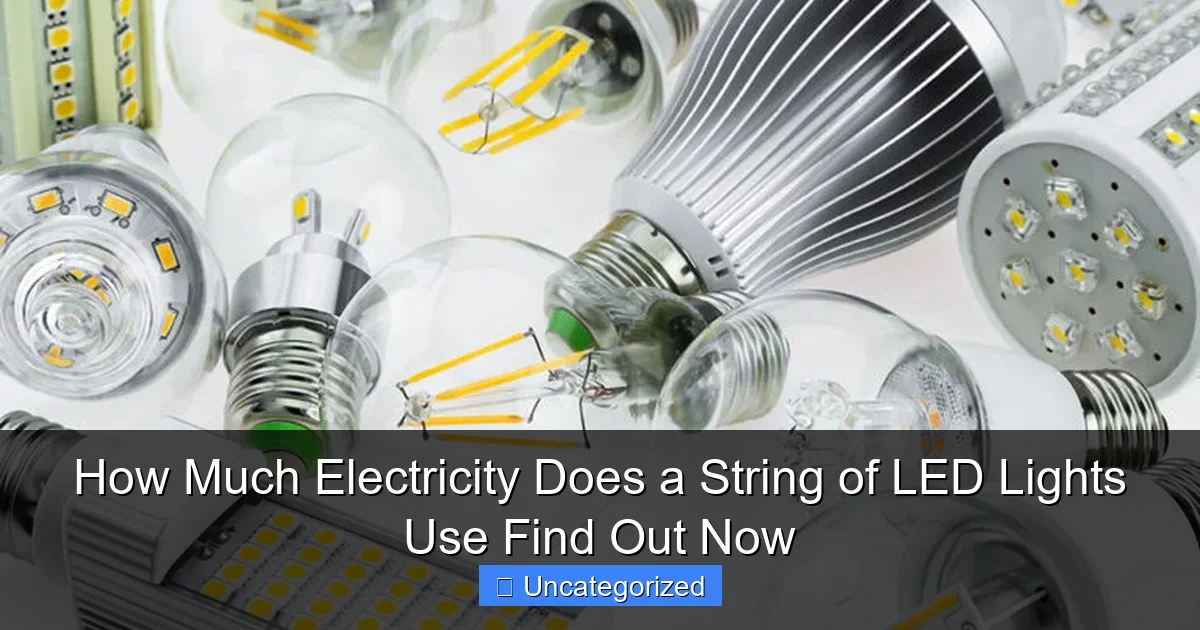
Featured image for how much electricity does a string of led lights use
Image source: localelectricalgroup.co.uk
A typical string of LED lights uses only 1 to 10 watts of electricity, making them up to 80% more energy-efficient than incandescent bulbs. Running a 5-watt LED string for 10 hours costs less than $0.01, offering brilliant illumination at a fraction of the cost—ideal for eco-conscious decorators and holiday displays alike.
Key Takeaways
- LEDs use 75% less energy than incandescent lights, slashing electricity costs.
- Check wattage ratings to estimate usage: most LED strings use 1–10 watts.
- Longer strings consume more power—measure total length for accurate calculations.
- Use timers or smart plugs to reduce runtime and save energy effortlessly.
- Compare lumens, not watts—higher brightness doesn’t always mean higher usage.
- Energy Star-certified LEDs guarantee efficiency and lower electricity bills long-term.
📑 Table of Contents
Understanding LED Light Power Consumption
What Makes LED Lights Different?
Light Emitting Diode (LED) lights have revolutionized the lighting industry by offering a highly efficient alternative to traditional incandescent and fluorescent lights. Unlike incandescent bulbs, which generate light by heating a filament, LEDs produce light through a process called electroluminescence. This method is far more energy-efficient, converting a higher percentage of electrical energy into visible light rather than heat. As a result, LED lights consume significantly less electricity while providing the same or better brightness. For homeowners and businesses alike, understanding how much electricity does a string of LED lights use is crucial for making informed decisions about energy consumption and cost savings.
LEDs also have a longer lifespan, often lasting tens of thousands of hours compared to the mere 1,000 hours typical of incandescent bulbs. This longevity, combined with their lower energy usage, makes them an economically and environmentally sound choice. Whether you’re decorating for the holidays, enhancing your home’s ambiance, or lighting up an outdoor space, LED string lights offer a practical solution. In this article, we’ll delve into the specifics of LED power consumption, explore the factors that influence it, and provide practical tips to help you maximize efficiency while minimizing costs.
Why It Matters
Knowing how much electricity your LED lights consume isn’t just about reducing your utility bill—it’s also about environmental responsibility. Lower energy usage translates to reduced greenhouse gas emissions, especially if your electricity comes from fossil fuels. Additionally, understanding power consumption helps prevent overloading circuits, which can be a fire hazard in extreme cases. With the increasing popularity of smart homes and energy monitoring devices, having precise data on your lighting’s energy use allows for better integration with energy-saving technologies.
Factors Affecting LED String Light Electricity Use
Wattage and Brightness
The most direct factor influencing electricity use is the wattage of the LED string lights. LED lights are typically labeled with their wattage, which indicates how much power they draw per hour of operation. For example, a string of LED lights might consume 5 watts per 100 bulbs, whereas a comparable incandescent string could use 40 watts. This stark difference highlights why how much electricity does a string of LED lights use is a key consideration for energy-conscious consumers.
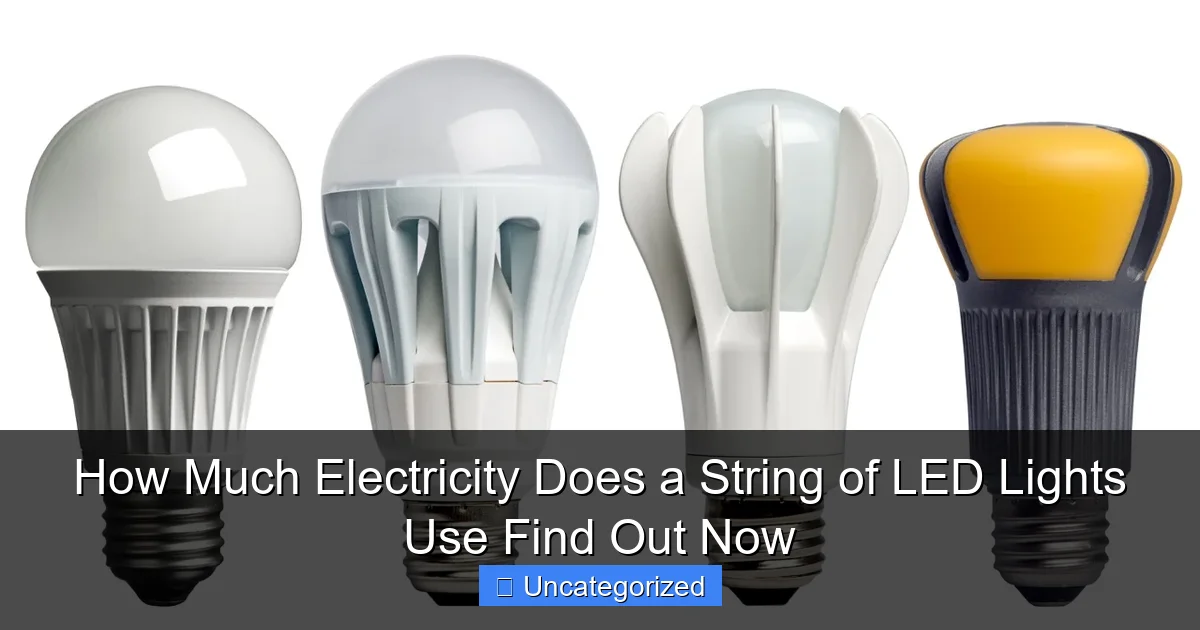
Visual guide about how much electricity does a string of led lights use
Image source: storables.com
Brightness, measured in lumens, also plays a role. While two LED strings might have the same wattage, one may produce more lumens due to higher-quality LEDs or better design. Higher lumens mean more visible light per watt, which is a measure of luminous efficacy. For instance, a 5-watt LED string producing 500 lumens is more efficient than a 5-watt string producing only 300 lumens. Always check both the wattage and lumens when comparing products to understand their true efficiency.
Length and Number of LEDs
The length of the string and the number of LEDs directly impact total power consumption. A 25-foot string with 50 LEDs will use less electricity than a 100-foot string with 200 LEDs, assuming similar LED specifications. However, it’s essential to note that not all LEDs are created equal—some strings use more powerful individual LEDs, which can increase wattage even if the number of bulbs is the same.
To illustrate, consider two 25-foot strings:
- String A: 50 LEDs, each consuming 0.05 watts → Total: 2.5 watts
- String B: 50 LEDs, each consuming 0.1 watts → Total: 5 watts
Even though both strings have the same number of LEDs and length, String B uses twice as much electricity. Always look for product specifications that detail individual LED wattage or total string wattage to make accurate comparisons.
Color and Technology
The color of the LEDs can also affect energy use. White LEDs, especially cool white, tend to be more efficient than colored LEDs like red, green, or blue. This is because the phosphor coating used in white LEDs to convert blue light into white light adds complexity but also improves overall efficiency. Multicolor or RGB (red-green-blue) strings, which can change colors, often use more power when displaying white or mixed colors due to the need to activate multiple diodes simultaneously.
Advanced technologies like smart LEDs, which include features such as app control, dimming, and color-changing capabilities, may have higher base power consumption due to the additional electronics. However, these features can also contribute to energy savings by allowing you to dim the lights or turn them off remotely, reducing unnecessary usage.
Calculating Electricity Consumption and Costs
Step-by-Step Calculation
Calculating the electricity consumption of your LED string lights is straightforward once you know the wattage and usage time. Here’s how to do it:
- Determine the total wattage: Check the product label or manual. For example, a 100-bulb string might use 4.8 watts.
- Calculate daily energy use: Multiply the wattage by the number of hours you use the lights daily. For 4.8 watts used for 6 hours: 4.8W × 6h = 28.8 watt-hours (Wh) per day.
- Convert to kilowatt-hours (kWh): Divide by 1,000. 28.8Wh ÷ 1,000 = 0.0288 kWh per day.
- Calculate monthly or annual use: Multiply daily kWh by the number of days. For a month: 0.0288 kWh/day × 30 days = 0.864 kWh/month.
- Determine cost: Multiply kWh by your electricity rate (e.g., $0.12 per kWh). 0.864 kWh × $0.12 = $0.1037 per month, or about $1.24 per year.
This example shows that a modest string of LED lights costs just over a dollar a year to operate—a fraction of what incandescent lights would cost.
Visual guide about how much electricity does a string of led lights use
Image source: archute.com
Real-World Example: Holiday Decorations
Let’s consider a holiday scenario with multiple strings:
- 5 strings of LED lights, each 50 feet long with 100 bulbs, totaling 24 watts per string.
- Used for 6 hours per night from December 1 to December 31 (31 days).
Total wattage: 5 × 24W = 120W
Daily energy use: 120W × 6h = 720Wh = 0.72 kWh
Monthly energy use: 0.72 kWh/day × 31 days = 22.32 kWh
Cost at $0.12/kWh: 22.32 × $0.12 = $2.68
For comparison, using incandescent lights with the same length and bulb count would consume approximately 400 watts per string, resulting in a monthly cost of over $14. This stark difference underscores why how much electricity does a string of LED lights use is a critical question for anyone looking to save money and energy during the holidays.
Using Energy Monitoring Tools
For precise measurements, consider using an energy monitor like a Kill A Watt meter. These devices plug between your lights and the outlet, providing real-time data on voltage, amperage, wattage, and cumulative energy use in kWh. They’re invaluable for testing different lighting setups and identifying energy hogs in your home. Some smart plugs also offer energy monitoring features, allowing you to track usage remotely via a smartphone app.
Comparing LED Lights to Other Lighting Types
LED vs. Incandescent
The energy efficiency gap between LED and incandescent lights is enormous. On average, LED lights use about 80-90% less electricity than incandescent bulbs to produce the same amount of light. For string lights, this means:
- A 100-bulb incandescent string: ~40 watts
- A comparable LED string: ~4.8 watts
Over a 30-day holiday period, the incandescent string would use approximately 72 kWh (40W × 6h × 30 days ÷ 1,000), costing $8.64 at $0.12/kWh. The LED string would use only 8.64 kWh, costing $1.04—a savings of $7.60. The LED also lasts up to 25 times longer, reducing replacement costs and waste.
LED vs. Fluorescent
Fluorescent lights are more efficient than incandescent but still lag behind LEDs. Compact fluorescent (CFL) string lights, if available, typically use about 50-70% less energy than incandescent. However, they have drawbacks:
- Lower color quality and slower warm-up time
- Contain mercury, requiring special disposal
- Shorter lifespan than LEDs (8,000-10,000 hours vs. 25,000+ for LEDs)
For outdoor use, fluorescent lights are also less durable in cold temperatures, which can affect performance. LEDs, by contrast, perform well in a wide temperature range and are increasingly affordable, making them the superior choice for most applications.
LED vs. Halogen
Halogen lights, a type of incandescent, are slightly more efficient but still consume significantly more power than LEDs. A halogen string light might use 20-30 watts for a similar setup, resulting in 36-54 kWh over a holiday month (costing $4.32-$6.48). While halogens offer better color rendering than traditional incandescent, they generate more heat, posing a fire risk near flammable decorations. LEDs remain the safest and most efficient option.
Energy-Saving Tips for LED String Lights
Use Timers and Smart Controls
One of the simplest ways to reduce electricity use is to limit the operating time of your LED lights. Instead of leaving them on all night, use a mechanical or digital timer to turn them off automatically after a set period. For example:
- Set the timer for 6 hours (e.g., 5 PM to 11 PM) to match typical evening use.
- Use a dusk-to-dawn timer that activates lights at sunset and turns them off at sunrise.
Smart plugs or timers with app control allow you to adjust schedules remotely, ensuring lights are only on when needed. Some systems even integrate with voice assistants like Alexa or Google Assistant for hands-free control.
Opt for Lower-Wattage and Energy-Star Certified Products
When purchasing LED string lights, look for the Energy Star label, which guarantees the product meets strict efficiency standards. Energy Star-certified LED lights use at least 75% less energy than incandescent and are tested for quality, reliability, and longevity. Compare wattage and lumens across brands to find the most efficient option for your needs. For instance, a 3.6-watt string producing 360 lumens is more efficient than a 4.8-watt string producing the same brightness.
Dimming and Color Temperature
Many LED string lights offer dimming features, which can reduce power consumption. Lowering the brightness by 50% typically cuts energy use by about 40%, as LEDs don’t scale linearly with dimming. Additionally, choosing warmer color temperatures (2700K-3000K) can create a cozy ambiance with slightly lower energy use compared to cooler temperatures (5000K-6500K), which require more blue light and thus more power.
Proper Placement and Maintenance
Strategic placement can enhance efficiency:
- Use reflective surfaces (e.g., white walls, mirrors) to amplify light, allowing you to use fewer strings.
- Clean dust and debris from LEDs periodically to maintain optimal brightness.
- Store lights properly to avoid damage, ensuring they last for many seasons.
Avoid overloading circuits by checking the maximum wattage your outlets can handle (typically 1,500-1,800 watts for a standard 15-amp circuit). For large installations, distribute lights across multiple circuits to prevent tripped breakers.
Data Table: LED String Light Power Consumption
| LED String Type | Length | Number of LEDs | Total Wattage | Lumens | Daily Energy Use (6 hours) | Monthly Cost (30 days, $0.12/kWh) | Annual Cost (365 days) |
|---|---|---|---|---|---|---|---|
| Mini LED (Warm White) | 25 ft | 50 | 2.4W | 200 | 14.4Wh (0.0144 kWh) | $0.052 | $0.63 |
| Mini LED (Cool White) | 50 ft | 100 | 4.8W | 500 | 28.8Wh (0.0288 kWh) | $0.1037 | $1.26 |
| Large LED (C7) | 25 ft | 25 | 3.6W | 150 | 21.6Wh (0.0216 kWh) | $0.078 | $0.95 |
| RGB Color-Changing | 50 ft | 150 | 7.2W | 600 | 43.2Wh (0.0432 kWh) | $0.1555 | $1.89 |
| Smart LED (Wi-Fi) | 25 ft | 50 | 5.0W | 400 | 30Wh (0.03 kWh) | $0.108 | $1.31 |
| Incandescent (for comparison) | 50 ft | 100 | 40W | 800 | 240Wh (0.24 kWh) | $0.864 | $10.51 |
This table illustrates how even modest LED setups use minimal electricity compared to incandescent alternatives. The annual cost difference between the most efficient LED and incandescent is nearly $10, highlighting the long-term savings potential.
Conclusion
Understanding how much electricity does a string of LED lights use empowers you to make smarter, more sustainable choices for your home or business. With energy consumption as low as 2.4 watts for a 25-foot string and annual costs often under $2, LED lights offer unparalleled efficiency, longevity, and versatility. By considering factors like wattage, length, color, and technology, you can select the perfect lighting solution for any occasion—without breaking the bank or overloading your circuits.
Implementing energy-saving practices such as using timers, choosing Energy Star-certified products, and leveraging dimming features can further reduce your environmental footprint and utility bills. The data clearly shows that LED string lights are not only cost-effective but also a responsible choice for the planet. Whether you’re decorating for a holiday, enhancing your garden, or creating ambiance indoors, LEDs provide brilliant, efficient lighting that stands the test of time. Make the switch today and enjoy the glow of savings for years to come.
Frequently Asked Questions
How much electricity does a string of LED lights use compared to incandescent lights?
LED string lights consume up to 80-90% less electricity than traditional incandescent lights. For example, a 20-foot LED strand may use only 10-20 watts, while an incandescent equivalent could use 100+ watts.
What factors affect the electricity usage of LED string lights?
The total power draw depends on bulb count, brightness (lumens), color temperature, and usage duration. Larger strands with more bulbs or RGB color-changing features typically use more electricity.
How much electricity does a string of LED lights use per hour?
Most LED string lights use 0.5-2 watts per bulb, so a 50-bulb strand would consume 25-100 watts hourly. Always check the product’s wattage label for exact figures.
Do LED string lights increase my electricity bill significantly?
No—their low wattage means minimal impact on bills. Running a 50-watt LED strand 8 hours daily costs roughly $1.50 monthly (at $0.12/kWh).
Can I leave LED string lights on overnight without wasting electricity?
Yes. Their energy efficiency makes them safe for extended use, but timers or smart plugs can further reduce consumption. Always follow manufacturer safety guidelines.
How do I calculate the electricity cost of my LED string lights?
Multiply the wattage by hours used, divide by 1,000 to get kWh, then multiply by your local electricity rate. Example: (50W × 5h) ÷ 1,000 × $0.12 = $0.03 daily.