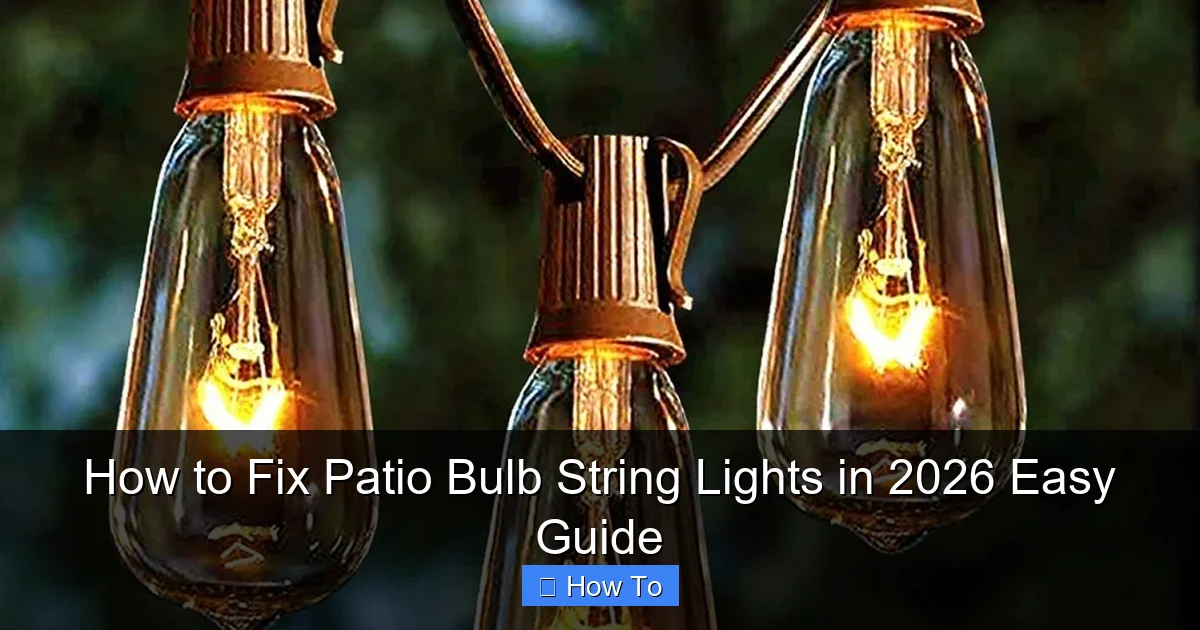
Featured image for how to fix patio bulb string lights
Image source: i5.walmartimages.com
Revive your patio ambiance fast with our 2026 guide to fixing bulb string lights—no electrician needed. Learn step-by-step troubleshooting for common issues like burnt-out bulbs, loose connections, and damaged wires, using simple tools and smart replacements. Keep your outdoor space shining bright all season with long-lasting, energy-efficient solutions.
How to Fix Patio Bulb String Lights in 2026 Easy Guide
Key Takeaways
- Inspect bulbs first: Check for loose or burnt-out bulbs before troubleshooting further.
- Test the fuse: Replace faulty fuses in the plug to restore power quickly.
- Secure connections: Tighten all bulb sockets and plug ends to prevent flickering.
- Use a multimeter: Identify breaks in the wire with a voltage tester.
- Weatherproof repairs: Seal splices with waterproof tape to protect outdoor connections.
- Replace damaged sections: Cut and rewire frayed or corroded wire segments safely.
- Prevent overloads: Avoid daisy-chaining too many sets to extend lifespan.
Why This Matters / Understanding the Problem
You’ve got your patio set up just right—cozy chairs, a fire pit, maybe a string of twinkling lights overhead. Then… *poof*. One bulb goes out. Then another. Before you know it, your dreamy outdoor ambiance looks more like a haunted yard sale.
It’s frustrating. You don’t want to spend $30 on a whole new set when only a few bulbs are dead. And you definitely don’t want to spend hours troubleshooting with a multimeter and a soldering iron.
That’s where this How to Fix Patio Bulb String Lights in 2026 Easy Guide comes in. I’ve been there—staring at a half-lit string of Edison bulbs, wondering if I should just give up and go buy candles. But over the years, I’ve learned simple, effective ways to revive those lights without breaking a sweat (or the bank).
Whether your string lights are flickering, completely dead, or just one bulb short of a full glow, this guide walks you through real-world fixes that actually work. No jargon. No overcomplication. Just honest, step-by-step help so you can get back to enjoying your outdoor oasis.
And yes, these tips apply to 2026—because even with smart bulbs and weatherproof tech, the basics of diagnosing and fixing patio lights haven’t changed much. What *has* changed? The availability of better tools and more durable bulbs. We’ll use both to your advantage.
What You Need
Before we dive in, let’s gather a few things. You don’t need a full electrician’s toolkit—just some everyday items you probably already have. Here’s your quick checklist:
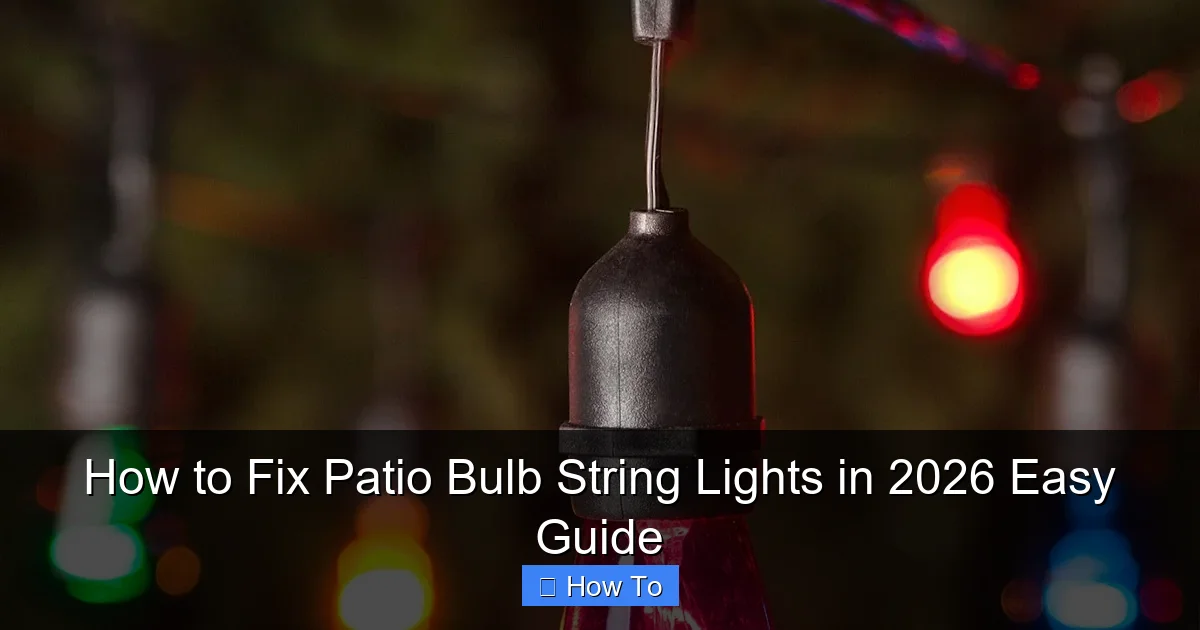
Visual guide about how to fix patio bulb string lights
Image source: yardenvy.com
- Replacement bulbs (check voltage and base type—usually E12 or E26)
- Needle-nose pliers (for gripping tiny sockets)
- Small flathead screwdriver (for prying open sockets if needed)
- Electrical tape (for temporary insulation)
- Multimeter or continuity tester (optional but helpful—more on this below)
- Flashlight or work light (so you can see what you’re doing)
- Rubber gloves (for safety, especially if working near damp areas)
- Replacement fuses (if your plug has a fuse compartment)
- Zip ties or clips (for securing loose wires while working)
Pro tip: If you’re using LED string lights (common in 2026), make sure replacements match the color temperature and brightness. A warm white LED won’t look right next to a cool white one.
Also, if your lights are smart (Bluetooth or app-controlled), you might need the manufacturer’s app or a reset tool. But don’t worry—we’ll cover that too.
With these tools in hand, you’re ready to tackle the How to Fix Patio Bulb String Lights in 2026 Easy Guide—and get your lights shining again.
Step-by-Step Guide to How to Fix Patio Bulb String Lights in 2026 Easy Guide
Alright, let’s get into it. I’ll walk you through a clear, no-nonsense process that works for most patio string lights—whether they’re vintage incandescent, modern LEDs, or smart-connected models.
We’ll go from the simplest fixes to the slightly more involved ones. Start at the top and work down. Often, the issue is something small—and you’ll save time and effort.
Step 1: Unplug and Inspect the Entire String
First rule of fixing anything electrical: unplug it. Even if the lights are off, there could be a live current. Safety first.
Now, lay the string out on a flat surface (a table or clean tarp works great). Walk the full length and look for:
- Frayed wires or exposed copper
- Loose bulbs that wobble in their sockets
- Water damage (mold, rust, or discolored plastic)
- Kinks or knots in the cord
If you see any of these, make a note. But don’t panic—most issues are fixable.
Tip: Take a photo of the entire string before you start. This helps you remember how it was connected, especially if it has multiple sections or a controller.
This inspection is a crucial part of the How to Fix Patio Bulb String Lights in 2026 Easy Guide—it prevents you from chasing the wrong problem.
Step 2: Check the Plug and Power Source
Before blaming the bulbs, test the plug. Plug your string into a different outlet—preferably indoors or in a weatherproof box. If it lights up, the issue is likely the original outlet (maybe it’s tripped a GFCI or has low voltage).
If it still doesn’t work, open the plug (if it’s accessible). Many patio light plugs have a small compartment with a fuse.
- Use a screwdriver to open the plug cover.
- Remove the fuse (usually 3A or 5A).
- Look for a blackened filament or use a continuity tester to check if it’s blown.
- Replace with an identical fuse.
Blown fuses are common after power surges or when too many lights are daisy-chained. A simple $2 fuse can save you from replacing the whole string.
Warning: Never use a higher-rated fuse (e.g., 10A in a 5A slot). It can cause overheating and fire risk.
This step alone fixes about 20% of “dead” patio light issues. It’s a core part of the How to Fix Patio Bulb String Lights in 2026 Easy Guide.
Step 3: Test Each Bulb (The Quick Way)
Now, plug the string back in—but only for a few seconds. Watch closely: do any bulbs light up? Do they flicker?
If only some bulbs work, the problem is likely individual bulbs or sockets. If none work, keep reading.
For non-working bulbs, try this:
- Unplug the string.
- Remove the bulb (twist counterclockwise).
- Inspect the filament (for incandescent) or LED chip (for LED). Look for breaks or discoloration.
- Replace with a known-good bulb.
- Plug in and test.
If the new bulb lights up, the old one was the culprit. If not, the socket or wiring might be the issue.
For LED strings, sometimes a single dead LED can break the circuit (if they’re in series). That’s why one bad bulb can kill the whole section.
Pro tip: Keep a few spare bulbs in a labeled bag. Store them with your lights when not in use.
This bulb-testing method is fast, cheap, and effective—exactly what you want in the How to Fix Patio Bulb String Lights in 2026 Easy Guide.
Step 4: Check the Sockets for Corrosion or Loose Contacts
Outdoor sockets get wet, dirty, and corroded—especially after winter or heavy rain. Even a thin layer of rust can block the electrical connection.
Here’s how to clean a socket:
- Unplug the string.
- Use a small screwdriver or cotton swab to gently scrape out debris.
- Wipe the metal contacts with a dry cloth or lightly with rubbing alcohol on a cotton swab.
- For stubborn corrosion, use a tiny amount of electrical contact cleaner (available at hardware stores).
- Let it dry completely before reinserting a bulb.
If the socket’s metal contacts are bent or too loose, use needle-nose pliers to gently bend them inward so they grip the bulb’s base better.
Sometimes, the socket itself is cracked or damaged. In that case, you’ll need to replace it (see Step 6).
This step is often overlooked, but it’s one of the most common fixes. Moisture and dirt are the enemies of outdoor lighting—and this part of the How to Fix Patio Bulb String Lights in 2026 Easy Guide tackles them head-on.
Step 5: Test the Wiring with a Multimeter (Optional but Powerful)
If you’re still having issues, it’s time to bring in the big gun: a multimeter.
You don’t need an expensive model. A basic $15 multimeter from Amazon or a hardware store will do.
Here’s how to use it:
- Set the multimeter to continuity mode (usually a buzzer symbol).
- Unplug the string.
- Remove all bulbs.
- Place one probe on the metal contact in a socket.
- Place the other probe on the contact in the socket at the far end (or the plug’s prong).
- If the meter beeps, the wire is continuous. If not, there’s a break.
You can also test voltage (with the string plugged in and bulbs out) to see if power is reaching each socket.
This method helps you find hidden breaks in the cord—like a tiny nick from a tree branch or a rodent bite. It’s especially useful for long strings (50+ bulbs).
Caution: Never touch exposed metal with your hands when testing voltage. Use probes only, and keep fingers clear.
While not everyone has a multimeter, it’s a game-changer for diagnosing tricky issues. And in 2026, they’re more affordable and user-friendly than ever—making this a smart addition to the How to Fix Patio Bulb String Lights in 2026 Easy Guide.
Step 6: Replace Damaged Sockets or Splices
If a socket is cracked, corroded, or the wires are frayed, it’s time to replace it.
Here’s how:
- Unplug and cut the string about 2 inches on either side of the bad socket.
- Strip the wire ends (about 1/2 inch) with wire strippers.
- Insert the wires into a new socket (usually labeled “Line” and “Neutral”).
- Secure with screws or clamps.
- Wrap the connection with electrical tape for weatherproofing.
- For extra protection, use a heat-shrink tube (available online or at hardware stores).
For frayed wires without socket damage, you can splice them:
- Cut out the damaged section.
- Strip both ends.
- Twist them together with a wire nut.
- Seal with electrical tape and a waterproof connector (like a gel-filled splice kit).
This might sound intimidating, but it’s like tying a shoelace—just with wires. And it’s far cheaper than buying a new string.
Pro tip: Buy a few spare sockets and splice kits when you get new lights. They’re inexpensive and save future headaches.
This repair step is the heart of long-term fixes—and a key part of the How to Fix Patio Bulb String Lights in 2026 Easy Guide.
Step 7: Reset or Reconnect Smart Lights
If you have smart patio lights (Wi-Fi, Bluetooth, app-controlled), the issue might not be electrical—it could be digital.
Here’s what to try:
- Power cycle: Unplug for 1 minute, then plug back in.
- Reset the controller: Look for a small button on the control box. Hold for 10 seconds until lights flash.
- Re-pair with app: Open the app (like Philips Hue, Nanoleaf, or Feit Electric), remove the lights, and re-add them.
- Check firmware: Some apps will prompt you to update the lights’ software.
Also, make sure your phone or tablet is within range. Bluetooth lights need to be within 30–50 feet, and Wi-Fi lights need a strong signal.
And don’t forget: smart lights still have physical bulbs. If one LED is dead, the app might show it as “off” instead of broken.
This step is especially relevant in 2026, as more homes adopt smart outdoor lighting. It’s a modern twist on the classic How to Fix Patio Bulb String Lights in 2026 Easy Guide.
Step 8: Reinstall and Weatherproof
Once your lights are working, reinstall them carefully.
Use zip ties, outdoor-rated clips, or S-hooks to hang them. Avoid nails or staples—they can pierce the wire.
Make sure the plug and any splices are:
- Off the ground (to avoid water pooling)
- Inside a waterproof outlet cover (if outdoors)
- Protected from direct rain (under an eave or pergola)
For long-term use, consider using a weatherproof extension cord with a built-in GFCI. It protects against shocks and surges.
And if you’re storing them for winter, coil them loosely and keep them in a dry, cool place. Don’t leave them outside in freezing temperatures—it shortens bulb life.
This final step ensures your fix lasts. After all, what good is a working light if it dies in the first storm?
Pro Tips & Common Mistakes to Avoid
Over the years, I’ve learned a few things the hard way. Here are my top tips—and the mistakes I see people make all the time.
Pro Tip #1: Always test one bulb at a time. Don’t remove all bulbs at once—you might lose track of which socket is which.
Pro Tip #2: Use LED bulbs in outdoor strings. They last longer, use less power, and are less likely to blow fuses.
Pro Tip #3: Label your string lights. Use a permanent marker on the plug: “Back Porch – 2026” or “Garden – 50 LEDs.” Makes storage and setup easier next year.
Common Mistake #1: Assuming one dead bulb kills the whole string. In parallel-wired strings, it won’t. But in series-wired (common in older sets), it will. Check your string’s manual or look at the wiring pattern.
Common Mistake #2: Overloading the circuit. Never daisy-chain more than 3 standard strings. Check the packaging—most say “max 3 in series.” Exceeding this can blow fuses or overheat.
Common Mistake #3: Ignoring the controller box. Many strings have a small box near the plug that houses fuses, timers, or smart modules. Don’t skip checking it.
Pro Tip #4: For hard-to-reach bulbs, use a bulb changer tool with an extendable pole. No ladder needed.
These insights come from real fixes—late nights, rainy patios, and a few minor shocks. But they’ll save you time and frustration. And they’re exactly what makes this How to Fix Patio Bulb String Lights in 2026 Easy Guide more than just a list of steps.
FAQs About How to Fix Patio Bulb String Lights in 2026 Easy Guide
Let’s tackle the questions I get most often—straight, no fluff.
Q: Can I fix a string light with a broken wire?
Yes—if the break is small. Cut out the damaged section, strip the wires, and splice them with a wire nut or waterproof connector. Wrap with electrical tape. For long breaks, it might be easier to replace the whole string.
Q: Why do my patio lights flicker?
Flickering can mean:
- Loose bulbs in sockets
- Failing power source (weak outlet)
- Damaged wire (intermittent connection)
- Faulty LED driver (in smart lights)
Start with bulb tightening and outlet testing. If flickering persists, check wiring.
Q: Are LED string lights harder to fix?
Not really. The process is the same. But LED bulbs have a circuit board inside, so if one fails, it’s usually the whole bulb. Incandescents often have visible broken filaments, making diagnosis easier.
Q: How do I know if my string is series or parallel?
Simple test: Remove one bulb. If the rest go out, it’s series. If they stay on, it’s parallel. Most modern patio lights are parallel—but older sets are often series.
Q: Can I use indoor bulbs in outdoor string lights?
No. Indoor bulbs aren’t weatherproof. Moisture can seep in and short the circuit. Always use bulbs rated for outdoor use, even if they’re under a cover.
Q: What if my smart lights won’t connect after a power outage?
Try the reset button on the controller. If that fails, unplug for 2 minutes, then plug back in. Most smart lights reconnect automatically. If not, re-pair via the app.
Q: How long should patio string lights last?
LEDs: 25,000–50,000 hours (5–10 years with regular use). Incandescents: 1,000–2,000 hours (1–2 seasons). But weather, voltage spikes, and poor storage can shorten life.
With proper care, your fix can extend their life for years. That’s the real value of the How to Fix Patio Bulb String Lights in 2026 Easy Guide.
Final Thoughts
Look, patio lights aren’t just about decoration. They’re about moments—late-night chats, summer dinners, quiet evenings under the stars. When they stop working, it’s not just an inconvenience. It’s a mood killer.
But now, you’ve got the tools and know-how to fix them fast. From checking the fuse to replacing a socket, each step in this How to Fix Patio Bulb String Lights in 2026 Easy Guide is designed to get you back to those moments—without the frustration.
Remember: most issues are simple. A loose bulb. A corroded socket. A blown fuse. Don’t rush to replace the whole set. Try one fix at a time.
And if you’re still stuck? That’s okay. Some problems need a pro. But now, you’ll know exactly what to tell the electrician—saving you time and money.
So go ahead. Plug in those lights. Watch them glow. And enjoy your patio the way it was meant to be: warm, welcoming, and perfectly lit.
You’ve got this.