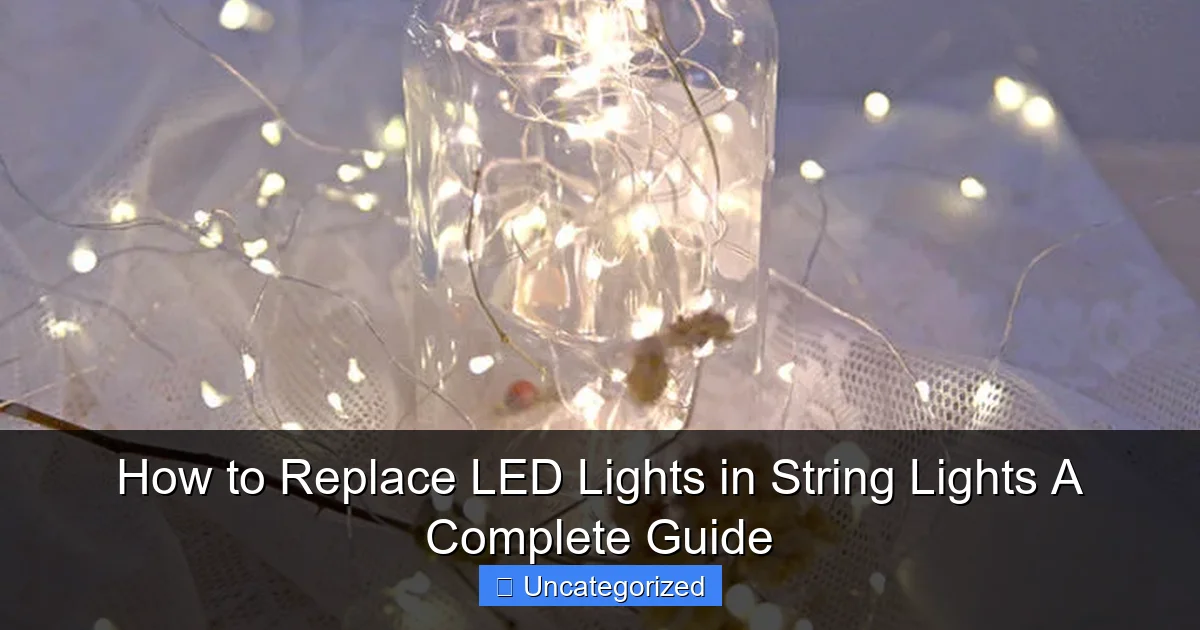
Featured image for how to replace led lights in string lights
Image source: img.lazcdn.com
Replacing LED lights in string lights is a simple, cost-effective way to restore their glow without replacing the entire set. This guide walks you through identifying the faulty bulb, safely removing it, and soldering a new LED in place—ensuring long-lasting performance and energy efficiency. With basic tools and a little patience, you’ll have your string lights shining bright again in no time.
How to Replace LED Lights in String Lights: A Complete Guide
Key Takeaways
- Power off first: Always disconnect string lights before replacing LEDs to avoid electrical hazards.
- Identify bulb type: Check wattage and base size to ensure compatibility with new LEDs.
- Use precision tools: A bulb remover or pliers helps safely extract faulty bulbs without damage.
- Test replacements: Verify new LEDs work before reassembling to avoid repeat repairs.
- Seal connections: Apply waterproof sealant on outdoor lights to protect new bulbs from moisture.
- Recycle old bulbs: Dispose of damaged LEDs responsibly at designated e-waste facilities.
Why This Matters / Understanding the Problem
You’ve probably been there: your favorite set of LED string lights—perfect for your patio, bedroom, or holiday decor—suddenly starts flickering or goes dark in spots. Instead of tossing them out, you might be wondering: Can I fix this? The good news? Yes, you can. Learning how to replace LED lights in string lights is a simple DIY project that saves money and reduces waste.
Unlike traditional incandescent bulbs, LEDs last longer and use less energy. But even the best LED string lights eventually fail—often due to a single dead bulb or a bad connection. Instead of replacing the whole strand, you can target and swap out only the faulty parts. This guide walks you through the entire process, from diagnosing the issue to installing new LEDs safely and effectively.
Whether your lights are for holiday cheer, outdoor ambiance, or year-round decor, knowing how to replace LED lights in string lights gives you more control and confidence. You’ll avoid the hassle of buying new sets every season and extend the life of your favorite lights.
Quick Insight: Most LED string lights use either removable bulb sockets (like E12 or E10 bases) or sealed mini-LEDs (soldered directly to the wire). This guide covers both types—so no matter your setup, you’re covered.
What You Need
Before diving into the repair, gather the right tools and materials. Having everything ready makes the job faster, safer, and less frustrating.
Visual guide about how to replace led lights in string lights
Image source: casyoo.com
- Replacement LED bulbs – Match the voltage (usually 24V or 3V for mini-LEDs), base type (E10, E12, etc.), and color (warm white, cool white, multicolor).
- Multimeter – To test voltage and continuity (a $10–$20 tool is plenty).
- Needle-nose pliers – For removing stubborn bulbs or adjusting sockets.
- Small flathead screwdriver – Useful for prying open sockets or adjusting contacts.
- Wire strippers – Only needed if you’re working with sealed mini-LEDs (soldered type).
- Soldering iron and solder – For replacing sealed LEDs (not needed for plug-in bulbs).
- Heat-shrink tubing or electrical tape – For insulating connections if soldering.
- Small container – To keep screws, bulbs, and small parts from getting lost.
- Work light or headlamp – Good lighting makes a big difference.
Pro Tip: Take a working LED bulb from the strand (if available) to the hardware store or online to ensure an exact match. Don’t rely on photos alone—LEDs vary in size, shape, and pin configuration.
For plug-in style bulbs (removable), you’ll only need pliers, a screwdriver, and replacement bulbs. For sealed mini-LEDs, you’ll need the soldering gear. Don’t worry—we’ll walk you through both scenarios in the steps below.
This guide on how to replace LED lights in string lights assumes you’re working with standard 120V AC-powered strands. If your lights are battery-powered or USB-driven, the process is similar, but voltage levels differ—so double-check specs.
Step-by-Step Guide to How to Replace LED Lights in String Lights A Complete Guide
Step 1: Unplug and Inspect the String Lights
Always start by unplugging the lights—even if they’re off. This prevents electric shock and protects you while handling bulbs and wires.
Lay the string out on a flat surface, like a table or floor. Look for obvious signs of damage: frayed wires, cracked bulbs, melted sockets, or loose connections. Pay special attention to the beginning and end of the strand, where wear is most common.
Check if the lights are plug-in bulbs (you can twist or pull them out) or sealed mini-LEDs (tiny bulbs molded into the wire). This determines your repair approach.
Warning: Never work on energized lights. Even low-voltage LEDs can carry residual charge. Unplug, wait 5 minutes, then begin.
Step 2: Test the Power Supply and Controller
Before blaming the bulbs, rule out the power source. Plug the lights into a working outlet and see if any part lights up. If the whole strand is dead, the issue might be the plug, transformer, or controller—not the bulbs.
Use your multimeter to test the plug or controller output. Set it to measure AC voltage (usually 200V range). Touch the probes to the plug’s metal prongs. You should see around 120V (for household) or 24V (for low-voltage sets).
If the voltage is zero or too low, the problem is upstream. Try a different outlet or replace the controller. Only if voltage is normal should you proceed to test individual bulbs.
This step ensures you’re not replacing good LEDs due to a faulty power source—saving time and money. It’s a key part of how to replace LED lights in string lights correctly.
Step 3: Identify the Faulty Bulb(s)
Now, find the dead or flickering bulb. For plug-in bulbs, you can often tell by visual inspection—look for dark or dim bulbs. But don’t trust your eyes alone. Use the multimeter to confirm.
Unplug the lights. Set your multimeter to continuity mode (the beeping one). Remove a suspect bulb and place the probes on the metal contacts inside the socket. If it beeps, the socket is good. If not, the socket may be faulty.
For sealed mini-LEDs, you’ll need to test the circuit. Set the multimeter to diode mode. Touch the red probe to the anode (positive) wire and the black probe to the cathode (negative). A working LED will show a voltage drop (usually 2–3V). No reading means the LED is dead.
Work methodically—start from one end and test every few bulbs. In parallel circuits, one dead LED can break the whole section. In series, a single failure can kill the entire strand.
Real-Life Example: Sarah’s 50-bulb strand had 4 dark bulbs. She tested each with a multimeter and found only one was truly dead—the others were just dirty. Cleaning the contacts fixed the issue!
Step 4: Remove the Bad LED (Plug-In Bulbs)
For removable bulbs, this is the easiest part. Grasp the bulb gently with your fingers or needle-nose pliers. Twist it counterclockwise (lefty loosey) about 1/8 to 1/4 turn. It should pop out of the socket.
If it’s stuck, don’t force it. Use a small flathead screwdriver to gently pry the bulb’s base. Sometimes corrosion or glue makes it hard to remove. Wiggle it slightly while twisting.
Once out, inspect the socket. Look for:
- Blackened contacts (clean with a cotton swab and rubbing alcohol)
- Loose springs (gently bend them back with pliers)
- Cracked plastic (if damaged, consider replacing the socket or the whole section)
Never pull on the wires—only the bulb. Pulling wires can damage internal connections and create new problems.
This careful removal is essential when learning how to replace LED lights in string lights without causing extra damage.
Step 5: Install the New LED Bulb
Take your replacement LED bulb and match it to the old one. Check:
- Base type (E10, E12, etc.)
- Voltage rating (usually printed on the bulb)
- Color temperature (warm white vs. cool white)
- Direction (some LEDs are polarized—must go in the right way)
Insert the new bulb into the socket. Line up the pins with the socket slots. Push in gently and twist clockwise until it clicks or feels snug. Don’t over-tighten—this can crack the base.
If the bulb has a flat side or arrow, make sure it matches the socket’s shape. Reversing polarity won’t damage most LEDs, but it might prevent them from lighting.
Plug in the string and test the bulb. If it lights, great! If not, double-check orientation and socket condition.
Pro Tip: Keep a few spare bulbs in a labeled bag. That way, you’re ready the next time a bulb fails—no last-minute shopping trips.
Step 6: Replace Sealed Mini-LEDs (Soldering Method)
For sealed mini-LEDs (common in modern, thin-wire strands), you’ll need to solder a new LED. This sounds advanced, but it’s manageable with basic tools.
First, cut out the dead LED. Use wire strippers to remove about 1/2 inch of insulation on both sides of the failed bulb. You’ll see two tiny wires—positive (anode) and negative (cathode).
Identify polarity. Look for:
- A small flat edge or dot on the LED body (marks the cathode)
- Longer leg on the replacement LED (anode)
- Color-coded wires (red = positive, black = negative)
Strip the ends of the cut wires. Tin them with a little solder (melt a small amount onto each wire end). Then, tin the leads of the new LED.
Twist the anode wire to the positive side and the cathode to the negative side. Solder each joint. Use heat-shrink tubing or electrical tape to insulate the connections. Slide the tubing over the joint and shrink with a heat gun or lighter (don’t burn it!).
Test the connection with the multimeter in diode mode. Then plug in the lights. If the LED lights up, you’ve done it right.
Warning: Soldering requires steady hands and good ventilation. If you’re new to soldering, practice on scrap wire first. Overheating can destroy LEDs instantly.
This step is crucial for anyone tackling how to replace LED lights in string lights with sealed designs. It’s more involved, but totally doable.
Step 7: Test the Entire Strand
Once you’ve replaced the faulty bulb(s), plug in the lights and test the full strand. Walk the length and check every bulb. Look for:
- Flickering
- Dim bulbs
- Sections that don’t light
If everything works, great! If not, recheck your work. Common issues:
- Loose solder joints (re-solder)
- Wrong polarity (swap wires)
- Dirty socket (clean again)
- Damaged wire (look for cuts or kinks)
Use your multimeter to trace the circuit. In series lights, voltage drops across each bulb. In parallel, each bulb gets full voltage. Knowing your circuit type helps diagnose problems faster.
Let the lights run for 10–15 minutes. Watch for overheating or strange smells. If anything feels hot, unplug immediately and check for short circuits.
Step 8: Secure and Store Properly
After repair, secure any loose wires with zip ties or electrical tape. This prevents strain on the connections and reduces the chance of future breaks.
If you used soldering, double-check that all joints are insulated and protected. Moisture can corrode exposed wires, especially in outdoor settings.
For outdoor lights, consider applying a small amount of dielectric grease to sockets. This prevents corrosion and makes future bulb changes easier.
When not in use, store the lights in a cool, dry place. Avoid tangling—use a reel or cardboard wrap to keep them neat. Proper storage extends the life of your repaired lights.
This final step ensures your repair lasts. It’s a key part of how to replace LED lights in string lights for long-term success.
Pro Tips & Common Mistakes to Avoid
Even with a good guide, small mistakes can ruin your repair. Here are the top tips and pitfalls to watch for.
Pro Tip #1: Always test bulbs before installing. A new LED might be defective out of the box. Test it with a battery or known-good socket first.
Pro Tip #2: Use LED-specific replacement bulbs. Don’t swap in incandescent bulbs—they draw more power and can overload the circuit.
Pro Tip #3: Label your wires when soldering. Use colored tape or a marker to identify positive and negative. It saves confusion later.
Common Mistake #1: Forcing a stuck bulb. This can break the socket or pull the wires. Use gentle wiggling and a screwdriver—never yank.
Common Mistake #2: Ignoring the socket. A corroded or damaged socket won’t make good contact, even with a new bulb. Clean or replace it.
Common Mistake #3: Overheating during soldering. LEDs are sensitive. Use a low-wattage iron (20–30W) and work quickly. Hold the iron for no more than 3 seconds per joint.
Common Mistake #4: Not checking polarity. Reversed LEDs won’t light. Always double-check anode and cathode before soldering.
Pro Tip #4: Keep a repair log. Note which bulbs you replaced, when, and any issues. This helps track failure patterns and plan future maintenance.
Following these tips makes your repair faster, safer, and more effective. It’s what separates a quick fix from a lasting solution in how to replace LED lights in string lights.
FAQs About How to Replace LED Lights in String Lights A Complete Guide
Q: Can I replace just one LED bulb in a string?
Yes! Most LED strings use parallel or series-parallel circuits, so one dead bulb won’t kill the whole strand. Just replace the faulty one. For series-only lights, you might need to bypass it with a shunt (a small wire or resistor), but that’s rare in consumer sets.
Q: How do I know if the bulb or socket is bad?
Test both. Use a multimeter in continuity mode on the socket. If it doesn’t beep, the socket is broken. Then test the bulb in a known-good socket. If it doesn’t light, the bulb is bad. This process of elimination saves guesswork.
Q: Can I use any LED bulb as a replacement?
No. Match the voltage, base type, and color. A 12V bulb in a 24V circuit won’t light. An E10 bulb won’t fit an E12 socket. Always check the specs on the original bulb or packaging.
Q: What if I can’t find the exact replacement bulb?
Look for equivalents. Many online stores (like Amazon, Home Depot, or specialty LED suppliers) list compatible bulbs. Search by model number, voltage, and base type. When in doubt, buy a few options and test.
Q: Is it safe to repair outdoor string lights?
Yes, but take extra care. Use weatherproof sockets and seal solder joints with heat-shrink tubing or silicone. Avoid exposing connections to rain. If the strand is heavily damaged, consider replacing it for safety.
Q: Can I repair battery-powered LED lights the same way?
Yes, but voltage is lower (3V or 6V). Use a multimeter set to the correct range. Soldering is similar, but be extra careful with polarity. Also, check the battery contacts for corrosion.
Q: How long will my repaired lights last?
If done correctly, a repaired LED strand can last years. LEDs have a 25,000–50,000 hour lifespan. Proper installation, clean contacts, and good storage make a big difference. Your repair is only as good as your workmanship.
Final Thoughts
Learning how to replace LED lights in string lights is one of the most useful DIY skills for home decor, holiday prep, and outdoor living. It’s not just about saving money—it’s about reducing waste, extending the life of your favorite lights, and gaining confidence in your repair abilities.
Whether you’re swapping a single plug-in bulb or soldering a sealed mini-LED, the process is straightforward with the right tools and a little patience. Remember: unplug first, test everything, and work methodically.
Don’t toss those flickering lights. With this guide, you now have the knowledge to bring them back to life. Keep your tools handy, save spare bulbs, and don’t be afraid to try—even if you’re new to soldering or electronics.
Your lights deserve a second chance. And now, you’re ready to give it to them. Start small, learn as you go, and enjoy the glow of a job well done.
Action Step: Pick one strand of lights that’s acting up. Grab your tools and follow this guide. You’ll be amazed how satisfying it is to fix something instead of throwing it away.
Now that you know how to replace LED lights in string lights, you’re not just a decorator—you’re a maker, a fixer, and a problem-solver.