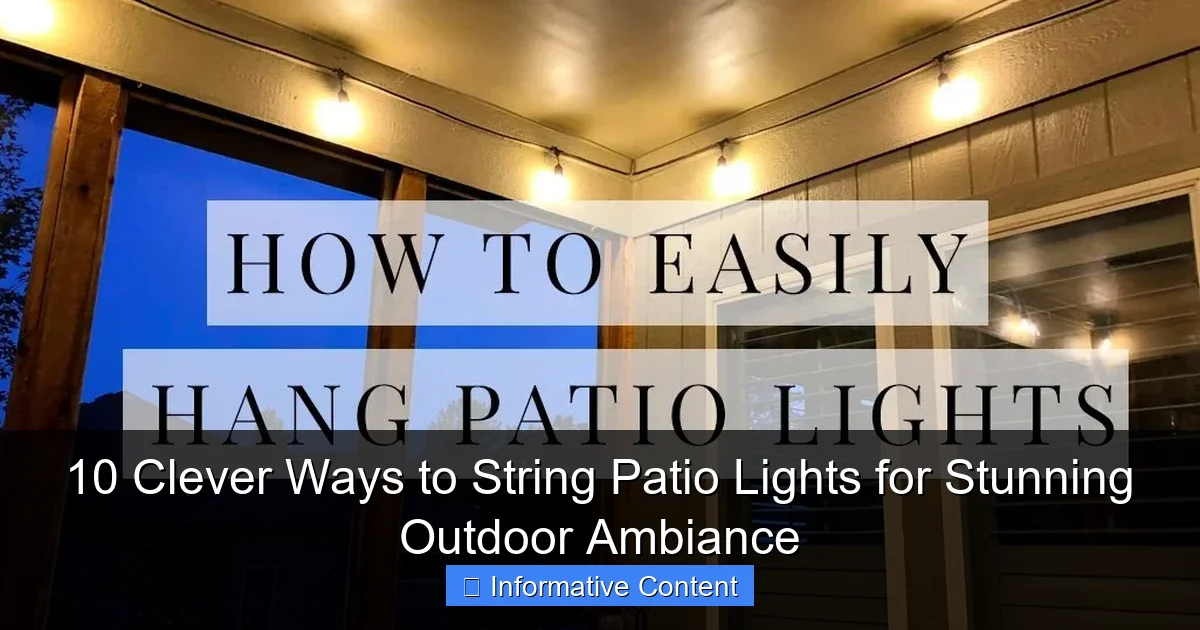
Featured image for ways to string patio lights
Image source: sengerson.com
Transform your outdoor space with creative patio light designs that boost ambiance and style. From wrapping trees and outlining pergolas to draping lights along fences or suspending them overhead in geometric patterns, these 10 clever techniques maximize visual impact with minimal effort. Whether you’re hosting a party or enjoying a quiet evening, strategic lighting turns any patio into a captivating retreat.
Key Takeaways
- Plan your layout: Sketch light placement before hanging for balanced, intentional coverage.
- Use existing structures: Leverage fences, trees, or pergolas to simplify installation.
- Mix light styles: Combine string, globe, or fairy lights for layered visual interest.
- Hang lights at varying heights: Create depth by staggering heights between 7–10 feet.
- Weatherproof connections: Protect outdoor outlets and wires with covers for safety and longevity.
- Anchor securely: Use hooks, clips, or zip ties to prevent sagging in wind or rain.
📑 Table of Contents
- Why Patio Lights Are the Secret to Outdoor Magic
- 1. Classic Canopy: String Lights Between Trees or Posts
- 2. Pergola and Gazebo Perfection: Built-In Elegance
- 3. Fence and Railing Magic: Low-Cost, High-Impact
- 4. Freestanding and Portable: Lights on the Move
- 5. Creative Architectural Accents: Lights as Design Elements
- 6. Seasonal and Themed Setups: Lights for Every Occasion
- Comparing Lighting Methods: What Works Best?
- Final Thoughts: Light Up Your Life, One Strand at a Time
Why Patio Lights Are the Secret to Outdoor Magic
There’s something undeniably magical about stepping into a backyard after dark, where the air is warm, the stars are out, and soft, twinkling lights drape overhead like a canopy of fireflies. I still remember the first time I strung up patio lights in my own backyard—it was a simple row of globe bulbs between two trees, but the transformation was instant. Suddenly, my plain concrete patio became a cozy, inviting retreat where friends lingered long after dinner, sipping wine under a warm, golden glow.
Outdoor lighting isn’t just about visibility—it’s about mood. Whether you’re hosting a summer barbecue, enjoying a quiet evening with a book, or just trying to extend your outdoor time into the cooler hours, the right patio lights can turn your space into a sanctuary. But here’s the thing: not all lighting setups are created equal. The way you string your lights—where they go, how they’re hung, and what style you choose—can make the difference between “meh” and “wow.” In this guide, I’ll walk you through 10 clever ways to string patio lights that don’t just work—they elevate your outdoor ambiance. From simple DIY hacks to creative architectural solutions, you’ll find a method (or two!) that fits your space, style, and budget.
1. Classic Canopy: String Lights Between Trees or Posts
How to Create a Floating Ceiling of Light
One of the most popular and visually stunning ways to string patio lights is the classic canopy—think of it as creating a “ceiling” of light above your seating area. This method works best when you have two anchor points, like trees, fence posts, or pergola columns. The key is to create a crisscross or zigzag pattern so the lights form a web-like canopy rather than a single line.
Start by measuring the distance between your two anchor points. Use sturdy, outdoor-rated hooks (like eye bolts or screw-in hooks) on each end. For a more dynamic look, install multiple hooks on each side at varying heights. Then, run your lights in a zigzag pattern—attach one end to a hook on the left, stretch it diagonally to a hook on the right, then back again. The more lines you add, the denser and more magical the effect.
Pro tip: Use a lightweight, shatterproof LED string for safety and longevity. I once used glass Edison bulbs in a windy area—let’s just say I spent more time picking up shards than enjoying the ambiance. LED strings are brighter, last longer, and are much safer around kids and pets.
Spacing and Tension: Avoiding Sagging and Snags
Nobody wants droopy, sad-looking lights. To keep your canopy taut, use a light line or paracord as a guide. Tie the line between your anchor points first, then clip the lights onto it every 6–8 inches using zip ties or S-hooks. This distributes the weight evenly and prevents sagging.
For extra stability, especially in windy areas, add a third anchor point in the middle (like a freestanding post or a weighted base). This creates a “V” shape in each run, reducing tension on the outer hooks. And always leave a little slack—about 2–3 inches per 10 feet—to allow for wind movement and temperature changes.
One reader told me she used this method on her sloped backyard and added solar-powered lights at the lowest point to create a cascading effect. Genius!
2. Pergola and Gazebo Perfection: Built-In Elegance
Using Existing Structures for Seamless Lighting
If you’re lucky enough to have a pergola, gazebo, or covered patio, you’ve got the perfect built-in framework for patio lights. The structure does the heavy lifting—no need to drill into trees or install extra poles. Plus, the beams and rafters give you multiple mounting options.
For a clean, integrated look, run lights along the perimeter beams first. Use outdoor-rated clips or adhesive hooks designed for wood. Then, drape strands across the top in a crisscross pattern, or hang them vertically from the rafters like a curtain. I love the “floating lantern” effect—where lights hang down 12–18 inches from the ceiling, creating pockets of soft light.
One of my favorite tricks? Use battery-powered puck lights inside the beams. They’re small, wireless, and give off a warm glow that makes the structure itself feel illuminated. Just pop them into the grooves between beams and control them with a remote.
Weatherproofing and Permanent Installations
Since pergolas are often exposed to the elements, it’s smart to think long-term. Use commercial-grade, weatherproof lights with IP65 or higher ratings. These can handle rain, snow, and UV exposure without fading or shorting out.
If you plan to leave the lights up year-round, consider hardwiring them. This involves running low-voltage cables through the beams and connecting them to a transformer (usually tucked away in a weatherproof box). It’s a bit more involved, but the payoff is a permanent, professional-looking setup with no visible plugs or extension cords.
A word of caution: avoid wrapping lights around wooden beams. Over time, the heat from bulbs (even LEDs) can dry out or damage the wood. Instead, use clips or hooks to keep the lights slightly away from the surface.
3. Fence and Railing Magic: Low-Cost, High-Impact
Transforming Boundaries into Ambient Features
Don’t overlook your fence or deck railing—they’re prime real estate for patio lights. This method is especially great for smaller yards or urban patios where overhead space is limited. It’s also one of the easiest and most affordable ways to add light.
Start by measuring the length of your fence or railing. Use fence clips or zip ties to attach the lights every 6–10 inches. For a more decorative touch, weave the lights in and out of the fence slats (if it’s a picket or lattice style). This creates a twinkling, “hidden” effect when viewed from certain angles.
I once helped a neighbor string lights along her 12-foot wooden fence. We used 200-foot LED strands with warm white bulbs and spaced them about 8 inches apart. The result? Her entire backyard felt twice as big, with a warm, golden glow that reflected off the fence and into the yard.
Creative Weaving and Layering Techniques
Want to go beyond a straight line? Try layering multiple strands. Run one set of lights at the top of the fence, another at the bottom, and a third in the middle. This creates depth and dimension. For a boho-chic look, weave in some fairy lights or colored bulbs between the main strands.
Another fun idea: create a “light curtain” by hanging individual strands vertically from a horizontal guide wire. Attach the top of each strand to a wire stretched between two posts, then let them dangle down to the fence. It’s like a waterfall of light—perfect for a romantic dinner or a late-night chat.
One thing to watch out for: if your fence is near a neighbor’s property, be mindful of light spill. Use opaque or frosted bulbs to reduce glare, or angle the lights inward so they illuminate your space without bothering others.
4. Freestanding and Portable: Lights on the Move
No Permanent Installation? No Problem
Not everyone has trees, pergolas, or fences to work with—and that’s okay. Freestanding and portable lighting solutions let you create ambiance anywhere, anytime. Think of them as “lighting furniture”—easy to set up, move, and store.
One of my go-to tools is a freestanding light pole. These are usually made of metal or heavy-duty plastic and come with a weighted base. You can place them in planters, on the ground, or even in the middle of a dining table. Attach your lights to the pole, run them to another pole or anchor point, and voilà—instant overhead lighting.
For a more whimsical look, try lighted umbrellas. These have built-in LED strands along the ribs and can be plugged into an outlet or run on batteries. They’re perfect for shading and lighting a small table or lounge area.
I once used two freestanding poles and a 30-foot string of globe lights for a backyard movie night. The poles were about 15 feet apart, and I stretched the lights between them like a clothesline. The kids loved it, and the soft glow made the whole experience feel like a drive-in theater.
DIY Hacks: Repurposing Everyday Items
You don’t need fancy gear to make this work. Get creative with what you already have. For example:
- Use tall planters: Fill large pots with sand or gravel for weight, then insert a metal pole or bamboo stake. String lights from the pole to a tree, fence, or another planter.
- Hang lights from a clothesline: If you have a retractable clothesline, clip your lights to it and extend it across your patio.
- Try a lighted arch: Build a simple wooden or PVC arch and string lights along the top. It’s perfect for a wedding, party, or just a fun weekend project.
One couple I know used repurposed wooden crates as bases for their poles. They painted them to match their outdoor furniture and added solar-powered lights. The result was rustic, eco-friendly, and totally unique.
5. Creative Architectural Accents: Lights as Design Elements
Highlighting Features with Strategic Lighting
Patio lights aren’t just for overhead glow—they can also accentuate your outdoor architecture. Think of them as a spotlight for your favorite features: a stone wall, a water feature, a fire pit, or even a garden path.
For a wall wash effect, run lights vertically along a stone or brick wall. Use adhesive hooks or clips to keep them in place. The light bounces off the textured surface, creating a warm, diffused glow. This works especially well with warm white or amber bulbs.
Another great technique: backlighting. Place lights behind a translucent feature (like a glass wind chime or a sheer outdoor curtain) to create a soft halo effect. I once used this trick on a sheer white curtain behind my outdoor dining table—it looked like a glowing cloud when the sun set.
For water features, consider submersible lights. These are waterproof LEDs that can be placed in fountains, ponds, or even a large planter. They add a magical shimmer and can change colors for different moods.
Path and Step Lighting: Safety Meets Style
Don’t forget the ground! Path and step lights guide guests safely and add a subtle glow to your yard. Use solar-powered stake lights along walkways, or install in-ground LED fixtures for a more permanent look.
One of my favorite tricks: line the edges of your patio with low-voltage rope lights. Tuck them under the lip of the deck or along the edge of a concrete slab. They’re bright enough to see where you’re walking, but not so bright that they ruin the ambiance.
For steps, use stair riser lights—small LED strips that attach to the front of each step. They’re barely noticeable during the day but provide crucial visibility at night.
6. Seasonal and Themed Setups: Lights for Every Occasion
Switching Up Your Lighting for Events and Holidays
One of the best things about patio lights? They’re incredibly versatile. You can easily switch up your setup for different seasons, holidays, or events without starting from scratch.
For summer parties, go for colorful globe lights or fairy lights with warm white bulbs. They create a festive, inviting vibe. I like to add some string lights with tiny lanterns or paper stars for a boho touch.
In the fall, switch to amber or orange lights to complement the changing leaves. Add some pumpkin-shaped LED lights or fall-colored fairy lights for a cozy harvest feel.
Winter calls for cold white or blue-tinted lights—they mimic snow and ice. Hang them in clusters or use them to create a “starry sky” effect. For Christmas, add some twinkling red and green strands or icicle lights along the roofline.
Quick-Change Systems: Easy Swaps Without the Hassle
To make seasonal changes easier, invest in a modular lighting system. Use a central power source (like a weatherproof outlet or a transformer) and attach different light strands with quick-connect plugs. This way, you can swap out your summer lights for winter ones in minutes.
Another idea: use light clips with removable bases. These let you detach the lights from the clips and store them in labeled bins. When it’s time to decorate, just snap them back in place.
One reader told me she keeps three sets of lights—summer, fall, and holiday—in a dedicated outdoor storage box. She swaps them out every season and even rotates them for parties. “It’s like having a new patio every few months,” she said. “And my kids love helping me change them!”
Comparing Lighting Methods: What Works Best?
| Method | Best For | Cost | Difficulty | Durability |
|---|---|---|---|---|
| Tree/Post Canopy | Large, open yards | $$ | Medium | High (with proper anchors) |
| Pergola/Gazebo | Structured spaces | $$$ | Medium-High | Very High |
| Fence/Railing | Small yards, urban patios | $ | Low | Medium |
| Freestanding | Renters, temporary setups | $$ | Low | Medium |
| Architectural Accents | Feature highlighting | $-$$$ | Medium | High |
| Seasonal/Theme | Events, holidays | $-$$ | Low | Medium (depends on storage) |
Final Thoughts: Light Up Your Life, One Strand at a Time
At the end of the day, the best way to string patio lights is the one that makes you feel happy and relaxed. There’s no one-size-fits-all solution—your space, style, and needs are unique. But with these 10 clever methods, you’ve got a toolkit of ideas to experiment with.
Remember, it’s not about perfection. It’s about creating a space where you want to spend time. Maybe it’s a simple line of lights along your fence. Maybe it’s a dramatic canopy that makes your backyard feel like a secret garden. Whatever you choose, take the time to enjoy the process. String the lights with a friend, play some music, and celebrate the moment when you flip the switch and see your patio transform.
And don’t forget: lighting is just the beginning. Pair your setup with cozy furniture, soft music, and maybe a glass of wine, and you’ve got an outdoor retreat that rivals any vacation spot. So go ahead—get creative, have fun, and let your patio shine. After all, the best memories are made under the glow of a thousand tiny lights.
Frequently Asked Questions
What are the best ways to string patio lights for maximum ambiance?
For maximum ambiance, drape string lights in zigzag patterns between posts, wrap them around pergola beams, or create a canopy effect overhead. Mixing techniques—like layering lights at different heights—enhances depth and warmth in your outdoor space.
Can I hang patio lights without drilling into walls or structures?
Yes! Use adhesive hooks, tension rods, or freestanding poles to hang lights without damaging surfaces. These methods are ideal for renters or those seeking temporary setups with flexible ways to string patio lights.
How do I power patio lights in areas without outlets?
Solar-powered or battery-operated string lights are perfect for off-grid setups. Alternatively, use an outdoor-rated extension cord connected to a nearby indoor outlet for reliable power.
What’s the safest way to string patio lights around a pool area?
Opt for waterproof, submersible-rated lights and secure them with non-slip hooks or clips. Keep cords elevated and away from the water’s edge to prevent tripping and electrical hazards.
How can I hide the cords when stringing patio lights?
Camouflage cords by running them through cable raceways, tucking them under railings, or using zip ties to blend them with existing structures. Neutral-colored cords or greenery can also help cords disappear.
Are there creative ways to string patio lights for small spaces?
Absolutely! Try vertical designs like wrapping lights around a tall pole or trellis, or use a single “light curtain” on a balcony rail. Compact, geometric patterns maximize impact in tight areas.