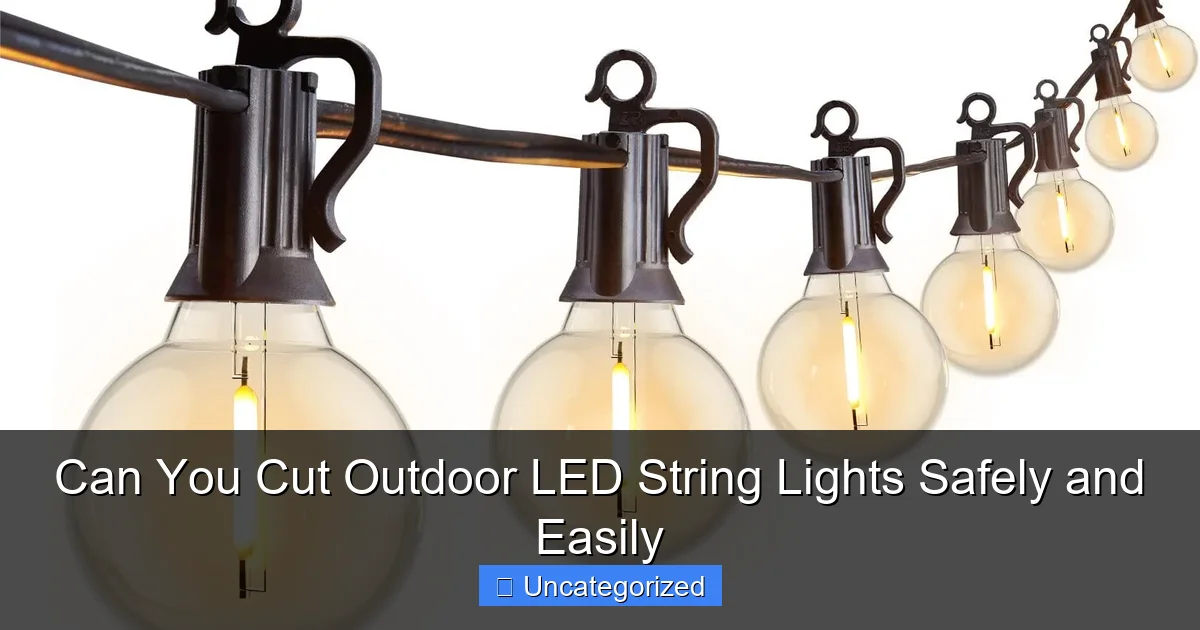
Featured image for can you cut outdoor led string lights
Image source: m.media-amazon.com
Yes, you can cut outdoor LED string lights—but only if they’re specifically labeled as “cuttable” or “customizable.” Doing so safely requires precise measurements, clean cuts at marked points, and proper sealing to maintain weather resistance and functionality. Always check the manufacturer’s instructions first to avoid damaging the lights or voiding the warranty.
Key Takeaways
- Check manufacturer guidelines: Always verify if your LED lights are labeled as “cuttable” before modifying.
- Use proper tools: Cut only at marked points with sharp scissors or wire cutters to avoid damage.
- Seal cut ends: Waterproof with silicone sealant to maintain outdoor durability and safety.
- Measure twice, cut once: Plan your layout carefully to avoid unnecessary trimming or waste.
- Test before installing: Power the lights post-cut to confirm functionality and connections work properly.
- Avoid overloading circuits: Ensure your modified lights don’t exceed the recommended wattage or length.
📑 Table of Contents
- Understanding Outdoor LED String Lights: Types and Construction
- Can You Cut Outdoor LED String Lights? The Short Answer
- How to Cut Outdoor LED String Lights Safely: Step-by-Step Guide
- Advanced Techniques: Splicing and Extending Cut LED Strings
- Common Mistakes and How to Avoid Them
- Data Table: Cuttable vs. Non-Cuttable LED String Lights
- Conclusion: Making the Right Choice for Your Outdoor Space
Understanding Outdoor LED String Lights: Types and Construction
The Anatomy of an LED String Light
Outdoor LED string lights have become a staple in modern outdoor decor, offering energy efficiency, durability, and vibrant illumination. But before you consider cutting them to fit your space, it’s crucial to understand their construction. These lights typically consist of several key components: LED bulbs, a copper wire circuit, a plastic or rubber coating, and sometimes connectors or end caps. The LED bulbs are embedded along the wire at regular intervals, and the entire string is designed to operate as a complete circuit. This means that altering the structure can disrupt the electrical flow, leading to partial or complete failure.
LED string lights come in two primary configurations: series circuits and parallel circuits. In a series circuit, each LED is connected end-to-end, so if one bulb fails or the wire is cut, the entire string goes dark. In contrast, parallel circuits allow each LED to operate independently, meaning a cut in one section doesn’t necessarily affect the rest. Most commercial outdoor LED strings use parallel wiring, but this varies by manufacturer. Additionally, many strings include in-line controllers for brightness, color, or mode settings, which can complicate cutting if not accounted for.
Common Types of Outdoor LED String Lights
- Plug-in LED String Lights: These are the most common, powered by an AC adapter plugged into an outdoor outlet. They often have a transformer or driver box, which must remain intact for safe operation.
- Solar-Powered LED String Lights: These use a solar panel to charge a battery during the day and illuminate at night. Cutting these can disrupt the charging circuit or disconnect the battery.
- Smart LED String Lights: These connect to Wi-Fi or Bluetooth and are controlled via apps. They may have microcontrollers or chips that are sensitive to physical alterations.
- Commercial-Grade LED String Lights: Used in large installations, these are often heavier-duty with thicker wiring and waterproof connectors. They may be more forgiving to modifications but still require careful handling.
For example, a 25-foot plug-in warm white LED string from a reputable brand like Philips or GE is likely designed with parallel wiring, making it more suitable for customization. On the other hand, a budget solar string with thin wires and no visible soldering points may not withstand cutting without failure. Always check the packaging or manufacturer’s website for specifications before proceeding.
Can You Cut Outdoor LED String Lights? The Short Answer
Yes, But With Conditions
The short answer to whether you can cut outdoor LED string lights is: yes, but only if they are explicitly designed to be cut. Some manufacturers produce cuttable LED strings that include designated cutting points, usually marked by small scissors icons or notches along the wire. These points are placed at intervals (e.g., every 12 inches) and are located between LEDs or at specific solder joints. Cutting at these points ensures the remaining sections remain functional and safe.
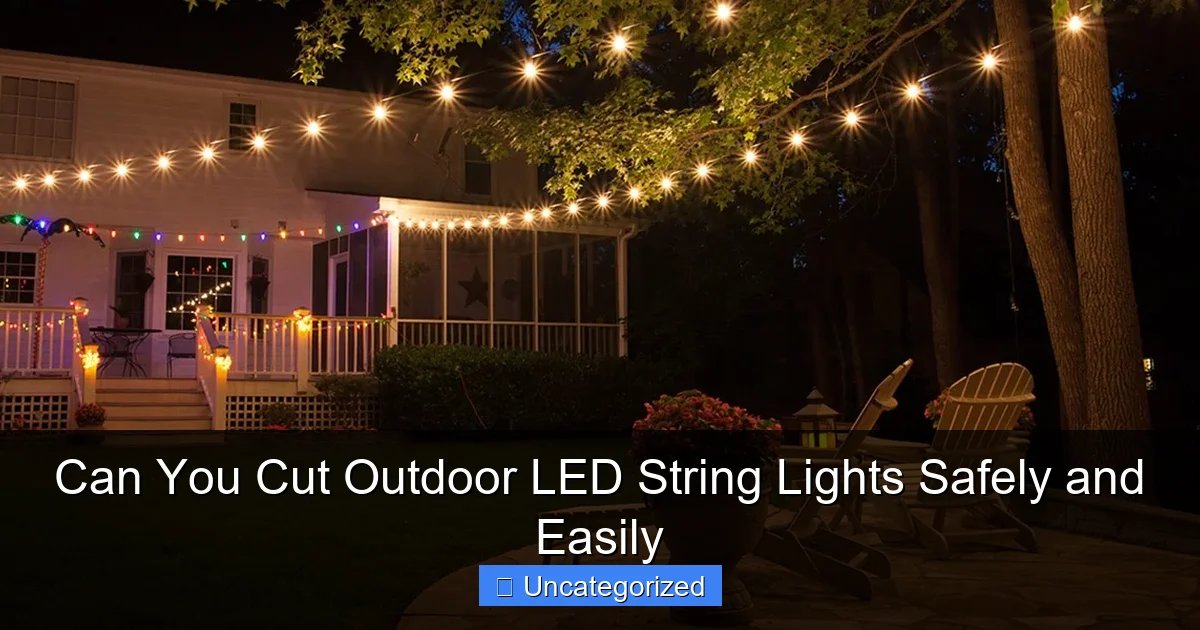
Visual guide about can you cut outdoor led string lights
Image source: cdn.christmaslightsetc.com
For instance, brands like Twinkly or GE Energy Smart offer cuttable LED strings with clear instructions. A Twinkly Cuttable 25-foot string, for example, allows you to cut at every 1.5 feet without damaging the circuit. However, cutting outside these points can sever the internal wiring, break the circuit, or expose live wires, posing a fire or shock hazard.
When Cutting Is Not Recommended
- Strings without cutting marks: If there are no visible indicators, the manufacturer likely did not intend for modification.
- Solar-powered strings: Cutting can disconnect the battery or solar panel circuit, rendering the lights useless.
- Strings with in-line controllers: Cutting near the controller may disable its functionality.
- Low-quality or no-name brands: These often use thin, fragile wires that can’t handle splicing or re-termination.
A practical example: A homeowner purchased a 50-foot non-cuttable LED string for their patio and attempted to shorten it by 10 feet. They cut the wire at an arbitrary point, not realizing it severed the return path in the circuit. The result was half the string staying dark. After consulting the manual, they discovered the string was not designed for cutting, leading to wasted time and money.
How to Cut Outdoor LED String Lights Safely: Step-by-Step Guide
Step 1: Verify Cutting Capability
Before making any cuts, confirm that your LED string is cuttable. Look for:
- Scissors icons or “cut here” labels on the wire
- Manufacturer specifications stating “cuttable” or “modular”
- Online reviews or forums mentioning successful cuts
If none of these apply, do not proceed. Instead, consider using connectors, extension cords, or purchasing a shorter string.
Visual guide about can you cut outdoor led string lights
Image source: thespruce.com
Step 2: Gather the Right Tools
Using improper tools can damage the wire or create unsafe conditions. You’ll need:
- Wire cutters or scissors: Precision is key; dull tools can crush the insulation
- Electrical tape: For insulating exposed wires
- Heat shrink tubing (optional): For a professional, waterproof seal
- Multimeter (optional): To test continuity after cutting
- Heat gun or lighter (for heat shrink)
For example, a Klein Tools wire stripper or Xuron precision cutters are excellent for clean cuts without fraying the copper.
Step 3: Cut at the Right Point
Locate the designated cutting point. These are usually:
- Between two LEDs, where the wire is thicker or has a notch
- At a connector junction (if the string has multiple segments)
Cut cleanly through the wire at the marked point. Avoid cutting too close to an LED or controller. For instance, if the cutting point is 6 inches from the last LED, cut exactly there—not 2 inches closer.
Step 4: Insulate the Ends
Exposed copper wires can cause short circuits, especially outdoors. After cutting:
- Wrap the cut end with electrical tape, covering at least 1 inch of wire
- For better weather resistance, slide heat shrink tubing over the cut end and apply heat until it seals tightly
A pro tip: For solar strings, seal the cut end with silicone sealant after taping to prevent moisture ingress.
Step 5: Test the Remaining String
Plug in the uncut portion to ensure it still works. If it doesn’t, the cut may have damaged the circuit. In this case, you may need to:
- Cut back another 2-3 inches to find intact wiring
- Check for internal breaks with a multimeter
For example, a 30-foot cuttable string was shortened to 20 feet. After cutting, only 10 feet lit up. Using a multimeter, the homeowner found a broken wire 5 inches from the cut point and trimmed further, restoring full function.
Advanced Techniques: Splicing and Extending Cut LED Strings
When You Need to Reconnect Sections
Sometimes, you may want to cut a string and later reconnect it—for example, to create a custom loop or extend it with a new section. This requires splice connectors or soldering.
Using Wire Nuts or Butt Splice Connectors
For a quick, tool-free solution:
- Strip about 1/2 inch of insulation from each cut end using a wire stripper
- Twist the exposed copper wires together clockwise
- Secure with a wire nut (for low-voltage strings) or a butt splice connector (for heavier-duty use)
- Insulate with electrical tape or heat shrink
Example: A 15-foot cuttable string was cut into two 7-foot sections. The homeowner used a butt splice connector to join them, then sealed the connection with heat shrink. The result was a seamless 14-foot string with no voltage drop.
Soldering for a Permanent Fix
For a more durable connection:
- Strip the wires and twist them together
- Apply rosin-core solder to the joint using a soldering iron
- Slide heat shrink tubing over the joint and apply heat
Warning: Soldering requires skill and safety precautions. Overheating can damage the LED or melt insulation. Use a 30-40W iron and work in a well-ventilated area.
Adding Extension Cords or Connectors
If you cut a string but need more length, use manufacturer-approved extension cords or end-to-end connectors. For example, GE offers 15-foot extension cords for their cuttable LED strings. These maintain the circuit integrity and are weatherproof.
Pro tip: Never splice a cut string with a generic extension cord unless the voltages match (e.g., both are 12V DC). Mismatched voltages can burn out LEDs or cause overheating.
Common Mistakes and How to Avoid Them
Cutting at the Wrong Point
This is the most frequent error. Cutting between designated points can sever internal circuits. For example, a user cut a 20-foot string 8 feet from the plug, not realizing it broke the positive lead. The entire string went dark. Solution: Always cut at marked points or consult the manual.
Using Poor-Quality Tools
Cheap scissors or wire cutters can crush the wire, making splicing difficult. Invest in precision tools. A Hakko CHP-170 wire cutter, for instance, makes clean cuts without deforming the wire.
Skipping Insulation
Leaving cut ends exposed is a safety hazard, especially outdoors. Moisture can cause corrosion or short circuits. Always tape or heat-shrink the ends. A homeowner in Florida skipped this step, and after a rainstorm, the cut end sparked, requiring replacement.
Ignoring Voltage and Amperage
Cutting a string changes its electrical load. For example, a 50-foot string drawing 0.5A becomes a 30-foot string drawing ~0.3A. While this usually doesn’t affect performance, it can impact dimmers or controllers. Check the manufacturer’s specs for maximum run lengths.
Overloading the Circuit
If you cut and reconnect multiple strings, ensure the total amperage doesn’t exceed the outlet or transformer rating. For example, a 120V outlet can handle ~1800W (15A). A 100-bulb LED string draws ~10W, so 180 strings would be the limit—but always leave a 20% safety margin.
Data Table: Cuttable vs. Non-Cuttable LED String Lights
| Feature | Cuttable LED Strings | Non-Cuttable LED Strings |
|---|---|---|
| Cutting Points | Marked with scissors icons or notches | No visible indicators |
| Wiring Type | Parallel circuits with redundant paths | Series or fragile parallel circuits |
| Common Brands | Twinkly, GE Energy Smart, Philips | Budget brands, solar strings, smart lights |
| Cutting Interval | Every 1-2 feet (varies by model) | Not applicable |
| Post-Cut Functionality | Remaining sections work if cut properly | Likely to fail or partially fail |
| Weather Resistance | IP44 or higher; heat-shrink recommended | Varies; sealing cut ends is critical |
| Cost | $15-$50 for 25-50 feet | $10-$30 for 25-50 feet |
| Example Model | Twinkly Cuttable 25ft (TWCUT-25) | Sunforce 50ft Solar String (SF-100) |
Conclusion: Making the Right Choice for Your Outdoor Space
Cutting outdoor LED string lights can be a safe and effective way to customize your lighting setup, but it demands caution and preparation. Always start by verifying whether your string is designed for cutting—look for marks, check the manual, and research the brand. Use the right tools, cut at designated points, and never skip insulation. If you’re unsure, opt for non-cuttable strings and use connectors or extensions instead.
Remember, the goal is to enhance your outdoor space, not create a hazard. By following the steps outlined here—from understanding circuit types to mastering splicing techniques—you can achieve a professional-looking installation. Whether you’re wrapping a tree, framing a pergola, or outlining a patio, a well-cut LED string adds magic to your evenings. And if you ever doubt your skills, consult an electrician or stick with plug-and-play solutions. With the right approach, your outdoor lighting can be both beautiful and safe for years to come.
As a final tip: Keep spare connectors, tape, and heat shrink on hand for future adjustments. Outdoor environments are unpredictable, and being prepared ensures your lights shine bright, no matter the conditions.
Frequently Asked Questions
Can you cut outdoor LED string lights without damaging them?
Yes, you can cut outdoor LED string lights safely if they are designed to be cut (look for “cuttable” labels or marks). Always follow the manufacturer’s instructions to avoid damaging the circuit or voiding the warranty.
Where should I cut my outdoor LED string lights?
Cut only at the designated cut points, usually marked by scissors icons or small lines on the wire. Cutting elsewhere may disrupt the circuit and cause the lights to stop working.
Do I need special tools to cut outdoor LED string lights?
No special tools are required—most cuttable LED string lights can be trimmed with regular wire cutters or scissors. Ensure the lights are unplugged before cutting for safety.
Can you cut outdoor LED string lights and still use the leftover section?
Yes, if the lights have cuttable sections with built-in connectors, you can reuse the remaining portion. Some models require sealing the end with silicone to maintain weather resistance.
Are all outdoor LED string lights safe to cut?
Not all LED string lights are designed to be cut. Always check the product manual or packaging for “cuttable” labels to avoid damaging non-modular strings.
What happens if I cut outdoor LED string lights in the wrong spot?
Cutting outside the designated areas can break the circuit, causing the entire string to fail. If this happens, the damaged section may need to be rewired or replaced.